It’s Complicated

It's ComplicatedSeveral years ago there was a television show called Lifestyles of the Rich and Famous wherein heavily-accented host Robin Leach would indulge viewers in glimpses of how people who were, well, rich and famous, lived their everyday lives. For the ten-year run of the show, viewers were entranced with visions of indoor swimming pools, personal chefs, expensive vehicles, and extravagant wardrobes.  It was escapist television, and offered a snapshot of what life could be like for the mortal average guys and gals who punched in at nine and out at five.  Watching It’s Complicated is kind of like Leach’s show, save for the fact that we are asked to possess a certain degree of empathy for the characters, specifically divorcee Jane (Meryl Streep) as she struggles with feelings of attraction to her ex-husband Jake (Alec Baldwin) while simultaneously being courted by her architect Adam (Steve Martin).  But in watching these highbrow socialites as they struggle through midlife crises, empathy is somewhat hard to come by.  Fortunately the movie doesn’t take itself too seriously, and provides enough lighthearted humor to be entertaining, if rather forgettable.

It's Complicated Jake

Give it up, Alec...you'll forever be Jack Donaghy in our minds. :)

The casting of It’s Complicated is as smart as they come, and it’s nearly worth the price of admission alone to see Alec Baldwin slipping into his role like a pair of comfy jeans.  After ten years of divorce, Jake is unhappily remarried to a typical Stock Hollywood Annoying Wife Character #4-C Agness (Lake Bell) with Stock Hollywood Bratty Kid #3-F Pedro (Emjay Anthony) in tow.  As luck (or movie logic) would have it, Jake and Jane meet up in the bar of the hotel where they are staying for their son’s graduation from NYU.  Sure enough, they hook up for the night and spend the next few days re-thinking their lives along with a series of romantic trysts at Jane’s new house.

Meanwhile Adam continues to develop feelings toward Jane, which leads to a bit of a conundrum for Jane:  Does she reunite with her ex-husband, with for whom she is beginning to develop some serious feelings of affection, or does she go for the Adam, the safe bet who is searching for love after a few years of his own divorce?  Despite the movie’s title, it’s actually not all that complicated, and this type of love triangle is nothing we haven’t seen before.  Streep and Baldwin have an infectious screen chemistry, and much of the fun of the movie comes from watching the two of them romp around like a pair of twitterpated high school lovebirds.  Martin’s incredible talent seems woefully underused, though, and only has a handful of truly funny scenes throughout the entire movie.

It's Complicated Meryl Streep Steve Martin

Jane and Adam, looking for love in all the wrong places. Like behind a lilac bush.

It’s Complicated plays on the premise of relationship confusion, something all of us have gone through. But Streep’s problems really don’t seem all that bad–she is the owner of a posh cafe where a single croissant will set you back over $10, she’s got a good relationship with her children, and has a group of Stock Hollywood Divorced Friends #6B-F with whom to gossip and eat pastries.  And Jack seems to be doing pretty well with his new marriage, even though his wife exhibits such egregious character flaws as wanting to know why he is out at all hours of the evening and why he seems to be having secret conversations on his cell phone.

Despite the somewhat questionable logic at work here, director Nancy Meyers must be commended for crafting a film that does not cater to the lowest common denominator:  though It’s Complicated secured an R rating, typical scatalogical gags, bathroom humor, and even swearing are almost nowhere to be found.  It’s a film that tries to be an exploration of midlife crises, past regrets, second chances, and horribly awkward video iChat sessions.  Ultimately it feels a little hollow, but at the same time it’s enjoyable as an escapist fantasy.  These individuals live in a world far removed from my own, and that of everyone else I know, and their fairly inconsequential problems and supposedly complicated relationships are a bit of an insult to the real people with actual problems and genuinely complicated relationships who will be watching the movie.  But sometimes it’s good to just sit back and enjoy a lighthearted movie for what it is.

Rating:[Rating:3.5/5]

It Might Get Loud

It Might Get LoudA few years ago director Davis Guggenheim set out to create a documentary about one of the most iconic instruments in music, and the driving force behind the entire rock and roll scene since its inception:  the guitar.  His way of doing so was to get the perspective of three musicians, each in some way the driving force behind a particular brand of rock music.  Jimmy Page, the guitarist from Led Zeppelin; The Edge, the genius behind the unique and experimental sound of worldwide rock sensation U2; and…Jack White from The White Stripes.  Guggenheim essentially films a conversation between the three men as they sit with their guitars in the middle of a warehouse, talking about their personal stories, influences, creative visions, and thoughts on the history of rock music.  It’s a daring concept to be sure, and one that is inherently fraught with musical controversy:  ask any guitarist to name their three heroes in the genre, and it’s doubtful Page, Edge, and White would all be mentioned in the same sentence.  The three are masters of their craft, but how many hundreds or thousands of brilliant, influential guitarists (Eric Clapton, B.B. King, Chuck Berry, Neil Young, Stevie Ray Vaughan, or modern virtuosos like Buckethead, John Petrucci, or even Mark Tremonti) were left off the list?  Why these three specifically?  The answer, it turns out, doesn’t really matter.  This isn’t a movie about the best, or most influential, or most popular, or most innovative, or hardest-shredding guitarists.  It’s just a movie about three dudes who are masters of their craft and offer their perspective–take it or leave it.

It Might Get Loud: Jack White, The Edge, Jimmy Page

Jack White, The Edge, and Jimmy Page. Two out of three ain't bad, I guess.

Beyond just filming a conversation, Guggenheim offers a much richer experience than just watching three dudes wax nostalgic about their geetars.  He offers glimpses into the creative processes each musician has gone though to lead them to where they are.  From Page’s humble beginnings as a studio musician and then playing backup for the Yardbirds, to the streets of Detroit where White, the youngest of 10 children, spent his days working in an upholstery shop and playing music with his boss in the evenings.  Even The Edge, who practically sleeps and bathes with a full set of pedals and FX boards, takes a trip back to the high school where he and his friends practiced music in their teacher’s classroom after the bell rang.

On some levels the movie succeeds quite well, and it’s fascinating to see how each of these men have taken the guitar and made it their own.  The most captivating is Page, who having achieved the pinnacle of rock and roll stardom, and been there/done that by any definition of the phrase, is just as enthusiastic as ever about the guitar.  Like watching a child utterly captivated by the simple pleasure of a rubber ball or toy car, Page jams away to classic Zeppelin tunes like Ramble On, exuding joy from every pore.  Watching him play air guitar as he listens to his early influences like Link Wray’s classic instrumental Rumble is the standalone highlight of the entire documentary, as his infectious affectation for the molasses-thick riffs practically oozes through the screen.

It Might Get Loud: Jimmy Page

Jimmy Page, rambling on with no regrets.

In stark contrast to Page and Edge, Jack White spends much of the film brooding over the sad state of over-produced music today, and strumming out harsh contrivances on old dusty guitars as if trying to make some kind of point about keeping the soul of music pure. It’s rare that he smiles, even when sitting inches away from Page and Edge, and watching him play the piano while encouraging his son (with whom he shares a scarily identical wardrobe of slacks, vest, and dour scowl) to simply bang on a guitar with his foot, as if the nonsensical rubbish were some kind of expression of musical purity, was actually a tad frightening.

Seeing the bombed-out haunts of Edge’s childhood in conflict-ravaged Dublin, the cavernous Headley Grange mansion where Zeppelin recorded IV, and the dirty streets of Detroit where the White family struggled to make ends meet is all very interesting, but the trouble is there’s just not much substance in the movie to go along with the powerful imagery.  It Might Get Loud seems like an extended trailer for what would make three very interesting biographies, and by merely touching on the primal elements from which some of the greatest tunes in recent history were born, it feels like so much more could have been explored that time just did not allow for.  It Might Get Loud is an interesting curiosity, though it lacks a true punch or even a real message.  So the guitar is a cool instrument–whether it’s a basic acoustic setup or a high-tech magical wand at a U2 show.  We already knew that.  And seeing these three men talk about it, while watching bits of their personal biographies, comes across like the impromptu jam session they find themselves in near the end:  curious but more than a little awkward.

Rating:[Rating:3.5/5]

Grave of the Fireflies (Hotaru no haka)

Grave of the FirefliesI often watch movies in 20-minute chunks while I eat breakfast, and while this sometimes creates a somewhat disjointed effect it is also the only practical way for me to consume cinematic material on a regular basis.  Recently a friend of mine suggested, in response to a Facebook post asking for suggestions of a good anime film, that I watch Grave of the Fireflies.  But, he cautioned, I should do so all at once instead of breaking it up into segments while I munch on rice krispies.  And so when I was at a conference recently I decided to shut out all distractions in my hotel room and focus solely on this movie while I watched it in its entirety.  Turns out my friend was right, and I was treated to one of the most engrossing tales of humanity ever committed to the silver (or, in the case of me and my laptop, LCD) screen.  Grave of the Fireflies is a heart-wrenching tale of devotion and despair, and one of the saddest movies I have seen since Schindler’s List.  The opening words, spoken by young teenager Seita, set the tone for the rest of the movie:  “September 21, 1945…that was the night I died.”  We then see him, bruised and hungry, as he lives out his final moments in a dirty train station.  The rest of the story is told in flashback as we see Seita and his young sister Setsuko and how their lives are transformed during the allied bombings of Japan during World War II.  Since the outcome is never in question, the focus of the film is shifted to the relationship between the two children as Seita struggles to care for his sister in the wake of their mother’s death during an air raid.

Grave of the Fireflies - Catching Fireflies

Seita and Setsuko reveling in the simple joys of childhood.

And what a relationship it is.  Though the two characters are colored drawings, they possess a deep humanity that is rarely seen in any movie whether live-action or animated.  The focus of the movie is on the simple moments that reinforce the love that Seita has for his sister, and the degree to which she depends on him for everything she has.  They play in the ocean, eat fruit drop candies, gather supplies for their makeshift shelter by a river, and catch fireflies in the moonlight.  Through it all Seita will do anything for his sister, sacrificing whatever he has and doing whatever it takes to get her the food and care she so desperately needs.  And that’s about it:  no conspiracies, no double-crosses, no hidden agendas, just a boy determined to care for his sister in the face of incredible odds and dwindling resources.  And even though we are fully aware of what will happen (to Seita, at least–the fate of Setsuko, though predictable, is not shown until the end of the film) we can’t help but be thoroughly enraptured with this simple tale of innocent care and affection.

In fact, I kept on expecting another shoe to drop:  when a group of children stumble across their shelter, my American movie sensibilities were bracing for the worst:  they would surely burglarize or vandalize the shabby campsite, leaving Seito and Setsuko even worse off than before.  But such conventional narrative tricks are nowhere to be found here, and serves to elevate Fireflies far beyond the level of typical cinema.

Grave of the Fireflies Seita Setsuko

War, as seen through the eyes of a child.

After Seita and Setsuko leave their hometown of Kobe they go to live with their aunt Akemi, and I found this to be one of the most frustrating segments of the narrative as Seita refuses to help out around the house, secure employment, or otherwise help the war effort of his native country.  After several sharp rebukes from Akemi, he decides to take his sister and seek shelter on their own–a choice that eventually leads to tragic ends for both children.  If only Seita had been more responsible, if only he had listened to his aunt, if only he had sought medical care for Setsuko sooner…if only.  And yet my frustration at the well-meaning but ultimately tragic decisions of Seita reinforces the strength of the film as a whole, as these flaws only served to draw me deeper into the story.

The simplicity of the story allows for a deep emotional connection to develop between the viewers and the characters:  sometimes Seita makes some fairly dumb decisions, and I found myself growing frustrated and irritated as I watched.  Setsuko is one of the most convincing young children I have ever seen in a movie–animated or live action–and the impeccable voice acting perfectly complements the stunning animation.  Metaphors abound too:  from the fireflies, which burn bright but reach the end of life so quickly, to Seita himself as a representation of Japan and her stubbornness to admit defeat in the face of overwhelming opposition.

I am not a soldier, and from the comfort of my living room which I so freely enjoy thanks to the ones who have bravely served in the line of duty, I am hardly in a position to make any sort of political statement on the validity of war.  But having seen many, many war films from Bridge on the River Kwai andThe Great Escape to Platoon and Saving Private Ryan, I can say that Grave of the Fireflies stands toe to toe with the greatest war films of our time, and possibly even since the inception of the medium.  It is a profound and deeply personal tale of how the hardships of war can affect the deepest of human connections.

Rating:[Rating:4.5/5]

As a side note, I cannot stress how important it is to see this film presented in Japanese. The voice acting is absolutely superb, and the American voiceover, as is the case with most anime, strips the film of much of its emotional weight.

Judge Dredd

There’s an old computer term called WYSIWIG.  It comes from the days of dot-matrix printers and non-TrueType fonts that basically means what you see on the screen is what comes out on paper (this used to be a big problem, actually).  Judge Dredd is a perfect example of this concept applied to a movie.  To explain what I mean, just take a look at the trailer:

We’ve got guns, explosions, fights, chases, tree-trunk-sized action stars, and some sweet cathphrases too.  The film is pretty much everything you see in the trailer expanded to 90 minutes, but I ask you, is that a bad thing?  My answer is a resounding “no.”  We’re not talking Dark Knight or Terminator 2 here (despite a scene with Stallone riding his police chopper that looks like was ripped directly from T2), and there’s little in the way of subtext and certainly nothing even remotely resembling subtlety.  But this is precisely why I found the movie to be so entertaining.  It’s a straight-up action movie with a ripped-to-shreds Sylvester Stallone, lots of cool weapons, and a straightforward plot that never deviates from its purpose.  And to be honest, you just don’t see that too much anymore.  There’s even a cool enemy robot that’s (gasp!) an actual animatronic creature instead of a shiny, sterile CGI creation.  Is it cheesy?  Sure, but that’s part of the fun.  Don’t take this one too seriously–just grab a busket of popcorn, sit back, and enjoy the ride.

A thousand years from now, the earth is so overpopulated that the only practical way of doling out justice is through the use of Judges with the legal authority to arrest and sentence anyone on the spot.  Entrusted with high-tech crimefighting implements like multifunction handguns, impenetrable body armor, hover-cycles that break down the instant the rider hits the throttle, and a litany of cool quips like “Court’s adjourned” and “I’ll be the judge of that,” these judges run around town responding to threats with an expediency that would make our current legal system wet its collective legal pants.

Judge Dredd

Judge Dredd: He. Is. The. Law. Don't believe it? He'll tell you so.

Stallone, basically the Master Chief of Judges, is falsely convicted of a murder and sentenced to a plane ride next to Rob Schneider and must find a way to clear his good name before he ends up in a Deuce Bigalow movie.  Several explosions later he ends up back in Mega City on a mission to find his estranged brother who, wouldn’t you know it, is the evil genius behind it all.

Somehow Diane Lane and Max Von Sydow were tricked into joining the cast, along with ex soap opera heartthrob Armand Assante, which makes Judge Dredd a somewhat anomalous compilation of A-grade acting talent (Rob Schneider notwithstanding) in a B-level script.  Don’t come to the show expecting character development either–Dredd was genetically engineered to be the perfect crimefighting tool, so he possesses none of those inconvenient traits like empathy, love, or self-doubt that so often lead to such annoyances like interpersonal relationships or romantic conflicts.  But the movie never takes itself too seriously, and even Von Sydow seems to be winking at the camera during a few scenes.  Fortunately there’s an outstanding production value to the whole spectacle, so the death-deflying stunts, high-speed chases, and human/robot showdowns are all fantastically realized.

The cheese meter is maxed out here, but unlike Stallone’s other future-based blow ’em up movie, Judge Dredd is more entertaining than embarrassing.  Walking a fine line between Michael Bay excess and Uwe Boll stupidity, it’s an outstanding guilty pleasure that gives you exactly what you would expect without overstaying its welcome.  Watching Judge Dredd is kind of like going to McDonald’s and going all-out for the biggest Angus Burger on the menu.  It’s not fine cuisine, but it sure does get the job done.  And sometimes that’s all you want.

Rating:[Rating:3.5/5]

Star Trek Voyager: Season 2

Star Trek Voyager Season 2The first season of Voyager was an excellent freshman effort for a series with such big shoes to fill, and though Season 2 finds Janeway and her crew still stuck in roughly the same part of space as when we last left them, with more or less the same set of aliens and long-standing conflicts, it does push things in some interesting new directions and offer some fantastic moments of action, philosophy, and character-building too.  The central goal remains more or less the same:  these people gots to get home!  Still stuck in the (we are constantly reminded) Delta Quadrant, in a hyper-advanced spaceship capable of traveling at warp 9.975, they continue their pattern of puttering along at warp four or five until even the smallest spatial anomaly or class-M planet catches their attention, at which point Janeway happily throws caution to the wind and risks the lives of everyone on board in order to make contact with alien races or get some veggies for the airponics bay.  It makes for some creative episodes, but at this rate it seems like the entire crew had better just abandon the idea of getting home altogether, as it sure isn’t likely to happen before they’ve all kicked the space bucket.

It’s a bit of a shame, really, because the idea of one ship stranded 70 years from home affords all kinds of interesting possibilities, but most of the concepts in Season 2 could have played out in regular Federation space.  It’s almost as if the wheel was reinvented just for the sake of doing so, especially when the aliens in the Delta Quadrant are so similar to races we all know and love from the Alpha Quadrant.  In essence, the gimmick begins to wear thin by the time Season 2 wraps up.

Voyager Denara Pel

The Vidiians are back again, but not all bad this time.

That being said, it’s not as if the content of Season 2 is bad at all.  It’s actually pretty solid for the most part, barring a few episodes near the end, and does a good job of expanding on the conflicts and characters introduced the first time around.  The first episode, The 37’s is a bit of a cheap throwaway bit, as the crew encounters a band of people who were mysteriously transported from Earth in the 20th Century.  (Think Bermuda Triangle and Roswell.)  And while it was fun to go through a bit of fish-out-of-water time travel, I find it frustrating that the Voyager crew wouldn’t build more of a relationship with the human colonists.  I guess it’s a constraint of the episodic nature of the show, but it seems like such fertile ground was laid for some amazing future developments, but at the end of the episode the Voyager crew say farewell and never speak of their newfound human friends again.  Ever.  But such is the nature of Star Trek–some conflicts make the cut and show up all the time, while others are left by the wayside like so much interstellar particles.

Also back for another go-round this season are the Kazon, an incomprehensibly anachronistic alien race whose reach apparently spans a great deal of the Delta Quadrant but is inexplicably fixated on blowing up capturing the USS Voyager and using their technology for their own nefarious deeds.  In a nod to the Godfather films, there is even a “Meeting of the Five Clans” in the episode “Alliances” that, predictably, doesn’t work out as well as Janeway had hoped.  We also have episodes about Kazon child-rearing, Kazon burglary, Kazon trechary, and a season cliffhanger where the Kazon finally take over Voyager and maroon the entire crew on a rocky planet.  The problem with the Kazon is they are neither threatening or interesting, and have the tactical smarts of a bowl of leola root stew.  They exist merely to provide an adversary for the crew, and only do a middling job at that.  Throw in a dash of Seska, up to her usual meddlings, and it all adds up to a persistent conflict that needs to just be vented like so much plasma gas.

Ensign Suder

Ensign Suder, the Star Trek equivalent of The Joker.

The rest of the season is a fairly inventive, not-entire-derivative, mix of suspense, danger, characterization, and thankfully, a whole lot less of Neelix and Kes (though the requisite Star Trek pon farr episode has a twist here since it’s Kes and not a Vulcan.  The joke remains the same, though.  *yawn*).  After a bit of an awkward start, things pick up with with the usual cornucopia of time travel, unexplained space phenomenæ, warring factions, and convention-breaking space maneuvers.  There is also a few head-scratching episodes that seem like they were directed by David Bowie on a weird acid trip, but to be honest, those kind of episodes (when used sparingly) are a nice change from the norm.  It’s par for the course for Star Trek, which is a good thing, since it’s all presented through the eyes of a fairly interesting crew.  Despite the paint-by-numbers makup of the starfleet personnel on board, each one is actually growing into his or her own character by this point in the series.  Janeway cements herself as a captain the crew can really get behind, Tuvok fits nicely into the shoes originally worn so well by Spock, Torres is still no Scotty, but she is proving that she doesn’t really need to be.  A few soft spots remain, though, most notably Neelix, whose presence on the ship continues to baffle me, and Harry Kim who is mostly bland and unremarkable despite an entire episode devoted to himself.  Chakotay and Janeway get a little closer when they are stuck on a planet for weeks on end, which could have been cool if only this relationship had been explored more during the rest of the series.

The end-of-season cliffhanger is kind of cool too, with the entire crew left stranded on a rocky planet with only Suder and the Doctor left on the ship.  Suder is one of the high points of the show, and even though his character is only in a few episodes he is one of the more compelling characters to enter the Star Trek universe in a long time.  He is indicative of the show’s ability to take risks, which is a refreshing change after sitting through four seasons of Enterprise, and serves as a good reminder of what has traditionally made Star Trek such a good series.  And at this point in the Voyager’s seven-year run,  it has grown into a show that, while not without fault, really is worth watching.

Rating:[Rating:4/5]

Taxi Driver

Taxi Driver“You talkin’ to me?”

So begins one of the most famous monologues in recent movie history.  Travis Bickle’s brief conversation with his reflection in a mirror is a brilliantly improvised moment in one of the most harsh, brutal, and honest visions of the darker side of New York ever committed to film.  Martin Scorcese’s story of an ex-Marine who works the night shift as a cab driver is an unflinching look at the less glamorous side of New York–the part that travel agencies and marketing campaigns work hard to gloss over, but nevertheless plays a vital role in keeping the city alive as a thriving metropolis and center of world commerce.  The film begins with Bickle, masterfully played by a young and talented Robert DeNiro, applying for a job as a taxi driver, and follows him as he transports all manner of lowlifes around the city.  No picnic himself, Bickle is a lonely and isolated man who sees corruption all around him, and is frustrated to the point of violence with the depravity of modern society.  He is the consummate anti-hero–Holden Caulfield all grown up, but with enough money and wherewithal to find his own violent means by which to end the problems of New York.

Taxi Driver is as much a character study as it is a compelling narrative, and watching it is akin to reading a scholarly paper on mental illness.  Bickle suffers from an undiagnosed condition augmented by chronic insomnia, and instead of seeking help he delves further into madness throughout his time as a taxi driver.  When he develops an affection for Betsy, a campaign worker whom he can watch from his cab through the glass windows in her office building, he is unable to pursue the relationship in any sort of meaningful way at all.  Consider their second date:  Bickle is certain that a movie would be a good idea for an evening together, but entirely removed from any type of social norms, the only movie he can think of to take her to is a salacious foreign film.  Their phone conversation following this unfortunate date is so painful to hear, Scorcese instead films the hallway to the side of Bickle’s pay phone rather than let the viewers see his pathetic pleas for reconciliation with Betsy.

Taxi Driver Travis Bickle Iris

Travis and Iris

Most of the movie takes place at night, when the lowlifes and scum of the earth are out en masse, and from the series of seedy characters whom Bickle transports across the city, it’s easy to see why he is so personally affected by the dysfunction which comprises his entire worldview.  Rather than reacting, though, he simply internalizes all the violence and depravity, as if he is logging everything on a sort of mental checklist.  Meanwhile, he puts his Marine Corps ingenuity to use by finding ways to hide weapons on his body, most notably by dissecting a desk drawer and using it to concoct a sliding mechanism for hiding a small pistol up his jacket sleeve.  It’s like we are watching a balloon slowly fill, knowing it will burst but wary of what will happen when it finally does.

The one ray of hope in Bickle’s life is a young street walker name Iris, a performance by Jodie Foster that would serve as a harbinger of the atypical roles she would choose throughout her acting career.  The two become friends, and her salvation becomes his mission:  she essentially gives the ex-VietNam vet a cause to fight for, and a clear enemy, in the form of her controlling master Sport, to overcome.

Premiere Magazine put Taxi Driver on its list of 25 Most Dangerous Movies, but don’t confuse this with a simple revenge fantasy or a film that sees violence as an end unto itself.  Taxi Driver is far from graphic, and the bloodletting near the end would easily qualify for a PG-13 rating today.  Bickle’s downward spiral from loner to sociopath to would-be savior is as engrossing as it is heartbreaking, and it is his descent into confusion and madness is far more compelling and disturbing than any run-of-the-mill shoot ’em up flick.  Scorcese’s hallmark has always been multi-layered characters wrestling with inner turmoil, and even though Taxi Driver was relatively early in his career, it’s a must-see for anyone interested in great classic cinema.

Rating:[Rating:4/5]

Alien 3

Alien3The third entry in the Alien franchise has been the series’ whipping boy ever since its release in the early 1990s.  Whereas the fourth film, Alien Resurrection, is such an oddity it’s more of a redheaded stepchild than a true Alien movie, the third film walks a fine line between terror and action–the hallmarks of its two predecessors–and though it ultimately succeeds at neither one, it is a compelling film and certainly worth watching.  Much has already been written about how the movie more or less betrayed fans by eliminating Hicks, Newt, and for all intents and purposes, Bishop, the main characters from Aliens, and re-imagining the action heroine Ripley as a brooding emo girl.  Add to that the film’s notoriously problematic production (including a walkout by first-time director David Fincher near the end of the shoot) and one could easily dismiss this as a throwaway sequel far better suited for the $5 Wal-Mart DVD Bargin Bin than on the shelf of any true science fiction fan.  However, despite these shortcomings I have found Alien3 to be far better than most people give it credit for.  Is it a worthy sequel to Aliens?  Not exactly.  But it is a good film, and worth a second look for those who have not seen it in a while or dismissed it altogether.

Where Alien set a new benchmark for realism in science fiction films, as well as a reinvention of monster movies that continues to influence filmmakers today, and Aliens set the gold standard for action films that has yet to be topped (save perhaps by the the director himself with Terminator 2), Alien3 excels at nothing in particular and introduces nothing really new into the franchise.  But in place of groundbreaking filmmaking, David Fincher brought incredibly deep thematic elements into the mix for the first time ever.  Essentially starting with a clean slate on a dirty planet, Fincher uses the Alien mythology as a backdrop from which to examine heavy themes of life and death, spirituality and salvation, and a look into human nature that bears a striking similarity to Golding’s “Lord of the Flies.”

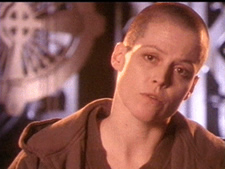
Alien3 Ripley

Sigourney Weaver reprises her genre-busting role as Ellen Ripley sans perm.

As the movie begins, Ripley’s escape pod from Aliens has crash-landed on Fiorina “Fury” 161, a prison planet run by the infamous Weyland-Yutani corporation from the first two movies.  The planet is all but forsaken, and only a handful of men are still around to “keep the pilot light on.”   These men, we are told, are all convicted murders, rapists, and generally nasty human beings who are kept in check by the ill-tempered warden Andrews (Brian Glover) and a spiritual guru-of-sorts named Dillon (Charles S. Dutton).  In essence we see humanity at its worst:  criminals devoid of any contact with the outside world, struggling to maintain a sense of order and decency lest they slip into anarchy.  They have all taken vows to maintain a sort of peace and order in the prison, and despite the lack of a true disciplinary force, they all realize the consequences should they get out of line.  Venerable actor Charles Dance is along for the ride as Clemens, a medical officer who has made some very costly mistakes years ago that continue to haunt him.  It’s a motley crew to be sure, and a rich tapestry from which to present a tale about morality and humanity.

During the opening moments we see an image of a cross silhouetted against the setting sun as debris and junk rolls across the landscape surrounding the prison–a harbinger of the thematic elements that will be explored in the film.  Dillon’s pastoral leadership of the prisoners, from his refusal to let them break the Third Commandment to his moving spiritual eulogy during the cremation of Ripley’s fallen comrades, is a stark contrast to the gun-toting reluctant leader Ripley was in the second film.  (In fact, the entire cremation/birth scene has some serious parallels to Coppola’s masterful baptism scene in The Godfather.) Dillon in essence shepherds the prisoners–a task warden Andrews, not one to upset the order or cause ripples in the water, is all to happy to have him do.  But how does one deal with a metaphysical God and satan when a very real monster is literally killing off inmates one by one?  The idea of rebirth, both spiritual and physical, is also very prominent in Alien3.  It is only through the death of a host that the alien can live, but the prisoners on Fury 161, all serving life sentences, are essentially dead anyway and it is only through death at the hands of the alien that they are set free from this mortal coil.  Ripley, with an alien queen implanted inside her, must decide whether the good of the one outweighs the good of the many, and is in fact the only human on the planet that the alien will not kill.  Elements of David Fincher’s classic directorial style are present in abundance:  a notoriously dark color palette, a cast of tragically flawed characters, and an ending that could hardly be classified as happy (not quite as bleak as the ending of Se7en, but close).  A typical action/horror film this is most certainly not.  And while Fincher lays it on pretty thick, at least there is a message and a subtext here, unlike many action blockbusters.

Alien3 Dillon

Dillon, the spiritual leader of the gang of prisoners.

But for all these high marks, there are serious flaws in Alien3 that are hard to overlook.  There are only a couple characters who are even close to relatable, and I must admit that in all my times of re-watching the movie I never felt a true emotional connection with anyone in it.  In any survival movie there must be someone whom we want to survive, but virtually everyone in Alien3 (including Ripley, unfortunately) is so unsympathetic that watching the film is akin to reading a report filled with bullet points about the tragedies that ensue when letting killer aliens run amok on a bleak prison planet.  It’s a tough bit of oil to swallow, to be sure, especially after the brilliant Ripley/Newt relationship from Aliens.  The prisoners are almost indistinguishable from one another, and possess nothing in the way of distinct personalities–a transgression that is compounded by the fact that they all look virtually identical thanks to their tattered brown clothes and shaved heads.  And as if to salt the wound, Fincher’s alien looks like a sock puppet compared to James Cameron’s ultra-realistic living, breathing xenomorphs in Aliens (with one notable exception).

For those who dismissed the film years ago, I urge you to give it another shot–you might find yourself pleasantly surprised.  For those who never saw it, by all means give it a rental.  While not exactly a worthy successor in the franchise, there is far more to this film than people often give it credit for.

Rating:[Rating:3.5/5]

48 Hrs. (Video Review)

I will say this…after watching 48 Hrs., National Lampoon’s Loaded Weapon 1 got a whole lot more funny.  :)

Rating:[Rating:3.5/5]