Freaks and Geeks

Freaks and GeeksFor all of the movies and TV shows that have tried to capture the high school experience, it’s rare that one truly succeeds.  Most come off as brazenly exaggerated, overly simplistic, or too silly to be taken seriously.  Sure there’s a few gems here and there, but for the most part movies that attempt to encapsulate the high school experience are far from authentic and easily forgettable.  Same goes for high school TV shows: there’s a dizzying array of shows set in the high school years, and only a couple are anything close to relateable.  But like that quiet kid in the back of class, Freaks and Geeks rises above the bottomless chumbucket of modern TV shows with intelligent writing, deep and interesting characters, and plenty of moments that genuinely ring true for anyone who has ever been through those four strange years of pubescent confusion.

The show is more or less about two siblings, Lindsay Weir (Linda Cardellini) and her younger brother  Sam, who go to the same high school in suburban Detroit on the cusp of the 1980s.  Lindsay is hyper intelligent but, sick of spending her time with fellow nerd herds like the Mathletes, seeks a new group of friends with whom she can just enjoy herself without judgement.  Her younger brother and his friends are social misfits who know nothing of dating, sports, or even pop culture, but try their hardest to carve out a niche for themselves in the complicated social networks of their school.  A cadre of compelling characters round out the cast: near-dropout Daniel (James Franco) and his on-again-off-again girlfriend Kim (Busy Philips), the pair of slackers Nick (Jason Segel) and Ken (Seth Rogen), would-be comedian Neal (Samm Levine), and hopelessly awkward smartie Bill (Martin Starr).  Throughout the season Lindsay and her friends, the freaks, form relationships, get in trouble, argue, start a band, and try to make it through their junior year of high school.  Similarly, Sam and his friends, all quintessential geeks, experience the ups and downs of their freshman year while bonding over comics, late-night TV shows, and trying to figure out the most complicated aspect of any young man’s life:  girls.

Freaks and Geeks: Bill Haverchuck

Bill Haverchuck, erstwhile geek complete with gigantic specs. Gotta love it.

This brief description could apply to almost any high school show, but what sets Freaks and Geeks apart is the characters and pitch-perfect writing.  No single individual can be pigeonholed, and every one of the teens in the show has multiple facets that display much more than one-dimensional high school cardboard cutouts.  There’s a scene in 10 Things I Hate About You in which we are introduced to each and every single clique at the school:  the jocks, the cheerleaders, the wannabe rednecks, and so on.  Mean Girls similarly divides the student population of North Shore High School into easily-classifiable bite-sized nuggets of social strata, most notably the antagonists of the film, the Plastics.  Freaks and Geeks is far more subtle, and the creators wisely understand that high school, and life in general, is not so easily classifiable. Even though the title of the show seems to create division and distinction, the lives of these students are as complicated and un-classifiable as can be.  To wit: the “freaks” mostly just want to be normal, have friends, and fit in.  Same with the “geeks.”  They just have their own way of doing it.  Lindsay’s struggles with friendships and her relationship with Nick come across as genuine instead of forced, and Sam’s coming-of-age experiences with his friends, the tortuous 50 minutes of daily gym class, and the perpetual pursuit of the hot girl who is just out of reach are as real as anything anyone could have experienced in high school.

Freaks and Geeks: Nick, Lindsay, Daniel

Nick, Lindsay, and Daniel, navigating social perils and locker problems.

But in Freaks and Geeks, as with real life, there are rarely simple answers or happy endings.  When Sam finally goes out with Cindy, the cute cheerleader he’s been longing for, he finds that there is far more to relationships than just physical appearances–a fact the willfully ignorant Neal refuses to believe. Lindsay also realizes through the course of the show that friendships and relationships are much more difficult to maintain than she thought, and struggles to find a balance between her old nerdy friends and her new near-dropout pals. It’s a social melting pot that keeps the focus on characters front and center, fitting in situational jokes and lighthearted moments where there’s room.  But always the characters get front billing, and though nearly all the actors were long past the age of their Michigan-based counterparts, they pull off the role of high school students more convincingly than almost any other show or movie I have seen.

Along for the ride is an outstanding supporting cast, most notably Joe Flaherty and Becky Ann Baker, who play Lindsay and Sam’s parents.  Their depiction of not-quite-clued-in paternal authority is just slightly caricatured, but it’s all in good fun.  Same goes for school counselor Mr. Rosso (Dave Allen) who, despite being a burnt-out ex-hippie, actually comes through in a pinch and, like most school counselors, really does help the kids out when they need advice or a listening ear. And then there’s the brilliant Tom Wilson who appears in a handful of episodes as the meathead gym teacher Mr. Fredericks who, like most individuals in this show, really does care for the kids and at the end of the day just wants to be a good teacher.  For all the wounds of those high school years laid bare in Freaks and Geeks, there’s an incredibly warm center to it all, an acknowledgement that while this time in a young person’s life might be fraught with melodramatic social turmoil, life will go on, people will change, and every little thing is gonna be alright.

Freaks and Geeks: Sam and Neal

Sam and Neal, pondering the mysteries of the universe and striped shirts.

Freaks and Geeks is an immensely entertaining, thoroughly funny show, but there is nary a one-two punchline to be found.  Humor comes naturally from the characters just being themselves, and the few situations in which setups are required or outlandish situations are established, such as when Neil takes the reins as the school’s mascot during a pep rally, come across as forced and a little too over the top.  Life doesn’t have convenient setups and easy punchlines, and neither does Freaks and Geeks, and the charm of the 1980s is on full display, from horrendous interior decorating choices to cringe-inducing everyday fashion, this was also a simpler time before cell phones and facebook updates added layers of confusion to an already complicated time of any young person’s life.  The only major letdown of the show is that it is over all too quickly, a victim of network cancellation and a public audience weaned on schlock like 90210 or Boy Meets World.  But perhaps that’s a good thing.  Freaks and Geeks was a flash in the pan, but it means we never see these kids grow up. And perhaps it really is better to burn out than fade away.

Rating:[Rating:4.5/5]

Invictus

InvictusMJV already gave Invictus a mini-review in his Best of 2009/Pre Academy Awards Analysis, but having just watched I thought I’d give the movie a full treatment.  While Invictus doesn’t quite live up to the heights to which it aspires, it contains some genuinely inspired performances and a storyline that ranks among the best of what the greatest sports movies have to offer.  It is an engaging, if sometimes muddled, tale of a scrappy underdog rugby team pulling together to win the highest prize the sport has to offer:  the World Cup trophy.  Directed by the great Clint Eastwood, one of Hollywood’s most storied personalities, the film is as much about Rugby as it is about prejudice, hatred, and the healing of a nation–a task that few directors would be willing to tackle, and despite the movie’s flaws, Eastwood is to be commended for embarking on a project with such a massive, yet still deeply intimate, scope.

Immediately following his election as president of South Africa, Mandela, impeccably played by Morgan Freeman, one of the greatest actors of this or any generation, seeks out a way to unite the country in a way that has never been done before.  While apartheid has officially been abolished, his country still carries the deep scars that decades of government-sanctioned segregation have wreaked on the populace.  Knowing that legal changes cannot alter hearts and minds, Mandela engages in a political calculation of deeply human proportion:  he entreats François Pienaar (a muscled-up, heavily accented Matt Damon ), captain of the Springboks, the South African rugby team, to do nothing less than win the world cup.  What follows is predictable but engaging nonetheless:  The Springboks and their captain rise to the challenge, bond over tough training regimens and shared victories, face a series of ever-more-difficult rugby teams until finally reaching the championship match against the New Zealand Allblacks.  If you can guess the outcome, I’ll give you a hot cup of jack squat for predicting the most obvious of sports movie endings.

Invictus Rugby Francois Pienaar

"Soccer is gentleman's game played by hooligans. Rugby is a hooligan's game played by gentlemen."

But Invictus, despite being entirely about a rugby team, isn’t really a movie about sports.  Eastwood instead wisely keeps the focus on Mandela and the political ramifications of his election and the cabinet-level implications of his personal interest in the tournament. He also includes several scenes that could have easily ended up in a DVD “Extras” menu, such as Mandela’s security guards discussing protective procedures and rules of engagement.  A bold move to be sure, as the movie does tend to drag on and even lose focus from time to time.  But Eastwood isn’t catering to a Michael Bay audience here.  He knows that the social ramifications of Mandela’s election, which affect every individual in South Africa even up to staff of the president, are the true soul of Invictus.  One of the most poignant scenes, which certainly would have been shed were the film in the hands of a lesser director, takes place not on the rugby field or presidential office, but inside Mandela’s actual cell when Pienaar and his team tour the prison.  And by adding these layers to the movie, Eastwood creates a tapestry that is far richer than just a story about a rugby team.

That Morgan Freeman did not win Best Actor at the Academy Awards is probably a tragedy, though having not seen Crazy Heart I can’t make that claim with all certainty. But his performance as Nelson Mandela was absolutely stunning.  The way he inhabited every bit of Mandela’s character was mesmerizing:  his gait, his speech and vocal patterns, his interactions with friends and colleagues…it is the stuff of acting legend.  Stanislavski himself would be hard pressed to find a greater master of method acting.

As a certified octogenarian, Clint Eastwood has officially retired from acting in order to focus on contributing as much as he can to the world through his directoral skills for as long as he is physically able.  I have no doubt he was keenly aware that the inconsistent pacing and occasional meandering would keep Invictus from achieving greatness.  But the result is a film that, while not as commercially viable as some other sports films, does an excellent job of showing what it takes to shed the chains of hatred and embrace a brighter, glorious future.

Rating:[Rating:4/5]

Star Trek IV: The Voyage Home

Star Trek IV: The Voyage HomeThe Star Trek franchise is known for many things, but humor is typically not one of them.  The TV shows are enjoyable but largely devoid of out-and-out humor, aside from a few tongue-in-cheek quips that would only make sense to avid Trek fans.  And the original series was often funny, but unintentionally so.  When the series was making somewhat of a comeback in the 1980s thanks to the original cast starring in a string of Star Trek movies, humor was once again relegated to the backburner or eliminated altogether.  The Star Trek universe, it would seem, was one of adventure, exploration, and soul-searching.  But it sure didn’t seem like it was all that fun.  After the pair of heady soul-searching, philosophizing, and Melleville-quoting, Wrath of Khan and Search for Spock, it was time for the series to lighten up.  And who better to man the director’s chair for Star Trek’s fourth celluloid outing than series straight man Leonard Nimoy, who famously plays the emotionless Spock.

In a classic fish-out-of-water tale, the crew of the Enterprise, whom are now piloting the stolen Klingon ship HMS Bounty, must travel back to earth circa 1986 to find (get this!) a pair of humpback whales (no, really) in order to bring them to the 24th century where (it gets better!) a giant alien probe that only speaks Humpback Whalian (seriously!) is destroying earth as it tries to communicate with the giant water-bound mammals that have been eliminated due to poaching.  The plot is incidental, really, as it’s really just an excuse to inject some lighthearted humor and good old fashioned adventuring into a franchise that was spending far too much time brooding over existential questions of life and death.  The result is a film that easily appeals to a wide range of audiences and doesn’t take itself too seriously, and in doing so becomes one of the best Star Trek movies of all time.

Star Trek IV: The Voyage Home

Somehow they got the entire Star Trek cast to shuffle their busy acting schedules around and come back to film a fourth movie.

When Kirk and his intrepid crew arrive in 1986 they are put in a number of situations that are designed to create a deliberate contrast with the Star Trek universe and conventions we all know and love.  Sans transporters and shuttlecraft, the crew must traverse San Francisco on foot, by bus, and the occasional hitchhike. Unaware of 1986 culture, Spock meditates on the purpose of profanity while Dr. McCoy pontificates about the sorry state of “dark ages” medical care.  And in one of the most endearing scenes, Scotty is forced to interact with what was then an ultra-sophisticated piece of computing hardware by using “quaint” input devices such as a keyboard and mouse.  There’s even a good joke made at the expense of Chekov’s native tongue as he attempts to ascertain directions to the nuclear vessels.  It’s all played for laughs, and comes off as heartwarming, endearing, and downright enjoyable–adjectives that are not often applied to Star Trek outside of certain circles of geekdom.

Of course Kirk and Spock are the stars of the show, and Kirk plays his usual Alpha Captain character to the hilt, even wining and dining (if pizza and beer count) the female marine biologist Gillian (Catherine Hicks) in order to get information about the humpback whales in her charge at the local marina. Star Trek IV deftly walks a line between catering to the fans (at one point Kirk pawns the specs that McCoy gave him as a birthday present in Star Trek II, only to postulate that the very act of hawking the glasses is what ultimately leads to McCoy being able to give them to Kirk hundreds of years in the future–a classic Star Trek ontological paradox if there ever was one) and opening the franchise up to a much wider audience.   And in doing so, the series successfully goes where it has never gone before.

Rating:[Rating:4.5/5]

Avatar contest winner!

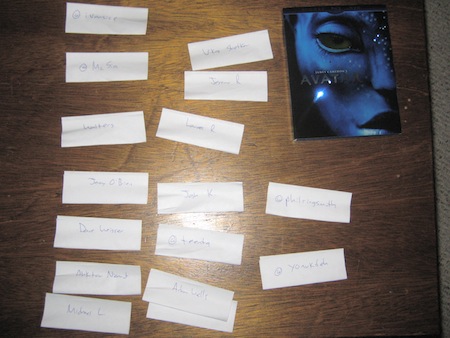
Congratulations to Angela and Maia Walter, who won our Avatar DVD/Blu-ray giveaway!  The two of them submitted only one entry, and theirs was chosen by my wife (all the names were put in a box, mixed up, and my wife picked one at random without looking) shortly after the contest ended tonight.

Avatar Contest Entries

All the entrants of our Avatar contest, along with the prize itself.

Thank you to all 16 individuals who entered the contest! To everyone who suggested movies for us to review, we’ll try our best to accommodate your ideas.  :)  And thanks to all our readers for a great first year of Walking Taco movie and TV reviews.  Here’s to many more!

-TacoGrande, MJV, and Movieseal

Lost: Season 2

Lost: Season 2After the whirlwind ride of Season 1, the second season of the hugely popular ABC drama/sci fi series goes a long way in answering many questions from the first outing, while raising entirely new ones that hint at a much larger plot and much deeper rabbit hole than ever seemed possible.  (Spoiler Alert: Having only seen through the first two seasons, I can’t give anything away about the rest of the show. But be forewarned–if you have not watched the show through the end of Season 2, you might be hit with some information you might not want.)

As any high school English student knows, the first part of any story is the exposition:  the introduction of characters, conflicts, setting, and plot.  And while the first season of Lost was engaging and entertaining in its own right, all the events set up in those original 25 episodes were really just about laying the groundwork for the rest of the show.  Season two expands on much of the original framework while giving fans all sorts of new twists and turns to speculate about around water coolers nationwide.  The survivors of Oceanic Flight 815 begin to segregate into a few distinct groups, each discovering clues that served to unravel many strands of the larger mystery of the island.  In what at first seems like an unnecessary subplot, Michael, Sawyer, and Jin find themselves washed ashore with the survivors from the tail section of the plane.  But as the show’s tagline says, everything happens for a reason, and it’s not long before we realize how interconnected these people are with the rest of the survivors.  Meanwhile Jack and Locke, while spending much of their time in the hatch, spend a good deal of time figuring out their own answers while also dealing with a man Rousseau caught in one of her traps who may or may not be one of the Others.  Topside most of the regulars from Season 1 are back to form new relationships, embark on journeys to different parts of the island, and search for answers to some of the long-burning questions about the island.

Lost: Season 2, Jack and Mr. Eko

Jack and Mr. Eko, looking for answers and a clean pair of shorts.

It’s a fantastic testament to the brilliance of the writers that various events which seemed trivial and innocuous throughout the first season turn out to be of the utmost importance during the second season.  Rather than throw distracting red herrings at the audience, there is hardly a single character, event, or object that is not steeped in meaning.  Perhaps more than any other serial drama I have ever seen, Lost treats its audience and subject matter with the utmost respect and care, rarely resorting to cheap tricks such as killing off characters to solve a case of writer’s block or inventing contrivances to link current events to past plot points.  There are much deeper themes at work here too, and every person on the island must deal with skeletons in his or her closet, confront personal demons such as drug addictions or marital conflicts, or rise to challenges of leadership and personal sacrifice.  For instance Locke, who used to operate on blind faith alone, begins to question everything he once knew while virtually trading places with newcomer Mr. Eko, a priest who is sure of what he hopes for and certain of what he cannot see.  It’s this multidimensional characterization, along with a seamless blending of science fiction, religion, and traditional drama that separates Lost from other dramas, and these ideas continue throughout Season 2 in masterful form.

Lost: Season 2, Ana Lucia

Michelle Rodriguez stretches her acting ability by playing a tough-as-nails ex-cop with an attitude.

There are a couple of low points of the season, though–particularly some strange choices made by Sawyer and Charlie in “The Long Con” that seem uncharacteristic and are never met with much follow-through.  A few episodes seem like outtakes from Days of our Lives, and the he-said-she-said dramatic tension that surfaces a few times feels forced and out of place.  The pacing is a bit slower this time as well, since much of the action takes place on the beachfront camp or inside the hatch, and the exploration is more of a personal than environmental nature.  I am also a tad disappointed that Shannon and Boone were jettisoned so early on, to be halfheartedly replaced with the altogether uninteresting Rose and Bernard.  But nitpicking these missteps is like dismissing the grandeur of Yellowstone National Park because of the mosquitoes.  The hallmark of Lost is the way each answered question (Where did the other plane come from? Who is Rousseau? What’s the deal with Henry?) leads to a host of new questions, and while the character drama isn’t as interesting this time around, partly because the backstories of many of the survivors have already been explored, the new questions raised are as compelling as ever.

By the end of Season 2, which takes place over roughly three weeks on the island, the survivors aren’t in much better shape than they were at the end of Season 1.  They are still stuck on the island, still scared of The Others, and Jin still can’t speak a lick of English.  But they have far more food thanks to the hatch, and their attitude has shifted from trying to find a way off the island to finding a way to dig in for the long haul.  And in a sense, so are we.  At this point it’s clear there are far greater forces at work, with stakes that are infinitely higher, than what we knew when the show began.  I’m not frantically wondering what will happen next like I was during the middle of the first season, though Season 2 does have its share of nail-biters to be sure, but I am simply awed at the spectacle that is beginning to unfold and eagerly awaiting the next season to see another chapter in how it will all play out.

Rating:[Rating:4/5]

Walking Taco Turns 1!

It’s been a great year for Walking Taco! June 21 marks the anniversary of the publication of our very first post, and to celebrate a year of movie and TV reviews, we are giving away a copy of Avatar on DVD and Blu-Ray!  It’s a combo pack, so no matter whether you prefer DVD or Blu-Ray, we’ve got you covered!

To enter, you must do one of the following:

1. Leave a comment on this post telling us the three movies you would most like to see reviewed here on Walking Taco.

Or…

2. Tweet the following message, along with the title of a movie you would like us to review.  Make sure to delete [Movie] and replace it with your idea for a film we should review!

@walkingtaco I want http://walkingtaco.com to review [Movie]. RT with your idea and be entered to win a copy of Avatar!

Or…

3. Tweet the following message:

@walkingtaco To celebrate a year of movie reviews, http://walkingtaco.com is giving away a copy of Avatar! RT to be entered to win!

Only single entries will be eligible to win.  Tweeting a message multiple times (or tweeting both messages instead of just one) is nice, but won’t increase your chances of winning.

That’s all it takes to enter!  Contest ends at 9pm CST, Sunday, June 20.  Winner will be announced Monday morning, June 21.  Thanks for a great year, and here’s to many more!

Questions and other inquiries may be made via our Contact page.

The Princess and the Frog

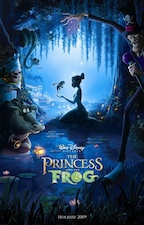
The Princess and the FrogAfter a decade of dabbling in CGI cartoons with the likes of Chicken Little, Brother Bear, Meet the Robinsons, and a slew of award-winning movies by its subsidiary Pixar, one might think that a return to traditional “cel” animation is a bit of a step in the wrong direction.  But like downing a glass of ice water after a long bike ride, watching The Princess and the Frog is a refreshing throwback to the basics:  good animation and a solid storyline, backed up with some fantastic foot-tapping musical numbers and a memorable supporting cast.  Aside from a few questionable scenes with the film’s nemesis, Dr. Facilier (Keith David), this is an extraordinarily pleasant reminder of the kind of moviemaking that made Walt Disney a household name.

Set in the humid streets and bayous of New Orleans, The Princess and the Frog tells the long-trodden tale of a young girl who wants more out of life.  The princess in question this go-round is Tiana (Anika Noni Rose), a young girl with a hard-working father and loving mother who dreams of opening her own restaurant with her dear old dad someday.  And in the tradition of Disney movies, she wishes upon a star, desperately hoping her dream will come true.  But far from the beaten path laid by the House of Mouse, Tiana does not wish for a handsome prince to sweep her off her feet.  Nor is she under any illusions that a ball of gas burning billions of miles away has the power to shape her destiny.  Instead, she knows that only hard work and unwavering determination can get her the restaurant she dreams of–a moral lesson reinforced by (what else?) a song.  Sometimes the classic formulas are the best, eh?

Princess Frog Balcony

Wow...a girl who wants more out of this (provincial?) life, staring off a balcony, wishing on a star. Didn't see that one coming.

And what good is a children’s movie without some weighty advice on sound financial planning?  Tiana’s entrepreneurial spirit is nearly snuffed out when she is told she only has three days to make the rather sizeable down payment on the riverfront property–a payment that her dozen change jars just can’t quite accommodate.  Fortunately she takes a side job making pastries for a party thrown by her spoiled rotten best friend Charlotte (Jennifer Cody) who wants to hit it off with the wealthy Prince Naveen (Bruno Campos).  Turns out he is broke, and visits the voodoo artist Dr. Facilier and sells his soul to get some quick cash.  At the party that evening one thing leads to another and Tiana and Naveen get turned into frogs and are float away to the swamp on a pack of helium balloons.

In classic Disney style we are soon introduced to a handful of oddball supporting characters, each with outlandish and highly exaggerated southern/cajun accents and mannerisms.  There’s an old lightning bug named Ray and a misfit alligator named Louis, as well as Mama Odie, a mystical priestess who helps Tiana and Naveen on their quest to return to human form.  Throw in a handful of aforementioned catchy tunes, and like Tiana’s gumbo, you’ve got a recipe for an animated delight.  The cel animation is the icing on the cake that givies the entire production a vibrant, sprightly attitude that makes nearly all computer-rendered animation in the past decade pale in comparison.

The Princess and the Frog is many things, but while the return to traditional animation is a welcome change from much of the bland, sterile computer animated schlock coming out of Hollywood today, I was disappointed in the overall storyline.  It was an enjoyable romp to be sure, but it felt like a paint-by-numbers Disney flick rather than groundbreaking or envelope-pushing like we have seen in Wall-E and Up.  But if anything, it does prove that there’s still plenty of life left in the realm of old-school animation.

Rating:[Rating:4/5]

Lost: Season 1

Lost Season 1Lost is first and foremost a show of mystery.  More than any other show I can recall seeing, it sets up fantastic yet somehow not entirely far-fetched scenarios with a host of compelling and more or less interesting characters.  The basic premise is one we have seen played out many times before:  a group of individuals, separated from the rest of the world, must work together to survive.  But while Lost owes incalculable debts to sources from Lord of the Flies to Gilligan’s Island, it presents an absolutely gripping storyline shrouded in mystery while dropping enough breadcrumbs to keep viewers riveted, eager to know just what is going to happen next and trying their best to make sense of everything.  And just so I’m covered…this review may contain possible Season 1 spoilers.  :)

Platitudes aside, and without revealing too much (though as of the writing of this review I have only seen the first season and a handful of episodes from Season 2), Lost does a good job of sticking first and foremost to the basics of storytelling:  presenting conflicts that the characters must overcome.  In the very first episode we witness the immediate aftermath of a horrific plane crash on a tropical island:  amidst mass confusion, exploding engines, and corpses littering the scarred shoreline, several individuals begin bringing order to the chaos and establishing a sense of control and uneasy sort of self-governing democracy among the crash survivors.  There’s the chiseled young doctor named Jack (where is the rule that says TV heroes need monosyllabic names that sound like garage tools?) who becomes the de facto leader, a young pregnant woman named Claire, a young druggie named Charlie, a young (see a pattern here? I guess they gotta appeal to the TV-watching demographic somehow) easygoing dude named Hurley, and several others like the cocky Sawyer, the standoffish Kate, and the mysterious John Locke. From the very first episode, viewers are left with myriad questions:  Who are all these people? Why did their plane crash? Why does it seem like there are monsters on the island?  Will they ever be rescued?

Lost Sawyer

Sawyer, the con-man who looks like he belongs on Days of our Lives.

The genius of the show lies in how it cleverly answers questions while raising intriguing new ones, and throwing just enough breadcrumbs at the viewers to satisfy our curiosity while enticing us to keep watching.  And though the group of individuals hovers around 40, there is a core set of characters central to most episodes whom we get to know very well over time.  They struggle to overcome mundane obstacles such as building shelter, finding food, and working together to provide medical care for wounded individuals or building rafts in order to sail away and seek help, but rarely do the survivors form a cohesive group.  Some do not trust others, and some are simply not trustworthy.  Others keep secrets, form relationships, and even set out on their own to seek help or simply answers to questions about what is happening on the island.  Each episode also contains several flashbacks that reveal backstories of various characters and give us an idea of who these people are, or at least who they were before the plane crash.  Often it’s the threads woven by these vignettes throughout each episode that are the most compelling part of the show, as we discover that, like the island, each of the plane crash survivors are far more than what they appear on the surface.

Lost Kate

Just like an Autobot, there's more to Kate than meets the eye.

Through it all there is a sense, woefully missing from other episodic shows like Heroes, that there really is a plan to everything that’s going on.  From the perplexing smoke monster, to “The Others,” a group of people who may or may not be sharing the island with the survivors, to the miraculous healing of Locke, to the mysterious hatch, there seems to be a design for how everything fits together–even if it will be several years down the line.  Whether or not that is in fact the case remains to be seen, but like 24, Lost is a show that demands the viewers watch every episode lest they miss a crucial plot point.  But unlike 24, Lost doesn’t jerk its viewers around:  characters are not killed off at will whenever the writers need to add a jolt of excitement into the show.

Lost is as impressive as it is ambitious, and I am eager to see how things play out for the rest of the show.  But sometimes I wish these people were just a little more normal and relatable.  Seriously, on a plane heading from Sydney to Los Angeles, wouldn’t there be just one regular guy with a 9-5 job and no secrets or skeletons in his closet?  I can understand a bit of dramatic tension and whatnot to keep viewers interested, but everyone in the show has so many secrets, often with backstories of life back in the real world that tend to push the limits of believability, that it gets kind of silly sometimes.  It is a TV show, though, and I guess outlandish characters can be part of the fun.  After all, the entire premise of Lost is pretty outrageous, so what’s wrong with a few exaggerated characters?  In fact, the worst complaint that could honestly be leveled against the show at this point is that Season 1 is so good I’m worried the creators simply won’t be able to top it.  But I’m sure anxious to see if they will try…

Rating:[Rating:4.5/5]