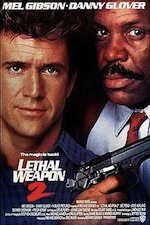
Lethal Weapon 2

Lethal Weapon 2Once upon a time, action movies were gloriously overblown romps of bullet-ridden testosterone.  Action stars unapologetically careened around cities with the tiniest amount of legality to their actions–just barely enough to justify their immortal status as good guys.  They fought villains who were bad just for the sake of being bad, and needed no justification for their misdeeds and wrongdoings.  No moral grey areas existed in this golden age of action movies, which we will one day tell our kids about with the same glint in our eyes that my dad now possesses when he speaks of The Good Old Days.  Heroes were heroes, bad guys were bad guys, and you left the theater rooting for the chiseled machismo on display before your very eyes.  Sadly, this gilded age of dude-centric cinema faded out in the late 1980s and has yet to be brought back, despite attempts like Live Free or Die Hard and The Expendables.  Maybe it’s political correctness, maybe it’s technology (action stars just aren’t as cool when toting iPhones and netbooks), or maybe it’s just a cultural shift that no longer idolizes larger-than-life movie stars.  But watching movies like Lethal Weapon 2 sure makes me pine for those days.  The good old days.

There’s no subtlety in Richard Donner’s follow-up to his 1987 barn burner, the original Lethal Weapon.  And that’s a good thing.  For any kids who think Mel Gibson is off his rocker nowadays, here’s a news flash:  some of us have known for decades.  In Lethal Weapon 2 Mel Gibson plays Martin Riggs, an iconic coyboy cop: he’s crazy, unpredictable, off his rocker, and never follows the rules.  He gets chewed out by his police captain, but such conceps like regulations and procedures mean nothing to Riggs.  He does what he wants, chases (and gets) the girls, and shoots (many times) first and asks questions later.  Balancing him out is straight-laced cop Roger Murtaugh, played by Danny Glover at his bewildered best.

Lethal Weapon 2: Gibson Glover

Many people don't know it, but the real lethal weapon in the movie is Mel Gibson's mullet.

Together the two of them must solve an international caper that gets personal when the bad guys start taking out cops around the city.  The details aren’t really important–something about money laundering and South African smuggling–as the film is really just a means to showcase one of the best mismatched duos in movie history.  Martin and Riggs are the perfect pair of cops, and Gibson and Glover are the perfect actors to play them.  Joining the team for this second go-round is Joe Pesci at his greasy, fast-talking slimeball best, but his character is often just too annoying and distracting.  Still, his Leo Getz character does have a certain charm that kind of grown endearing by the end.

The movie starts with an entirely implausible car chase through the Los Angeles, and things only ramp up from there to the point of bordering on self-parody.  It’s the first of several increasingly ridiculous car chases sandwiched between exploding houses, exploding swimming pools (oh yes) and exploding toilets (you better believe it).  One-liners rack up like the body count, but this was 1989–a time when a hero could shoot a couple bad guys with a nail gun, followed by a quip like “Nailed ’em,” and get away with it.  Of course there’s a “romance” too, just to keep the ladies interested, but it’s not so much a romance as it is sheer conquest.  At times it’s almost comical to see Gibson careening down city streets clad in tight jeans and cowboy boots, or standing atop a bullet-riddled trailer home while spraying bullets from an M-16.  The whole spectacle just screams action movie but it does so with such unapologetic gusto that you can’t help but watch in awe.  Perhaps best of all, though, is the total lack of any CGI or digital trickery here.  When Dwayne Johnson takes out bad guys in movies like Faster you can practically smell the pixels.  But in Lethal Weapon 2, when cars crash and buildings explode there’s a palpable sense of reality knowing that something, even if it was just a model, really did meet a fiery end in order to get the shot filmed.

Maybe I’m waxing a bit nostalgic here, but watching Lethal Weapon is an astounding guilty pleasure.  And I could be a tad jaded in my old age, having turned the big three-oh last year, but when I watch action movies today I think about films of yesteryear like Lethal Weapon 2 and think how they just don’t make ’em like they used to.

Rating:[Rating:4/5]

Batman Returns

Batman ReturnsAfter reinventing the Batman character in 1989, and introducing audiences to a new level of box office bravura, Tim Burton decided to up the ante in every way with the inevitable sequel.  But even the soulless title has overtones of what to expect here:  Batman is back, and has a new round of villains to fight.  The weird thing is, Batman never went anywhere at the end of the first film, so why did he have to “Return” for round two?  Alas, such questions will find no answer here, as the point is to simply push the envelope of good taste and cash in on a newly-minted franchise.  And while Batman Returns isn’t a complete train wreck, it jumps off the rails early on and never even tries to find its way back.

Burton’s first Batman movie, while flawed, at least provided some good entertainment and a solid hero/villain tale.  Batman was well matched against The Joker, and the conflict provided for some interesting, if not entirely quality, film making.  In an attempt to up the ante with Batman Returns, the story has two villains: The Penguin and Catwoman, neither of whom is as interesting or compelling as Jack Nicholson’s Joker.  To further complicate matters, each villain has an origin story in this movie, which means that the title character actually gets painfully little screen time.  The film begins with the grim birth of The Penguin, a child so horribly disfigured that his parents abandon him in a baby-sized river basket to float to a watery grave.  But since this is a comic book movie, this child is (of course) adopted and raised in a secret chamber inside the Gotham City zoo by a pack of wild penguins.  Years later Danny DeVito emerges from the sewers as The Penguin, ready to wreak havoc on the city.

Batman Returns: Keaton, Pfeiffer

Selina Kyle, demonstrating the newest trend in hairstyling: "The Bird's Nest."

Meanwhile, plucky do-gooding secretary Selina Kyle (Michelle Pfeiffer), who just can’t seem to catch a break, is tossed out of a window and left for dead by her evil corporate boss Max Schreck (Christopher Walken, whose unapologetic scenery-chewing is the best part of the movie).  But since this is a comic book movie, mere secretaries can’t simply die after 20-story defenestration!  No, they are brought back to life by a pack of wild cats.  Somehow.  And thus begins her transformation into Catwoman.

None of this makes any sense whatsoever, but when watching a movie about a rich dude who fights crime in a bat mask, all bets are off.  For reasons entirely unexplainable by any stretch of logic, Max Schreck recruits The Penguin to run for mayor in exchange for some political favors. Never mind the fact that just a week earlier The Penguin was entirely unknown to Gotham and had spent his entire life in a penguin-filled sewer.  (I know we live in a world where professional wrestlers can become state governors, but even this is pretty ridiculous.) And because the plot requires it, Catwoman joins forces with The Penguin to (what else?) get rid of Batman.  Because, you know, it’s a comic book movie and stuff.  In the middle of this is an awkward romance between Bruce Wayne and Selina Kyle (oh, the irony!).

Batman Returns: The Penguin

The toy action figure creators really earned their paychecks on this movie.

Michael Keaton reprises his role as Bruce Wayne, either out of contractual obligation or some type of legal fine print. His blandness pervades every aspect of the character, and when he is not throwing awkward punches or delivering a menacing glare through the Caped Crusader mask, he is squirming uncomfortably in a suit or trying to warm up to Michelle Pfeiffer in front of a ginormous fireplace back at Wayne Manor.  DeVito turns in a solid performance as an aquatic terrorist, but the entire Penguin character is a disaster from top to bottom.  There is no reason for the character to exist, no reason for a conflict between him and Batman, no way (even by comic book logic) that he could have established a massive underground terrorist organization, dependent on mindless henchmen and hundreds of trained penguins, from inside a city zoo.  And somehow, wearing a skin-tight leather suit and assigning an feline-based moniker makes one impervious to the penetrating power of 9mm bullets.  The list goes on.  The entire movie is a series of face-palm-inducing moments and cheap thrills, wrapped up in a sadistically violent tale in which Batman himself is largely peripheral.  But hey, if it sells happy meals, why not?  Oh, wait.

Rating:[Rating:0.5/5]

Tron

Visiting a movie like Tron for the first time can be described as none other than tricky business.  First of all, the movie is a vintage visual effects spectacular from 1982.  Secondly, it came about in the early days of computer technology which poses major difficulty in addressing the film’s ‘revolutionary’ use of such special effects and the problems derived from the plot.  In a time of Windows 7, and in the wake of The Matrix, it’s a little hard to digest a Disney version of a super computer bent on taking over the world, and a human computer program designer being zapped into the computer’s infrastructure.

Even though Tron is widely considered a classic among fanboys and became a landmark in its time for visuals, I could only appreciate it for its advances in its time—which look incredibly awful by today’s standards.  A movie like this could only be approached today by techy gurus obsessed with the 1980s or nostalgic adults remembering this flick of their youth.  I felt that due to a slight interest in the upcoming Tron: Legacy that I must visit the niche film that started it all.

As a fan of science-fiction I can see the impact that Tron must have had upon its release.  It combines digital effects with hand-drawn animation and utilizes live actors in the process against a computer-rendered backdrop.  Talk about ambition for its time.  Jeff Bridges plays Kevin Flynn, a top computer programmer and former video game designer for a software company.  His colleague, Ed Dillinger (David Warner), sabotages him by stealing all of his arcade game designs which promotes Ed to a Chief Executive position.  Soon enough Flynn is removed from the company.  Dillinger’s Master Control Program (or MCP), in charge of the company’s operations, continues to gain intelligence following Flynn’s departure, and eventually becomes self-aware determined to tap into access at the Pentagon (for world domination I presume).  The MCP keeps Dillinger in check by threatening to expose a file that proves Flynn is the real creator of the most popular arcade games on the market.  As MCP continues to gain more control and knowledge, the software company’s access to other human ‘users’ is cut off sending these programmers into a frenzy.  Employee Alan Bradley (Bruce Boxleitner) has designed a program called Tron that will put a stop to foreign program violators which poses a threat to the MCP.  He teams up with co-worker Lora (Cindy Morgan) to recruit the genius Flynn into helping them sneak into the company and load Tron into the system.  Flynn sees this as is opportunity to track down the data file that will prove Dillinger’s scheme and earn him his job back.   All the while, an experimental laser has been developed at the company that can break a physical object down into a digital data stream.  Of course this laser comes into play when the MCP finds Flynn’s intrusion into the computer network.  The MCP decides it logical to stop Flynn from loading the Tron program by zapping him with the laser and turning him into a digital program that brings him into the world of the super computer.  As a program, Flynn must participate in a series of arcade games within the computer while trying to implement Tron (or more appropriately, a computer anti-virus in today’s terms) into the system and thus killing the MCP.

Whew… Still with me?  Tron as a film is further ‘out there’ than most, and is truly laughable by today’s standards.  But keep the year 1982 in your mind and also the fact that it’s a family-friendly Disney film, probably best remembered as a pioneer in experimental special effects.  The story is as odd and shallow, and yet as utterly complicated and confusing as it needs to be.  If you can accept Jeff Bridges being zapped by a laser that turns him into a computer program, then you’re half way to enjoying this movie.  I haven’t even mentioned that all computer programs within the computer are human counterparts that exist as replicants of their human users.  But I don’t want to confuse you even more.  The plot really has me scratching my head, and to contemplate it more and more I don’t think was the intent of the filmmakers.  Why would the MCP send Flynn, the ultimate threat to whole system, through a series of arcade battles and races when he could just have him terminated?  If the MCP really did gain so much knowledge and control, why don’t these human computer programmers so bent on uploading the Tron program decide to simply pull the power cord?   I have other questions that would spoil further developments of the plot, but I think ultimately I need to turn off my brain and recognize Tron simply as an early example of computer effects technology—even as laughable as it looks today.  I suppose my biggest question is how this type of film will translate to a wider audience today?  Upping the special effects will certainly help, but can today’s viewers really get into this?  We’ll have to wait and see when Tron: Legacy takes over soon enough.

So did I enjoy Tron or not?  I don’t know.  I really couldn’t see myself watching it again.  It has very little lasting qualities, and because I didn’t experience the film in the 80s, I can’t generate any sort of nostalgic attachment or appreciation for it.  Is it terrible?  No.  This is an ambitious project for its time, and in many ways was much ahead of its time.  I can appreciate it on that level, but find the film to hold little weight today.

[Rating:2.5/5]

Harry Potter and the Deathly Hallows, Part 1 (Book and Movie)

So it has come to pass. Twenty years after an “idea simply fell into” author J.K. Rowling’s head, we are nearing the completion of a franchise development truly without precedent. Not only did Rowling manage to write an extremely rare heptilogy of novels, and make every one engaging enough to keep readers begging for more, but Warner Brothers Studios is now nearing completion of a truly unique achievement: an actual octilogy of multi-hundred-million dollar films, consistently written and cast over ten years. This achievement deserves mention, even if it’s ultimately just a testament to mindless consumerism. With so many major characters in the epic tale, many of them juveniles, keeping the entire cast together for eight movies must have been a managerial and legal nightmare, to say nothing of churning the movies out fast enough to (almost) keep up with the aging actors. Add to that the level of special effects the story requires and the problems always posed by child actors, and it’s truly amazing any of these films turned out decent.

And I would have to say, that’s just what they are: decent. Nothing more, nothing less. None of them are bad by any means, but it’s impossible for me to watch one without thinking about how much more powerful the book was. The books, unfettered by the logistical problems mentioned above, and free to be as long as they needed, took us to places no movie ever could. Two of the most powerful scenes from Book VII – when Ron destroys the locket, and when Herminoe attacks him afterward – have been reread many times by me, drinking in every word and feeling the raw emotion of the characters. Both of these scenes are pretty flat in the movie. In all honesty, though, I can’t read the more recent books without longing for the early books.

The tone of the stories has certainly changed along the way from Sorceror’s Stone to Deathly Hallows. Check out this excerpt from Stone, chapter 8:

There were a hundred and forty two staircases at Hogwarts: wide, sweeping ones; narrow rickety ones; some that led somewhere different on a Friday; some with vanishing steps halfway up that you had to remember to jump. Then there were doors that wouldn’t open unless you asked politely, or tickled them in exactly the right place, and doors that weren’t really doors at all, but solid walls just pretending. It was also very hard to remember where anything was because it all seemed to move around a lot. The people in the portraits kept going to visit each other, and Harry was sure the coats of armor could walk.

Now listen to Hallows, chapter 1:

“Do you recognize our guest, Severus?” asked Voldemort. Snape raised his eyes to the upside-down face. All of the Death Eaters were looking up at the captive now, as though they had been given permission to show curiosity. As she revolved to face the firelight, the woman said in a cracked and terrified voice, Severus! Help me!”

“Ah, yes,” said Snape as the prisoner turned slowly away again. “For those of you who do not know,” said Voldemort, “We are joined here tonight by Charity Burbage who, until recently, taught at Hogwarts.”  There were small noises of comprehension around the table. A broad, hunched woman with pointed teeth cackled. “Yes, Professor Burbage taught the children of witches and wizards all about Muggles … how they are not so different from us …”

“Severus … please … please …”

Nobody laughed this time. There was no mistaking the anger and contempt in Voldemort’s voice. For the third time, Charity revolved to face Snape. Tears were pouring from her eyes into her hair. Snape looked back at her, quite impassive, as she turned slowly away from him again.

“Avada Kedavra.”

The flash of green light illuminated every corner of the room. Charity fell, with a resounding crash, onto the table below, which trembled and creaked. Several Death Eaters leapt back in their chairs. Draco fell out of his onto the floor. “Dinner, Nagini,” said Voldemort softly, and the great snake swayed and slithered from his shoulders onto the polished wood.

We all love stories about more exciting worlds hidden in our own. As we all know, the premise of Harry Potter is that there is a civilization of wizards and witches living in hiding somewhere within our own world. There are enough of them and they have enough power and resources to have their own towns, traditions and unique modes of transportation. Of course, if you’re buying this, you’ll probably buy that there are mutant turtles practicing ninjitsu in the sewer. Why haven’t any of the zillion satellites orbiting the earth photographed Hogwarts? How could an airborne event the size of the Quiditch World Cup go unnoticed by Muggles? If wizards are so powerful, why do they need to hide? The story occasionally posits flimsy explanations for this, but of course, we all know, the real answer is WHO FRICKIN’ CARES? Harry Potter gives us the chance to escape our world completely and enter one of dragons, adventure and the moral clarity that’s hard to find in real life.

Some more questions about Harry’s world: if Parseltounge is such a rare gift, why can any human apparently talk to Aragog the Spider in Chamber of Secrets? Why is Hogwarts full of ghosts, while Harry’s parents and other’s killed by Voldemort are truly gone?  (This one must have hit Rowling about halfway through the series, because she starts ignoring the ghosts as much as possible about then.) Things like this weren’t a problem when we laughed with 11-year-old Harry on magical school grounds, but as Rowling made the books more and more serious and world-changing, we were forced to question them more and more. One of the most irritating features of the movies is that they increasingly portray Harry against a backdrop of skyscrapers. Harry Potter was at his best when we could join him in a closed universe, nothing like our own, and forget our troubles amid the innocent fun of quiddich and wizard’s chess. Frankly, the subject matter of Harry Potter just isn’t worthy of epic battles and mature romance.

Having said all this, I must confess that I still genuinely enjoyed the later books, and genuinely enjoyed Deathly Hallows, Part 1. Splitting this story in half enables the film to at least come closer to the depth and richness of the book. I’m eager to see Part 2. If you’re a Potter fan, you should check this one out. Just do me one favor. Don’t deprive yourself by only watching the movies. PLEASE read the books.

The Book: [Rating:4/5]

The Movie: [Rating:3/5]

Batman

BatmanI was nine years old when Tim Burton rebooted the beloved Batman franchise, replacing the aging Adam West with a much younger (and, for many fans, much more controversial) Michael Keaton and giving audiences their first look at a Gotham City that was dripping with darkness.  Far from the bright palettes and cartoony enemies of the 1960’s TV show, this new Batman was grim, unflinching, and strikingly violent.  It also ushered in a new era for comic book movies and summer blockbusters, and reaping a pile of cash for Warner Brothers that continues to grow to this day.  But was the movie any good, or was it all spectacle and marketing?

The answer is a little of both.  There are few effects-heavy movies that stand the test of time; aside from the original Star Wars trilogy, Kubrik’s masterful 2001: A Space Odyssey, and classics like Jason and Argonauts, modern audiences have little patience for obvious blue-screen chroma key and once high tech effects like stop motion.  Unfortunately, Batman does not hold up quite so well, but this wouldn’t be a problem if the plot and acting were any good.  As it stands, Batman can be seen today as an average comic book film or a sub-par comic book film, but either way it’s not much use outside of a footnote in the annals of summer blockbuster history books.

I grew up on the cheesy but lovable Batman after-school reruns where Batman and Robin battled an endless array of implausible foes while spouting dialog so terrible it made George Lucas look like Shakespeare.  It was campy and fun, and you have to respect a guy like Adam West who acts so badly with such utter conviction.  Burton eschews much of this campiness, but his version of Batman is trapped in movie limbo:  despite the dark and serious tone of the film, we are nonetheless asked to accept wild and outlandish premises that only work when planted firmly in the roots of 1960’s cheese.  Street thugs, crime bosses, and city officials are depicted as two-dimensional caricatures, barking out lines of such obvious exposition that it’s like watching an eighth-grade school project.  Jack Napier, one of the higher-ups in the Gotham crime syndicate, falls into a giant vat of green toxic waste which transforms him into the venerable Joker.  And his plot to take down the city (because what else would a criminal mastermind do) involves contaminating all the city’s cosmetic products with poison that causes victims to die of laughter (no I am not making this up).

Kind of makes the idea of exploding sharks seem almost normal.

Batman: Michael Keaton

Michael Keaton is Batman...striking bewilderment into the hearts of Gotham City criminals.

As if to countermand the potential silliness of some of these plot devices, this Batman is surprisingly violent.  Almost too much for a PG-13 rating, and certainly more than what most parents would be comfortable having their kids watching.  Watching the Joker dance around the room as he gleefully pumps his victim full of lead is a far cry from the classic Wham-Bam-Pow fight scenes of yore.  It serves the character, one might argue, but to me it reeks of overcompensation.  But throughout the film Jack Nicholson’s turn as the Joker is extremely well acted and the character more or less holds his own when pitted against Heath Ledger’s masterful portrayal of the same character in 2008’s The Dark Knight.  Unfortunately the same cannot be said for the bland, charisma-draining performance of Michael Keaton.  Woefully miscast as Bruce Wayne and his crimefighting alter ego, Keaton somehow manages to pump out lines like “I am Batman” with a straight face, though probably because he does it while wearing a mask.  The romance between him and Vicky Vale (Kim Bassinger, trying her best to fend off her 40’s) is as shallow and unbelievable as we might expect from a 1989 comic book movie, and only serves to give Batman a reason to go after the Joker in the end.  After all, what better motivation could a superhero have for fighting the bad guy than to get back his kidnapped girlfriend?

I have a feeling that if Tim Burton were to be able to re-make his original film today it would be more in line with Christopher Nolan’s mature, dark, and introspective Batman Returns and The Dark Knight. But back in 1989 audiences were hardly accustomed to plausible superheroes with innter turmoil and realistic villains, and in that sense I can kind of understand the motivation for straddling the line between comic book absurdity and dark reflections of reality.  But ultimately Batman is a lot of spectacle without much substance to back it up.

Rating:[Rating:2.5/5]

Faster

“I can’t.”

“God can’t save you from me.”

“Where’s the exit?”

“Steel plate.”

“Your dad is sorry.”

“That’s a long dark road you’re headed down.”

“Where’s the old man?”

Sorry to spoil half of the main character’s dialogue in Faster, but I couldn’t resist.  Ah, good ol’ gritty revenge sagas for bulky action stars of few words—you gotta love ’em.  Dwayne Johnson should generally be pleasing his action fans with Faster, as everything but “The Rock” splitting up his name brings him back to that brawny star his followers have missed since 2004’s Walking Tall.  Now he’s out to settle the score against the men who made a snuff film out of his brother’s and his own murder.  Did I lose you?  I promise this isn’t science-fiction… for the most part.

Director George Tillman, Jr. attempts to strip down excessive vigilante tales and bring the premise to its most basic of elements, so much so that his lead characters don’t even have names—they’re rooted in archetypes, acting as functions of formula or machines driving the plot.  The film opens with Driver (Johnson) being released from prison while his face practically has ‘bloodthirsty’ written all over it, and he simply requests for the exit.  He sprints away from his incarceration to an auto lot where his wheels of vengeance await, a 1971 Chevelle all spruced up and film-ready.  Driver has a list of perps to take out one by one.  Who will stand in his way?  Enter a scruffy Billy Bob Thorton as Cop.  You wouldn’t believe he’s ten days away from retirement, has a wife and son who want little to do with him, and he’s a dope addict trying to scrape by until he’s home free.  Cop is partnered with another detective, Cicero (Carla Gugino) to track down Driver, or at least follow up on his trail of dead bodies.  Not only are the cops on Driver’s trail, but an assassin labeled Killer (Oliver Jackson-Cohen) has been dispatched to stop Driver in his tracks before the body count gets too high.

Driver has been driven to kill (forgive me) after a bank robbery went bloody sour, and he watched his older brother bite the dust.  Even Driver himself took a gunshot to the back of his skull, but not before he declares: “I’m gonna kill all of you.”  I’ll let the movie tell you how he survived a bullet to the head.  Armed with a .454 Casull, unlimited ammo, the look of a hungry grizzly bear, and a list of names, he’s ready to find some bad guys.  Tillman counts the passing days throughout the film as Dwayne Johnson covers lots of ground killing lots of bad guys, and finds little to no interference from the law, even with his giant shaved mug covering every flat-screen television in America.

I can find a lot to like in Faster, but I question what Tillman is after here.  Revenge tales come and go all the time, so why try and flatten leftovers?  If you’re going to take the last remaining current action star, which is really a debatable title for Johnson these days, why don’t you try and make him memorable?  Why divulge in archetypes?  I think he is going for a grittier tone sans all the visual extremes of Tony Scott’s bloated, yet engaging Man on Fire.  But Johnson is playing more machine than Schwarzenegger ever saw in his day.  His character is far less interesting than Thorton’s and Jackson-Cohen’s.  Johnson gets little to do and his fans will be hard-pressed to find an action sequence that isn’t abrupt and to the point, allowing The Rock to do little more than grimace and pull the trigger.  His physicality is constantly paraded in front of the camera and yet never utilized.  This is most definitely a point-blank film featuring nearly zero glaring, complex action sequences, and because of this, those expecting the return of Johnson laying the smack down, may have their hopes up a bit too high.

I have no doubt viewers will still be interested in a low-rent, gritty film that’s delivering Johnson into R-rated territory.  This stripped-down thriller seems to taking things a little bit seriously, yet also feels self-aware.  Tillman presents us with tools to get the bloody job done and he does so.  I suppose I was looking for a little more flare and intrigue.  Did I buy into Faster?  Who cares.  I had a good enough time to remember it for another half hour.  Here’s hoping another filmmaker finds Dwayne “The Rock” Johnson on that rare day where he has a thirst for action movies, and let’s hope that filmmaker doesn’t hold back.

[Rating:2.5/5]

Mega Piranha

Piranhas are found in a handful of rivers  in South America. They are usually slightly bigger than a man’s hand, and are widely feared for their ability to eat a 400 pound animal down to the bone in minutes (they occasionally eat the bones as well). Now, what would happen if they started to grow to hundreds of times their normal size? That’s right. They would choke the river with their bodies and die of asphyxiation, and the worst part of it would be the cleanup. Problem is, that doesn’t make for much of a movie, which is why, when he saw a script with the title Mega Piranha, any director with half a brain would have run the other way. Apparently, Eric Forsberg wasn’t that smart.

This movie has the same basic strategy as the Megalodon films; take something people are scared of and make it even bigger. Except that, unlike sharks, piranhas are feared for their tendency to attack in groups, each one taking many little bites. You might as well make a movie about giant germs. This might be the worst movie I have ever seen, but it’s so much fun to make fun of; an excellent candidate for Deathstalkering. So prep your air tank and leave the cap off your de-skeletonizer ointment as we tear into the bloated, drifting carcass that is Mega Piranha!

It starts the way all monster movies start, with a couple picnicking next to the Orinoco river. They go for a swim and get eaten. So far so good. But then, with no break, Forsberg shows us a boat going down the same river. On board is an American ambassador and some other bigwigs. The piranhas actually attack the boat, sinking it. Mind you, we’re less than five minutes into the movie. We then meet Jason Fitch (Paul Logan), some special forces-type guy (that’s all the explanation we get) who is dispatched by the U.S. Secretary of State to investigate the ambassador’s disappearance. Logan has the body for playing a special forces guy, but we’re going to spend most of the movie wondering who taught him to act. It’s as if he watched 30 seconds of a John Wayne movie and tries to recreate it over and over. He doesn’t say his lines so much as bark them out, and every single line is awkward. He makes Gerard Butler’s performance in 300  look subtle and understated. To his credit, though, he does manage to keep a straight face when he delivers the line “It wasn’t terrorists. It was giant piranha.” Fitch has to sneak out of the Venezuelan base where he is staying in order to do his job without a corrupt colonel interfering. He walks around half-bent over in order to show us that he is sneaking, and that he is a sneaky special forces guy. To further emphasize his sneakiness, Forsberg fills this scene with totally random (and pointless) camera wipes from all directions. These wipes cause the guards to go blind right before Fitch walks by. You can actually see guards start to look at him and then quickly turn their heads away.

Following this death-defying escape, Fitch meets Sarah Monroe, a scientist (former pop princess Tiffany, trying desperately to slow the aging process. You can almost hear her thinking “Oh, and I used to sing to sold-out shows. Sob …”). She tells him that the boat was sunk by piranhas, who are getting bigger by the day because they were injected with a serum called O-Hucares, and they will keep growing exponentially until they are (I’m not kidding) the size of a whale. So Fitch teams up with Monroe and her team of nerdy scientists to fight the potentially world-destroying phenomenon of giant piranha.

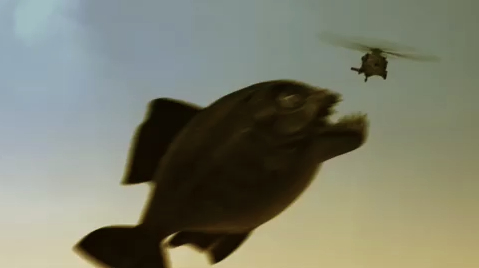
The abomination that is the special effects in this movie deserves a section all its own. Also ala Meg, Forsberg relies completely on CGI for the visuals. No miniatures, no

Oh, yes they did.

animatronics, just cheesy, pixelated images, clumsily bolted over the footage. I don’t hold that a film has to have seamless special effects to be worthwhile, but that shouldn’t be an excuse not to try. And even with a limited budget, a resourceful filmmaker can make decent effects. James Cameron and his crew built only six Alien models for Aliens, but with some creative camera work, they made us believe there were hundreds of them. Similarly, our first ever glimpse of a face-hugger in Alien is simply Ridley Scott’s hands in a pair of gloves. CGI has become an excuse for a lot of wanna-be directors to be lazy. Were model piranhas so hard to come by? Would it have been so hard to use a few five-dollar air hoses to generate the thrashing in the water? Was it so prohibitive to rent one helicopter, instead of the computer-generated blob that we see, then use a split-screen to reproduce it?

Then there’s the editing. Countless times, we see the same footage used over again. At one point, when Fitch’s phone battery dies, Monroe tells him to suck on the battery. We actually watch him do this for close to two minutes.

The stupidities just keep piling up. Once the piranha problem is known, the Venezuelan government actually tries to eradicate the plague by firing lots of missiles into the river. (And you thought W was trigger-happy.) Later, Venezuelan soldiers interrogate a prisoner by smacking him with a phone book. Toward the end, the piranha seem to have not only grown to enormous size, but developed a death wish, as we see them leaping out of the water, and crashing into buildings, resulting in huge explosions! One fish actually impales itself on a light house!

The one thing you can sort-of feel good about in this movie is that nothing was wasted. No good actors poured their talents into a hopeless script. No quality special effects were wasted on a stupid concept. All the components of this movie deserve each other.

There are a couple of lessons we should take away from this. One is that, as we saw in Meg, bigger does not mean scarier. Many things, piranhas included, are scary for their speed, their efficiency, and above all, their invisibility. When they grow to such size that they have to leap out of the water to do anything, and then they explode, it’s stupid, not scary. The other is that incredibly lame monster movies were not limited to the days of the Blacklist. The only thing Mega Piranha has that, say, Invasion of the Saucer-Men didn’t is bad CGI. Hollywood has always spat out tripe, regardless of the political landscape.

As much as I complain about this movie, I have to admit, we had a great time making fun of it. It’s perfect for lampooning. It’s stupid, it’s over the top, there are countless opportunities to insert lines or jokes, and these opportunities are extended by bad editing. And of course, just when you think it can’t possibly ask you to swallow anything more ridiculous than what it already has, it does. From Fitch ninja-kicking a school of piranha back into the river (I’m not kidding) to a school of piranha actually eating an entire destroyer (I’m still not kidding), this is one of those movies you have to see to believe. The one thing that is kind of impressive is how actors say things like “Florida is being attacked by giant fish!” without cracking up. I wonder how many takes they had to do.

[Rating:0/5]

I wanted to include one real mega-piranha, since it’s more interesting than the movie.

Days of Thunder

Days of ThunderTop Gun Days of Thunder, from director Tony Scott, is a pretty decent action/drama movie about a plucky, hotshot fighter jet pilot NASCAR driver, played by Tom Cruise, and his bitter journey to exorcize a few personal demons in the cockpit on the race track while trying to balance a newfound romance with a pretty astrophysicist doctor.  Of course there’s a healthy dose of competition from his frenemy-with-a-clever-nickname Iceman Rowdy, and a healthy dose of high-speed flight race scenes, a crash or two, and enough close calls to have your nails digging into the seat.

Ok, so it’s not the most original movie out there, but Days of Thunder is a perfectly passable by-the-numbers late-80’s dude flick.  Tom Cruise plays our unfortunately-named protagonist Cole Trickle with all the vintage Tom Cruiseness you could hope for.  He knows he’s one of the biggest stars in the world, and from time to time the frame can barely contain the sheer amount of smugness on display.  Filling out the cast is a couple of acting giants–the Obi-Wan Kenobi to Trickle’s Luke Skywalker, Nicole Kidman as the no-way-she’s-old-enough-to-have-completed-med-school doctor, and even some B-listers like Randy Quaid, Cary Elwes, and Fred Thompson.  The movie is kind of a who’s who for movie stars in 1990, and for that reason alone, Days of Thunder is worth watching.

Days of Thunder: Cruise, Kidman

Now that's how you do product placement.

The basic idea here is as predictable as one would expect, and if you’re in doubt even for one moment how things will end up when the credits roll, it’s back to movie-watching-101 for you.  Our hero Trickle (it’s hard to even write that without laughing out loud) starts off as a disgraced race car driver eager to get back in the saddle, while his would-be mentor wants nothing to do with race car driving anymore.  But sure enough, Cruise is soon cruising (get it?  No?  You didn’t watch the trailer, did you?) around NASCAR tracks at 190 mph, dodging tires and sparring with rednecks for the elusive checkered flag.  His old mentor gets on his case for taking too many risks, and–you guessed it–Cruise’s newfound racing career is brought to a sudden halt–a trickle, if you will–when he crashes one too many times and ends up in the hospital along with racing nemesis Rowdy.

Will the two solve their differences?  Will the pretty doctor fall for the crazy scientologist?  Will Robert Duvall ever have a role as good as Tom Hagen?  It’s not rocket science, people.  It’s not even finger painting.  But it is actually a lot of fun.  Watching stock cars zoom around, crash into walls, and explode into tiny bits is a joy to behold, and it’s fun watching these A-Listers overact all the way to the bank.  Tony Scott’s fast-paced overblown directorial style is in full effect here, and as long as there’s a bucket of popcorn and 12-pack of Mello Yello handy there’s really nothing no way not to mindlessly enjoy Days of Thunder.

Rating:[Rating:3.5/5]