In Defense of George Lucas: Why the New Trilogy Matters


This article is in response to Simon’s article Star Wars: Why the Originals Matter (So if you haven’t read that yet, read it first.)

Simon’s article is, as always, well written, and he touches on many of the issues that have inflamed fans for years now. I must, however, do my part to stand up in defense of Mr. Lucas, and the things he and his films (even the less desirable prequels) have accomplished, which were not acknowledged in what was a fairly unflattering assessment of Lucas’ work over the past three decades.

I too consider myself to be an avid Star Wars fan. I’ve loved it since I was a kid, collected all the toys, I teach a unit on Star Wars in my film classes, and I even pre-bought a set of the Star Wars playskool toys for my children. For years I read every Star Wars novel that came out, and considered myself to be an expert of sorts on all matters Star Wars, memorizing pages out of the Star Wars Encyclopedia and dominating at Star Wars Trivial Pursuit. I would consider myself, to a more conservative degree, a “fanboy”. So I acknowledge that there is some bias in my love of Star Wars, but as someone who appreciates film as an industry and an art form, I have nothing but a profound admiration for what George Lucas has accomplished.

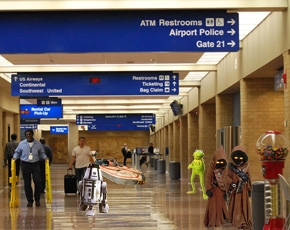
"Mos Epply Airport. You will never find a more wretched hive of scum and muppetry."

I don’t really recall the releases of the original films as part of my childhood, although I know I watched them growing up. Perhaps my first true recollection of a Star Wars-related release was when the original films hit the theatres again in 1997 as part of the “Special Edition” craze. I was thrilled to see Star Wars on the big screen, and to be honest, there were just as many pros as there were cons to the enhancements.  There were the not-so-desirable character alterations, such as the infamous “Han Shot First”, awkward deleted-scene inserts such as the odd-looking Jabba and a badly spliced Han stepping over his tail (to hide the fact that it was actually a fat Scottish guy in a fur coat and not a slithery lizard creature), but there were also some very nice touch-ups of the effects, such as the landspeeder looking like it was actually hovering and not like they smeared Vaseline on the lens, making Mos Eisley look like a bustling spaceport and not Epply Airport in Omaha (which never seems to have more than 50 people in it at a time), or enhancing the Yavin skyline to make it look like it was actually on a foreign moon. Let’s not forget that Lucas did throw the fans a bone by including Boba Fett in the bonus Jabba scene of New Hope (renamed to Episode IV: A New Hope after Lucas got the greenlight to make his sequels, which he wasn’t initially sure would happen). I will not attempt to justify that every change Lucas made was, in my opinion, the best, but these changes were not all bad. Sadly, the hardcore fans seem to focus on the negatives. Like whiney, ungrateful children, we the fanboys never really stop to say thanks to Lucas for all the positive things that he has done, we just complain about that toy we saw in the store and wanted, but didn’t get.

I think the biggest culprit in the disappointment of fans is nostalgia.  We look back on things from our childhood with a fondness and forgiveness that we would never grant to even the best of films from our adult years. Really think about it. I’m an 80s kid, so if I mention shows like Thundercats, Transformers, GIJOE, Teenage Mutant Ninja Turtles, Mask, He-Man, we reminisce about how TV just isn’t the same, and we had “quality” shows back in our day.  I don’t know if you’ve managed to track down any episodes of those old shows and watch them, but some of them were pretty horrible in terms of the writing and animation. Heck, most of them existed solely to sell toys – another argument fans throw in the face of new Star Wars properties. The fact is, we get so caught up in the fuzzy glow of our childhood memories, that we selectively omit the negative aspects and zero in on the positives. Simon acknowledges the technical limitations in Star Wars, and points out that they add to the charm of the original films, which they do, but ultimately if you can fix those little flaws to polish up the film for today’s standards… why wouldn’t you? To Lucas’ credit, he didn’t do a complete gut-job, he left representations of the original work while putting some polish here and there. The industry isn’t disavowing all knowledge of the original contributions, but at the same time, they’re not going to make the next Transformers movie using tauntaun-style stop motion.

To a degree, nostalgic blinders put a jaded slant on the new Star Wars films. The writing was just as bad in the originals, the effects were worse (although still groundbreaking at the time), heck even the titles were just as cheesy and blunt in their descriptions. (“The Empire Strikes Back” and “Attack of the Clones” are about the same in caliber.) If anything, I’d say the saving grace on the writing in the originals was that the actors were better at turning Lucas’ words into something more believable. Irvin Kershner tells the story of how in ESB as they’re about to lower Han into the carbonite chamber, Leia says “I love you” and Han was originally supposed to say “I love you too”. Thankfully with it being someone other than Lucas as director, he was able to say “Harrison, this isn’t working. Don’t think, just say what comes naturally” and we got the classic we response we all know and love: LEIA: “I love you”, HAN: “I know.”

On the point of Lucas as a director, I have to agree with Simon that he is not the strongest at directing.  His actors always comment that he has a hard time communicating with them to get the performance he wants.  As a director and actor, I can tell you, at the end of the day, if your director isn’t helping give you a direction on your character, the performance will ultimately suffer.

I also agree with Simon that the original Star Wars films succeeded because they were a collection of many individuals’ artistic contributions. To a degree, Lucas’ complete control over everything in his films doesn’t put in that system of checks and balances he had on the original films – between the studio execs having input, his wife, fellow film makers, etc. (Probably the best moments of Episode III came from Lucas’ collaboration with Spielberg on the Obi-wan Anakin fight.) But even the special effects guru behind the original films, John Dykstra, praised Lucas’ tweaking of the originals, even though it essentially erased some of his own work. I like to think of it in this regard – yes these effects were pioneering at the time, but if we stuck with that mentality, we’d all still be driving westward on covered wagons.

Outside of Pixar, which sprang out of a development at Lucasfilm, all of these companies were started by George Lucas in the past 35 years.

But perhaps my biggest disagreement with Simon, and the reason I felt compelled to shed some positive light on Lucas’ work, is Simon’s belief that Lucas has simply “wallowed in mediocrity” since the original Star Wars films were released.  Although it is true that Lucas has not directed more than a handful of films (and I think we agree that it’s better when he leaves his work in the hands of more capable directors), Lucas has worked non-stop at literally redefining the industry of film as we know it. George Lucas the film student/startup director ceased to exist after the release of the original Star Wars, and since has become George Lucas of Lucasfilm, Lucasarts, THX, Industrial Light and Magic (ILM), and Skywalker Sound. Through these subsidiary companies, George Lucas has essentially built the modern filmmaking, animation, and even video game environment.

Through his guidance, these companies developed SoundDroid one of the first audio mixing/editing stations and EditDroid an early computerized non-linear editing system. Let’s not forget that under his watch Lucasfilm developed the PIXAR animation computer, which was eventually sold off and developed into the PIXAR animation company we know and love. Edutopia is an online resource which provides educational computer resources for educators and students alike, and Lucasarts created some of the most beloved games (even non-Star Wars games) of my youth. In the 80s and 90s Lucas continued to develop ILM and Skywalker Sound to provide state-of-the-art film creation facilities for film makers from all over the world. Skywalker Sound has 568 credited films to its credit, and ILM over 300. One might argue that technology companies would have figured out how to do these things on their own, but I contend that it takes a film maker to say “This is what I would want, this is what would help me make a better movie.” It was through this approach that ILM developed the stunning and groundbreaking CGI work that went into Jurassic Park which was developed hand-in-hand with the visual effects tweaking on the Special Edition release of Star Wars.

JAR JAR: "Heya, Gollum! Me-sa you-sa father!" FANBOYS: "Noooo! That's not true... that's impossible!"

And let’s not forget the new trilogy. Often despised by adult fans for being “not as good as the originals”, but generally enjoyed by children of this generation, these films pioneered the digital film making era we’re experiencing today. Admittedly I think the new trilogy films lost their way trying to fill in gaps and appease a rabid fan-base that had been salivating for 15 years for something new, but they were not without their merits. Attack of the Clones was the first film shot entirely using digital cameras, a practice which is becoming more and more the norm.  The continued development of seamless CGI character integration and motion capture technology (yes even Jar Jar served a purpose) paved the way for film makers like Peter Jackson and James Cameron to take the next step and develop technology seen in films like the Lord of the Rings trilogy and Avatar.

The list of Lucas’ accomplishments and contributions goes on and on.  George Lucas succeeded where almost no other film maker has.  He broke away from a system which had established itself as the only way to make films – driven primarily by the almighty dollar without much care for artistic expression – and created his own empire, where he was empowered to make films the way he wanted, and improve the climate for other directors who otherwise would not be able to afford that luxury. Although even Lucas himself acknowledges the irony and parallel in his story to that of Vader – he started out fighting against the empire, and in the end became the very thing he sought to destroy.

His vision and direction of his companies has ushered in a new era of film making, and he continues to strive toward new advances with each new project. Right now Lucasfilm is developing a live-action Star Wars TV series, but in order to make it become a reality, his companies are working to improve the way CGI is produced so that it becomes cheaper and more feasible on a faster time frame. This would open the door for more advanced CGI in television series – think Heroes, only where they actually had the budget and time to do loads of cool super-powered effects every week.

And we cannot overlook the simple power of these films to inspire people.  Not simply from their entertainment value and the artificial realities they encourage us to act out as children – otherwise Simon and I would still be in our back yards practicing our lightsaber skills – but to seek out methods of creative expression, be it film, art, theatre, music, or even an articulate debate over another man’s work.  I would even contend that the negative changes have inspired people to try their hand at creating something “better”. Star Wars fan films have blossomed from simple rotoscoped light saber fights, to 2-hour epics with fully developed CGI effects.

Ultimately Star Wars is George Lucas’ creation, it’s his world, and we are fortunate enough to experience it. My high school drama teacher ran into George Lucas in London a few years back. I often think of what I would have done in that situation or what I would have said. My teacher came up with something I think was absolutely perfect, he said “Thank you for your work, Mr. Lucas.”  If you don’t like the re-re-re-releases with enhanced this-and-that and want so desperately to cling to your childhood nostalgia, stick with the original theatrical releases on DVD. The fact is, our kids will love them regardless of what’s original and what isn’t. My film students never even notice the changes unless I point them out.

Lucas didn’t have to re-release the original, non-enhanced films, but he did – which is a big consolation. Think what would happen if you wrote an article, revised it, and the revision was published. Now what would happen if the people demanded you publish your first draft, which you know was full of typos and poorly worded points? Wouldn’t you resist turning out something you didn’t feel was your best work? Ultimately the Star Wars films are Lucas’ baby, and we should all be so lucky to be able to revise our work into something we can be 100% content with.  Eventually he will have to let the originals go (probably when he finally dies) but that is his prerogative. As for the man’s work, we are extremely fortunate that George Lucas did not simply “wallow in mediocrity” for the past 30 years, or we’d be looking at a very different cinematic landscape right now.

In short, I get you, George Lucas. God bless you, and keep on doing what you’ve been doing.

P.S. I eagerly await your new film Red Tails.

VN:F [1.9.13_1145]
Have you seen this movie? Rate it!
Rating: 3.0/5 (1 vote cast)
4 COMMENTS

Star Wars: Why the Originals Matter


star-wars-original-poster

The poster for the original Star Wars. Note the absence of the subtitle "A New Hope," the first of many additions Lucas would make in subsequent years.

I can’t pinpoint the time when I first saw Star Wars, but I think I have a fairly good idea.  I was born in 1980, three years after Star Wars was released, and while I was growing up I had no concept of Jedis, the Force, Darth Vader, or X-Wing fighters.  But somewhere along the line, perhaps around the mid-1980s, my parents rented a VCR and let us stay up late to watch George Lucas’ masterpiece.  From the moment John Williams’ score poured from our 19-inch TV’s single three-inch speaker I was hooked.  I watched with bated breath as R2D2 and C-3PO evaded capture and flew an escape pod to Tatooine. I marveled as Luke Skywalker handled his first light saber, my mind reeling with the possibilities such a weapon offered. And when the X-Wing fighters took to the trench in the film’s climactic battle, I gaped at the screen, mesmerized and completely, utterly hooked.

The technical details mattered not to my six-year-old brain.  The monaural soundtrack, the obvious puppeteering, the poor quality matte lines…those didn’t even register.  What kept my mind spinning for days and weeks was the incredibly story of a young boy who grew up to realize his destiny, his friends who never abandoned him even in the face of great danger, and the haunting, chilling sound of Darth Vader’s mask.  Rooted deep within the story, at some primal level, were the basic elements of mythology that humans have used to tell stories for generations without end, and in our living room more than two decades ago they connected with me too.

Soon after that we rented Empire Strikes Back and Return of the Jedi, and I was absolutely thrilled to be able to continue the journey of Luke Skywalker and his friends.  My brothers and I used sticks in the back yard to pretend we were Jedis.  I delivered newspapers on my bike pretending I was on a speeder bike evading scout troopers and dodging trees.  On cold walks to school I would make believe I was looking for a tauntaun I could ride instead.  The entire universe captivated me, despite the fact that it was riddled with technical glitches, chroma-key matte lines, and obvious modelwork and puppetry.  All that is beside the point, because as George Lucas himself said, special effects are just a tool, a means of telling a story, and it’s the story itself that matters.

And it’s the story itself that endures.

With the release of the Special Editions in 1997, George Lucas began what would be a seemingly endless journey of tinkering, tweaking, altering, and even polishing his original trilogy.  He has stated that his original movies were only 25 to 30 percent of what he wanted them to be, largely due to technical limitations.  The changes he has since made, from the mundane (cleaning up the colors of the lightsabre duels) to the horrifying (Greedo shooting first) continually eroded not only fans’ appreciation for the newer editions, but their respect and admiration for Mr. Lucas himself.  All this tinkering has been well documented, and will not be explored in depth here, but suffice it to say the version of the classic trilogy that hit store shelves recently is, in many ways, a shadow of its original counterpart.

The originals weren’t perfect by any means, and compared to today’s cinematic productions with 1080p and 4K resolutions, 7.1 sound, and 3D effects, they do show their age more than a little bit.  But, and this is the part of the argument that seems to escape Mr. Lucas, that is precisely the point.  Star Wars broke new ground in so many ways, and advanced cinema in so many unprecedented directions, that to essentially deny the validity of the originals is akin to robbing popular culture of one of its most enduring treasures.

Consider the man behind all this for a moment: George Lucas.  Thirty years ago he was a kid fresh out of film school with an epic story to tell and enough tenacity to actually pull it off despite massive obstacles facing nearly every element of the production.  However, ever since his success with the original Star Wars (not subtitled “A New Hope” until long after its initial theatrical run), Mr. Lucas has, for all his notoriety, wallowed in mediocrity.  To this date, a scant half-dozen films comprise his entire directorial resume:

George Lucas Han Shot First

George Lucas on the set of Indiana Jones and the Kingdom of the Crystal Skull, wearing a t-shirt with a graphic that says "Han Shot First."

THX-1138

American Grafitti

Star Wars

Star Wars: Episode I – The Phantom Menace

Star Wars: Episode II – The Clone Wars

Star Wars: Episode III – Revenge of the Sith

And that’s it.  Consider, then, the laundry list of films directed by Steven Spielberg, one of Lucas’ contemporaries whose films like Raiders of the Lost Ark and E.T. have had a similar impact on the cultural zeitgeist.  While Lucas had a gap of more than twenty years between directing the original Star Wars and The Phantom Menace, Spielberg was busy making dozens of films and refining his craft, and currently has four films in various stages of production.  So what was Lucas doing that whole time? Nearly every project he was involved in after 1977 bears the words “Star Wars” or “Indiana Jones,” a film which he was, admittedly, very influential in creating.  Stymied by his own myopic vision, or perhaps simply too scared to venture out with other projects, Lucas has seen fit instead to tinker with his original creations rather than branch out into new areas of science fiction and storytelling.  Not every film made by Spielberg, Martin Scorcese, James Cameron, Christopher Nolan, or other influential Hollywood personalities, is a success.  Even the greatest artists sometimes fail, which in its own way an integral part of success.  But George Lucas has never experienced failure, thanks to his refusal to exit the comfortable confines of his Star Wars universe and try something new.  Instead, he is content to meddle with Star Wars, babbling on about his “original vision” and adding pointless things like additional rocks and blinking ewok eyes to films that, for years, have stood entirely on their own without enhanced color grading or CGI dewbacks. Notice also two curious omissions from the aforementioned list: The Empire Strikes Back (which Lucas actually said was the worst in the series) and Return of the Jedi. These films were borne from Lucas’ original creation, but he did not actually direct them. Instead, he wisely left that task to men who understood conventions like dramatic tension, character arcs, and (gasp!) good dialogue.  Even the original Star Wars owes a great deal of its success not to Lucas, but his wife Marcia, who edited the film and in many ways helped her husband guide its direction (it was her idea to kill Ben Kenobi, an idea which Lucas initially resisted).

X-Wing Approach

In the originals, shots like this were the culmination of cutting-edge motion control and compositing. In the Special Edition, they were replaced with CGI, effectively erasing some of ILM's most pioneering work.

In other words, George Lucas may have been the guy with the idea, but Star Wars owes its enduring popularity to a host of individuals. And yet it is Lucas who has decided not to leave well enough alone and revise the very objects of art which catapulted him to fame and fortune.  Star Wars is not simply his vision. It was the product of many committed individuals who poured their heart and souls into the films. And with the release of the Blu-Rays, the original trilogy has been, in many ways, marred beyond recognition so as to effectively snuff out out the contributions of the many individuals who helped bring them to fruition.  The special effects might have been cheesy, the colors less than perfect, and the sound a humble stereo mix, but these are what made the films great.

Of course Lucas is free to alter the films if he so chooses.  He owns the copyright, and he can take his fancy ball and go to another playground if he wants to–even if no one else is there to play with him.  But it was the original trilogy that changed how movies were made. It was the original  trilogy that defined special effects for the next 30 years. It was the original trilogy that created legions of devoted fans around the world.  And it was the original trilogy that entranced a generation and made them believe that each and every one of them had the power to do something special, to stretch their wings and fly.  Lucas can update his films with newer gee-whiz computer graphics and add floor-rumbling surround sound, but to deny future generations of moviegoers the opportunity to see the original films as they actually existed, regardless of his somewhat specious claims regarding his original vision, is like denying a grandmother the opportunity to hold her grandchild.

Of course the originals on VHS and Laserdisc can still be tracked down by dedicated fans, and in 2006 Lucasfilm even released a DVD set of the Special Editions that included a bonus disc with the original version of each film (infuriatingly presented in non-anamorphic widescreen, almost as if Lucas was just goading legions of fans clamoring for his original creations). But Lucas has since essentially abandoned the originals, tossing them to the curb and dismissing them as mere rough drafts. What he fails to realize is that those “rough drafts” are precisely what put him in the position he is in today. And it is those “rough drafts” that will be celebrated for years to come, not despite their imperfections but because of them.

The People vs George Lucas

In The People vs. George Lucas, filmmaker Alexandre O. Philippe documents the love/hate relationship Star Wars fans have with George Lucas.

And so remains the question: what is to be done? In a sense, the best chance to make sure these films are not relegated to the celluloid dustbin is to keep the feedback coming. SaveStarWars.com has an incredible FAQ that answers a host of questions regarding the original trilogy (and debunks some of the common myths, such as Lucas’ own statement that it would be too expensive to restore the originals) and contains myriad resources for fans to take action.  But by far the most influential method for changing Lucas’ mind is simply affecting his pocketbook.  Each time he releases newer altered versions of his films, they are purchased by fans all around the world (the Blu Rays recently broke all kinds of sales records)–many of them torn between keeping the original films alive while also delighting in seeing them gussied up with all of today’s home theater wizadry.  And the films will soon be back in theaters with a full 3D treatment and, presumably, even more changes to fit Lucas’ ever-changing “original vision,” with a 3D Blu-Ray release years down the line virtually a foregone conclusion.

Imagine if George Lucas threw a party and nobody came.  Imagine if his 3D Star Wars films bombed at the box office, and if the blu-ray sales fell like a dead tauntaun.  Would he finally listen to the fans and release the original versions? I’m thinking he would.

The fact of the matter is, there’s room in Star Wars fans’ hearts for all kinds of versions.  He can release all the HD/3D/Special Editions he wants, just as long as he releases the originals too.  And not a cheesy laserdisc transfer from 1993 either.  If Star Wars was big before, just imagine the sales figures of this hypothetical boxed set.

In the meantime, there’s plenty of resources for fans to keep the originals alive for generations to come.  And as for me, my son who will one day be old enough to watch Star Wars. One day I’ll pull out my 2006 DVD versions, skip to Disc 2, and let his imagination be caught up in the adventures of Luke Skywalker, Han Solo, Princess Leia, Yoda, and all the rest.  If I have my way, he will only know the originals–the ones with the poor-quality matte lines (“That’s how they used to make movies, son.”) and bad lightsaber visuals (“They didn’t have computer graphics back then…”).  I’m sure some day he’ll ask about the prequels or the Special Editions and maybe we’ll even watch those too, but the Star Wars he grows up will be the same as the one that millions of fans around the world grew up with–one in which Mos Eisley is not a wretched hive of CGI distractions, the Max Rebo band is not a gaggle if cartoon muppets, and Han always, always shoots first.

VN:F [1.9.13_1145]
Have you seen this movie? Rate it!
Rating: 0.0/5 (0 votes cast)
2 COMMENTS

Howard the Duck (Video Review)


Fresh off of the Academy Awards, I thought I would go in the opposite direction for a little bit and review one of the worst movies I have seen in a long time, the 1986 George Lucas travesty Howard the Duck.

Rating:

VN:F [1.9.13_1145]
Have you seen this movie? Rate it!
Rating: 1.0/5 (3 votes cast)
3 COMMENTS