Star Trek VI: The Undiscovered Country

Star Trek VIThe first episode of the venerable Star Trek sci-fi series was aired on September 22, 1966, and spawned an entertainment tour de force that, despite some rocky times in syndication and various states of cancellation, continues to chug along even today more than 30 years later.  But with the passing of time, the weathering of the starship Enterprise, and the graying of its crew, the original series that started as a gleam in Gene Roddenberry’s eye graced the silver screen for the last time 25 years after it began.  Even though Undiscovered Country is the sixth movie in the sci-fi franchise, it stands tall as one of the best and still holds its own against its spry, modern, younger successors.

In a bit of a twist from previous films, Sulu is never seen together with the rest of the Enterprise crew.  Instead, from the outset of the film, he is in command of his own ship The Excelsior (Note to William Riker: this is called career advancement).  Off exploring space as usual, his ship encounters a gigantic energy surge resulting from an energy explosion on the Klingon moon Praxis which was, as near as I can tell, basically a gigantic Klingon Power Plant.  In a brilliant twist on typical Star Trek lore, the mighty Klingon race is forced to come to the Federation for aid lest they go extinct as a species in less than five decades.  Kirk is then put in the awkward position of playing would-be ambassador to the Klingon high council, an incredibly uncomfortable diplomatic role considering that his son was murdered at the hands of Klingons.  It’s this type of juxtaposition that is the hallmark of Star Trek and all good science fiction, and further propels Undiscovered Country into the upper echelons of Star Trek movies.

Star Trek VI Cast

The gang's all here

The phrase “Action-Packed” has never been apt for Star Trek, save for the notable exception of First Contact, but it wouldn’t be far off the mark here.  After the abysmal Final Frontier, and knowing that this film would be the series’ swan song, director Nicholas Meyer (who also helmed the brilliant Wrath of Khan) ratchets up the intensity on all fronts.  From the uncomfortable dinner scene aboard the Enterprise, where the Klingons and Enterprise crewmen can barely contain their disdain for each other while General Chang (Christopher Plummer) and Kirk try to out-Shakespeare-quote each other, to the amazing courtroom scene (“Don’t wait for the translation!”) to the final showdown between the Enteprise and a Klingon bird of prey, Undiscovered Country is about as intense as they come.  There’s also a bit of mystery, treachery, backstabbing, and old-fashioned fisticuffs thrown in for good measure.  It all comes together quite well, despite a few missteps here and there such as the over-the-top climax which is far too abrupt and logic-defying to go over with much satisfaction.  Believe it or not, even the visual effects are far from terrible, though still mired in typical Star Trek cheese.  Couldn’t they find decent model builders by now?

Star Trek VI Courtroom

The Klingon judicial system: a model of legal efficiency.

Unfortunately what gets sacrificed here, as with some of the other movies, are the characters.  Most of Kirk’s intrepid crew is reduced to goggle-eyed stares at the viewscreen or groan-worthy one-liners.  The story here is about Kirk, and to a lesser degree, Bones and Spock, and unlike Voyage Home no one else is given any significant contributions to the story.  It’s an unfitting sendoff for Sulu, Uhura, and of course Scotty, but given the high quality of the movie as a whole these character missteps are somewhat forgivable.

Few movie series ever make it to their sixth iteration, and those that do are mostly content to cash in on trends, following the same regurgitated storylines all the way to the bank. But rather than churn out a halfway decent film destined for the VHS bargain bin, Meyer and his crew gave Undiscovered Country all they had and put effort into crafting a work that respects the source material while offering an incredibly pleasing finale to the journey begun by Gene Roddenberry more than three decades earlier.

Rating:[Rating:4.5/5]
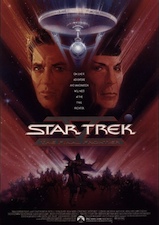
Star Trek V: The Final Frontier

Star Trek V: The Final FrontierThe Star Trek movie franchise is one of the most inconsistent string of films in existence. While some franchises are either mostly good or mostly terrible, the Star Trek movies swing like a pendulum from amazing to awful.  Conventional wisdom among Trekkies states that every other film is good, and my experience pretty much verifies this.  The first one in the franchise spends well over two hours chasing Kubrick’s coattails and ends up being a mess of heavyhanded philosophizing, but its sequel, Wrath of Khan, is considered one of the greatest science fiction movies of all time.  And so the pendulum swing begins, with Search for Spock floundering while Voyage Home soars.  The pattern being established, then, things don’t look good for Final Frontier from the get-go, even though it’s directed by William Shatner.  If anyone can do justice to a Star Trek film, it’s Captain Kirk, right?  Unfortunately, the pattern holds true: Final Frontier is a poorly written, haphazardly directed, logic-defying science fiction disaster.

Things begin with a bit of promise, as all the trappings of classic science fiction are present and accounted for:  Mysterious Distant Planet? Check. Strange aliens? Check. Hints at a violent struggle–a system to be overthrown–and an allegorical savior figure, check.  We then meet our intrepid Captain James Kirk (affably played, as always, by the great William Shatner), free-climbing mountains in Yosemite with all the fervor a post-middle-aged guy can muster, and soon find and his pal Bones (DeForest Kelley) him teaching Spock (Leonard Nimoy) how to sing Row, Row, Row Your Boat around a campfire.  It’s a tad endearing, and all in all not a bad start for the film.

Star Trek V: Go Climb a Rock

Good advice, Shatner...

It’s not long before things spiral hopelessly out of control, with Starfleet sending Kirk and his aging crew off to the aforementioned Distant Planet to figure out what is going on with Sybok, the man who has taken over the only settlement on the planet.  Why Starfleet would send Kirk on a dangerous mission with a brand new Enterprise that is clearly not ready for a trip around the block, much less across the galaxy, is the first of many such asteroid-sized plot holes in the movie that is just too big to overlook.  Sybok, no doubt cribbing from a few self-help books, persuades all of Kirk’s loyal companions to follow him and turn against their fearless captain.  With the flip of a couple switches, the Enterprise gallivants off to the mythical Great Barrier at the center of the galaxy all because Sybok thinks he will get to have tea with the Almighty. Turns out the mythical Great Barrier is a) about five minutes away, and b) about as impenetrable as a kleenex, meaning Sybok and company sail right through as easily as if they were heading off to Risa for a cup of earl gray.

The final showdown with God has all the drama of a middle school play, but it does give Shatner a chance to ask one of the great questions that has plagued mankind since the dawn of time:

Meantime, those darn Klingons keep causing trouble (wouldn’t you if Kirk had blown up your starship two movies earlier?), and the fabled Enterprise crew is reduced to uttering one-line expositions while staring blankly at the bridge viewscreen.  The movie is an exercise in futility, and the special effects are as cheesy as a jar of Velveeta (though to be fair, this wasn’t entirely Shatner’s fault).  Even though a few lighthearted and genuinely entertaining bits are scattered here and there, it’s like having to sidestep piles of horse manure to pick up some candy at a parade.  As Kirk and his bros enter into a reprise “Row Row Row Your Boat” to close out the film, the best we can do is wish that the film would have also been left ‘but a dream.

Rating:[Rating:1/5]

Days of Thunder

Days of ThunderTop Gun Days of Thunder, from director Tony Scott, is a pretty decent action/drama movie about a plucky, hotshot fighter jet pilot NASCAR driver, played by Tom Cruise, and his bitter journey to exorcize a few personal demons in the cockpit on the race track while trying to balance a newfound romance with a pretty astrophysicist doctor.  Of course there’s a healthy dose of competition from his frenemy-with-a-clever-nickname Iceman Rowdy, and a healthy dose of high-speed flight race scenes, a crash or two, and enough close calls to have your nails digging into the seat.

Ok, so it’s not the most original movie out there, but Days of Thunder is a perfectly passable by-the-numbers late-80’s dude flick.  Tom Cruise plays our unfortunately-named protagonist Cole Trickle with all the vintage Tom Cruiseness you could hope for.  He knows he’s one of the biggest stars in the world, and from time to time the frame can barely contain the sheer amount of smugness on display.  Filling out the cast is a couple of acting giants–the Obi-Wan Kenobi to Trickle’s Luke Skywalker, Nicole Kidman as the no-way-she’s-old-enough-to-have-completed-med-school doctor, and even some B-listers like Randy Quaid, Cary Elwes, and Fred Thompson.  The movie is kind of a who’s who for movie stars in 1990, and for that reason alone, Days of Thunder is worth watching.

Days of Thunder: Cruise, Kidman

Now that's how you do product placement.

The basic idea here is as predictable as one would expect, and if you’re in doubt even for one moment how things will end up when the credits roll, it’s back to movie-watching-101 for you.  Our hero Trickle (it’s hard to even write that without laughing out loud) starts off as a disgraced race car driver eager to get back in the saddle, while his would-be mentor wants nothing to do with race car driving anymore.  But sure enough, Cruise is soon cruising (get it?  No?  You didn’t watch the trailer, did you?) around NASCAR tracks at 190 mph, dodging tires and sparring with rednecks for the elusive checkered flag.  His old mentor gets on his case for taking too many risks, and–you guessed it–Cruise’s newfound racing career is brought to a sudden halt–a trickle, if you will–when he crashes one too many times and ends up in the hospital along with racing nemesis Rowdy.

Will the two solve their differences?  Will the pretty doctor fall for the crazy scientologist?  Will Robert Duvall ever have a role as good as Tom Hagen?  It’s not rocket science, people.  It’s not even finger painting.  But it is actually a lot of fun.  Watching stock cars zoom around, crash into walls, and explode into tiny bits is a joy to behold, and it’s fun watching these A-Listers overact all the way to the bank.  Tony Scott’s fast-paced overblown directorial style is in full effect here, and as long as there’s a bucket of popcorn and 12-pack of Mello Yello handy there’s really nothing no way not to mindlessly enjoy Days of Thunder.

Rating:[Rating:3.5/5]

Prince of Persia: The Sands of Time

I love a good time-travel story.  From the Terminator films, Back to the Future series, and ripping yarns like the 2000  film Frequency, there is something alluring and exciting about the past and future colliding.  Even the recent Star Trek reboot found a few wormholes.  Time travel will always come across in film as a tricky contradicting device full of paradoxes.  In Prince of Persia, the film bases its premise on the possibility that time travel and its power may fall into the wrong hands (as all films of this sort do), but it presents time travel in a limited arrangement.

The plot introduces the Persian empire at the height of its power.  Its king is paraded through the streets where he comes across a defiant young boy who seeks to protect another young man from punishment as a result of thievery.  In fact, it feels very similar to a live-action version of Disney’s Aladdin.  This protective boy, Dastan, stirs up the king’s heart, and the orphaned boy is taken into the royal family as a young prince.  Later on he grows up to become the adult Jake Gyllenhaal, bulked up with flowing dark hair and bronzed skin attributed to multiple trips to the tanning salon.  He is a trained warrior, and trusted commander in the nation’s army.  Dastan’s royal brothers are set to capture the peaceful city of  Almut.  Though Dastan’s skills as a fighter are commendable among his siblings, they feel he is not ready for such a massive attack.  To prove himself worthy, Dastan scaffolds the wall of Almut and lays siege to the city, leading a small band of soldiers to victory before the royal brothers arrive.  Dastan becomes a hero, and as such, takes a handsome dagger from Almut—one with mystical powers. 

During a celebration, the ceremony is interrupted when a prestigious cloak, laced with an acidic poison, is offered to the king and kills him very quickly.  Dastan, having been asked to offer the cloak before the ceremony, appears to be the traitor with the intent of taking the throne.  Quickly afoot from his own people, Dastan escapes with a princess of Almut, Tamina (Gemma Arterton) captured shortly following the attack.  Tamina’s sole interest is in protecting the dagger Dastan carries and returning it, as it has the power to rewind a minute (or roughly so) in time.  It soon becomes apparent to Dastan that someone, most likely his eldest brother, must have been after the dagger for its power.  The story eventually expands the power of the dagger in revealing an underground stone ruled by the gods that can ultimately lead to a total reversal of history and mankind’s complete destruction.  What else is new?

Caught in this storm of chaos, Dastan seeks out his uncle (Ben Kingsley), the only man he can trust to clear his name and restore order in the kingdom, as well as return the dagger to safety.

Regarding the dagger and its power, I love how the story has found a way to eliminate the paradox of time travel.  The dagger holds a button on it, that if pressed with the proper sand in it (dopey, I know), simply rewinds time back about a minute.  Only the holder of the dagger knows that any change has taken place.  So in essence, there really isn’t any traveling in time—time is simply rewinding itself, and this is the limit of the dagger.  I like the premise, and the limited power there.  But of course the premise takes things to a new level once man’s history is revealed.  The gods apparently had wiped out all of humanity but one young girl who pleaded to live and was granted her survival.  She was given this dagger of power and it has been kept in secret… blah, blah, blah.  The narrative makes a huge leap to potential world annihalation, and once this happens, the story gets incredibly sloppy and stitched together, when it could have stuck to this dagger’s original limit of power.  I’m sure that would have been more enjoyable.

Prince of Persia is based on a video game series I haven’t played, nor ever will I’m sure.  And of course, this coulda-shoulda-woulda blockbuster film from Producer Jerry Bruckheimer (hoping so desperately to turn this into a Pirates of the Caribbean franchise) delivers a very expensive product.  You can see it onscreen, even if a few of the digital shots look a little hammy.  With a lot opportunity here, the film turns to silliness to try and exact the charm of that Johnny Depp adventure.  The problem is that Gyllenhaal is no Depp.  And as much leaping and jumping around as Gyllenhaal’s stuntmen do, as muscle-bound as the actor has become, it doesn’t bring natural charisma or wit to his performance as a side effect. 

The story doesn’t help Gyllenhaal’s cause.  Pirates was silly, yes, but the characters carried the plot.  Once Prince of Persia evolves into a history lesson on the gods’ wiping out humanity, and their intent on doing so again if the dagger is misused, I felt the story crumbling in on itself, as if I could see the writers in the background trying to staple ideas together.  Ultimately, the film gets too big, too silly, and too careless for any of its original ambitions to prevail, and the filmmakers should have realized that a mammoth production wouldn’t sell itself.  Pirates of the Caribbean certainly didn’t.  Bruckheimer had his ace in the hole after all was said and done—Johnny Depp making an icon out of Jack Sparrow.  Unfortunately he failed to repeat that process.  While Persia still isn’t quite the mess that the third Pirates film became, it’s still about as silly and unpolished.  As a marginally enjoyable big-budget diversion, I found this film to be watchable, but I can’t heartily recommend it.

[Rating:2.5/5]

Lord, Save Us from Your Followers

It's hard to take a documentary seriously when it's billed as "Michael Moore-meets-Monty Python."In this age of digital movie making, instant YouTube publishing, and homebrew editing software that anyone can use, I’m starting to wonder just what qualifies a work of film as a documentary.  In the classic sense, a documentary should investigate a subject in the hope of arriving at some type of conclusion.  And if no conclusion can be found, then at least the documentary should unearth facts, viewpoints, or ways of thinking that are generally missing from the public consciousness.  But when anyone can pick up a camera and start filming, the brute force research and legwork required to produce a quality piece of work is often missing at the expense of graphical flair and story narrative.  Even though Lord, Save Us from Your Followers is an interesting look at faith in America today, it doesn’t function well as an actual documentary on the subject.  In the end it is more of a video-blog of one man’s journey to some sort of spiritual enlightenment or resolution.  An entertaining and at times touching video blog, but nonetheless, it would be hard to draw any meaningful conclusions about religion, or specifically Christianity, after watching this film.

The idea, as director/narrator/star Dan Merchant tells us, is to find out why Jesus’ gospel of peace has resulted in such extreme viewpoints in our country.  Fred Phelps, Pat Robertson, Jerry Falwell, David Koresh, James Dobson…all have espoused a particular brand of Christianity, but all are fairly divisive when expressing their viewpoints or political opinions.  How can this be, asks Merchant, and how can we rectify the Culture War that supposedly exists in our society today?  His solution is to dress up in a white jumpsuit with all manner of religious extremist bumper stickers and paraphenalia, cobble together a camera crew, and interview people on the street about what they think of Jesus, Christians, and Christianity.

Lord Save Us from Your Followers - Dan Merchant

Dan Merchant, stirring the melting pot.

His results are about what one would expect–some people think Christians are mean-spirited, others think they are kind and loving.  Some think Jesus was the son of God who died for our sins, and others think he was more along the lines of a troubadour with an impressive array of parlor tricks at his disposal.  Also chiming in are Al Franken, Michael Reagan, Rick Santorum, and other prominent figures in American politics and media, each with a position on the issue or at least a personal story to tell.  Excerpts from speeches by Presidents Bush and Obama, as well as prominent media figures like Jon Stewart and Bono, also add some good perspective into the mix as well.

The most interesting, and ultimately effective, segments are when Merchant talks to  secular radio host Shelia Hamilton in Portland, Oregon, about her station’s involvement with the Christian relief organization World Vision, his exploration of the Christian response during the aftermath of hurricane Katrina, and his time spent with Night Strike, a ministry that serves homeless people in Portland.  In each of these instances he discovers that, despite the politicking of some outspoken leaders in the Christian community, the ground-level view held by many in the secular world is that Christians are nice, decent folks who are willing to lend a helping hand or two when the going gets tough.  It’s these bits that are comforting and reassuring, and help dissipate the pharisaical air of so many national Christian figures.

Lord Save Us from Your Followers - Sister Mary Timothy

Sister Mary Timothy, who has a less-than-positive opinion of most Christians...

Unfortunately, for every morsel of genuine insight in this movie there are a dozen flashy gimmicks and Michael Moore-style empty-headed stunts that do nothing except to draw attention and generate a few laughs or crocodile tears.  A few statistics are thrown out here and there, like the fact that 9 out of 10 individuals in America profess a belief in God, but a cheesy Family Feud-style game show pitting Christians against Atheists sheds light on nothing and only serves as a distraction from the main argument of the film.  Anecdotal evidence, gleaned from dudes on the street or interviews with mid-level politicians, should never be confused with actual research.  But actual research is rarely flashy and, darn it, just takes so much time.

A large segment near the end of the film is dedicated specifically to the mainstream Christian treatment of the gay community–or at least the perception of mainstream Christians by a handful of gays and lesbians.  In a bit that seems oddly self-serving, Merchant sets up a fake reverse confessional at a gay and lesbian festival in Portland, and invites people to hear his confessions and apologies on behalf of all Christians and their treatment of the GLBT community.  Discounting all serious theological arguments that many decent, level-headed Christians have to the GLBT lifestyle, Merchant sanctimoniously offers his apologies to the gay community and promises to offer love and support rather than condemnation and ridicule.  It’s the kind of stunt that might generate a few DVD sales, much like Michael Moore driving around Washington D.C. with a megaphone, but ignores the deeply-held convictions of many individuals on both sides of the fence.  Editorializing should have no place in a documentary, but sadly, it is far too often on bold display here.

The film does serve as a somewhat compelling wake-up call for Christians who might need to swallow a taste of their own medicine from time to time.  It is certainly worth watching, and should be required viewing for Sunday School classes (if for no reason other than to generate a discussion), so long as it is accompanied by a healthy-sized grain of salt.

Rating:[Rating:3/5]

Die Hard with a Vengeance

Die Hard with a Vengeance Having essentially re-invented the loose cannon archetype for a new generation with John McClane (the character Bruce Willis was born to play) in the original Die Hard, McTiernan returns to the franchise to direct its second sequel and in doing so injects a whole new meaning to the phrase “over the top”.  After a string of middling successes following his early breakout triumphs of Die Hard and Predator, McTiernan went back to basics with the cop-versus-terrorists approach that worked so well seven years earlier.  And what a trip is is.  Vengeance is the most outlandish film in the series, and an experience that continues to up the tension and excitement with each act right up to the climactic Canadian finish.  But the spectacle never gets ahead of itself, and McTiernan keeps things loose with a healthy dose of humor and genuine on-screen chemistry between Willis and his new sidekick Zeus Carver (a masterfully-cast Samuel L. Jackson, playing his character to the hilt).  But while sizable portions of New York City end up as smoldering ruins, the focus is on the characters, not the action and explosions.  A trick Michael Bay might want to try out sometime.

The movie starts with an explosion outside a department store, which sets in motion a series of events crafted by criminal mastermind Simon Gruber–brother of Hans Gruber, the financial would-be terrorist handily dispatched via defenestration at the hands of McClane in the original Die Hard.  Naturally our favorite khaki-clad cop is at the center of it all, and is forced to jump through a series of hoops lest Mr. Gruber blow up more locales around the city.  Rather than have him go it alone, though, he is joined by a perfectly mismatched foil in Zeus Carver, an angry electrician who has a bone to pick with nearly everyone in the city.  Well, everyone who isn’t like him anyway.  The pairing of Jackson and Willis is what lends Vengeance its true charm, as their constant bickering and insulting is as explosive as a pile of C4.  Both reluctant heroes end up tearing through New York while being guided by the sinister hand of Gruber, who may or may not be using the entire act as a distraction for a much larger plan.

Die Hard 3: McClane, Carver, Laptop

John McClane and his new BFF Zeus Carver take a break from busting heads to play some 7th Guest and Monkey Island.

While the scale of the action gets continually ramped up throughout the film, there are times when things get a little too outlandish for their own good.  I can handle subway explosions, high-speed car chases through crowded streets, and elevator shootouts just fine.  But when refrigerator-sized (and shaped) plot devices appear out of thin air, or McClane literally surfs on the hood of a dump truck, things start to get a little silly.  I think McTiernan was sort of going for broke, though, and as long as he was capping the Die Hard trilogy he was going to throw everything at the audience that was even remotely within the realm of metaphysical possibility.  There is not one iota of plausibility in the entire film, but that’s not really the point.  Vengeance is in many ways the culmination of 1980’s action movie excesses, and it knows it.

One other troubling aspect of the film is the fact that the first half kind of wastes one of the most hardened, do-or-die action heroes ever committed to celluloid.  McClane and Carver, as pawns in Gruber’s diabolical scheme (you can practically hear Jeremy Irons practicing his Evil Villain Laughterâ„¢ offscreen), spend the first hour demolishing the five boroughs while solving riddles and mind puzzles instead of actually fighting bad guys.  Screenwriter Jonathan Hensleigh has said that the entire first hour of the film was taken directly from his original project with character names changed to fit the Die Hard series, and while the action is still as explosive as ever, it does feel out of place for a Die Hard film.  Even so, action film junkies need to look no further for a liberal dose of adrenaline.

Rating:[Rating:4.5/5]

The Real Wolfman

Man has not always been at the top of the food chain. Our lack of fangs, claws, etc. once made us a temping treat. Only in the last two centuries or so did our ingenuity give us the tools to consistently overcome the world’s top predators. Before that, humans huddled around campfires for eons, jumping at bumps in the night and teaching their children to fear the dark. Most of the time, the fear of fire would keep our primitive superiors at bay. However, there are many instances in history where a human settlement became little more than a buffet to a lion, a pack of wolves, or the Beast of Gevaudan.

The Beast of Gevaudan (pronounced je-voo-DAN) lived, killed, and died in southeast France in the disturbingly recent 1760s. It fataly mauled and mutilated 102 people, most of them women and children. It was hunted by hundreds and shot at by dozens, many of whom were sure they had hit it, but this only seemed to increase its boldness. One cannot study this period without sensing the terror peasants must have felt, cowering in their homes as the Beast walked unchallenged through their villages. But the most frightening thing about the Beast? Nobody knew what it was.

George Deuchar

Enter the History Channel. This story has long been a source of fascination for crypto-zoologists, because whatever this creature was, it left 102 bodies behind. Ergo, it couldn’t have been a hoax or a myth. So it only makes sense that the History Channel would enlist the talents of crypto-zoologist Ken Gerhard to investigate the mystery. Why they paired Gerhard with Jersey criminal profiler George Deucher is less clear. Deucher is sort of the Dana Scully of the pair; the hard-bitten, no-nonsense skeptic. For most of the film, while Gerhard insists the Beast must have been some previously undiscovered animal or mutation, Deucher is equally adamant that it was a human serial killer. How he plans to identify this killer, however, is beyond me. One of the tricky things about crime detection is that the trail goes cold fast. It’s hard to catch a murderer a few weeks after the killing, let alone 240 years. I’m sure the man is good at his job, but it would seem Deuchar was included less for any particular expertise than for the sake of having a skeptic voice in the cast of characters.

Most of the way through, the film progresses about like you’d expect, with the cheesy reenactments that we’ve come to expect from documentaries, and the monster-cam effects that we’re used to from B-grade horror films. We see a lot of retellings of documented instances where the Beast killed. Humorously, we see the same four or five actors die over and over. These are interspersed with Deuchar and Gerhard’s visits to sites in France and arguments between them about

what the few bits of evidence they have mean. For instance, Gerhard reads an excerpt to Deuchar from one scholarly compilation

Ken Gernhardt with a statue of the Beast

of sightings. It says that one man said he heard the Beast “laughing.” He then shows Deuchar some footage of hyenas in Africa. The sound they make resembles a human laugh. His argument: laughing sound = laughing hyena. The only question is how did one get to France. This is a classic crypto-zoologist explanation, known as the out-of-place-animal.  Deuchar retorts “when I hear about a killer laughing, to me that means one thing: human serial killer.”

Realistically, the Beast could not have been a human. Too many people saw a quadruped animal, including some who were attacked by it and survived, often in broad daylight. Doubtless, the witness accounts include some embellishments. One man said he saw the Beast walk on water. Witnesses also reported the Beast to be as big as a horse. None-the-less, I don’t think there can be any doubt that there was a real, unknown animal involved.

But in its exploration of what the real animal was, The Real Wolfman betrays the problems that plague many documentaries: fast assumptions and a rush to meet a deadline. To support his hyena theory, Gerhard leads Deuchar to the Caves of Sarlat in the Gevaudan province, where the Beast was said to prowl. There they appear to discover cave paintings of over-sized, prehistoric hyenas (the editing is a bit rough here and it’s hard to tell if our detectives are seeing what we’re seeing or if this is recycled footage from somewhere else). Deuchar asks “So do you think one of these was still around in the 1700s?” Gerhard replies “Well, give me two months and a shovel and I might find evidence.” What he doesn’t say, but we all hear, is “… but we need to finish a TV show here. We don’t have time for that.” Too bad. On their way out of the cave, they find the skeleton of a goat. Gerhard says “It looks like some predatory animal drug it in here for a snack.” Deuchar pipes up “Like a human.”

We’ll never know for sure what the Beast of Gevaudan was, but, based on what I have read from the time, there are a couple of theories worth taking seriously. One thing we can be sure of is that it was no wolf. Many wolves were killed in the hunt for the Beast, yet the attacks continued unabated. What’s more, this rural shepherd population dealt with wolves on a regular basis, and the wolf had been a symbol of evil across Europe for centuries (just read a few fairy tales). A wolf killing people would not have mystified the locals. Likewise, it seems that French peasants would have recognized a bear, had one been the Beast. And with world exploration well under way by this time, they most likely would even have recognized a great cat had they seen one. A mutation has been suggested by crypto-zoologists, and cannot be totally discounted, but it should be remembered that the overwhelming majority of mutants die in infancy. Obviously, this thins the list of known large predators quite a bit, but, as Sherlock Holmes would say, once we have eliminated the impossible, what remains, however improbable, must be the truth. I think the hyena theory is plausible. As noted, prehistoric hyenas once roamed across Europe, and were larger than today’s. While they were supposed to be extinct in 1764, it would not be the first time, or the last, that a supposedly extinct animal was found alive. Failing that, it was fashionable for European nobility to collect exotic animals. One could have escaped. A hyena (above) would match most of the witness descriptions of the Beast very well, with reddish-brown, flecked or striped fur, a pig-like muzzle, and an arched back with a fringe of fur. Finally, this species would probably not be recognized by the average Frenchman in 1764. There is another most interesting, and credible, explanation I have read from a crypto-zoologist. He proposes that the Beast may have been a mesonychid, a species of hoofed predator that once roamed Europe, but supposedly went extinct around 5000 years ago. A number of witnesses said the Beast had hooves; sometimes a hoof on each toe. The mesonychid’s hooves had developed a split design that made them function more like claws. Looking at the picture (right), you can see how a mesonychid would fit descriptions of the Beast as well, and would have puzzled any witness (who lived long enough to puzzle) as to what it was. With the world being sparsely populated, and no mass media to speak of, an unusual animal could have migrated a great distance through rural Europe in those days, even killing the occasional human, without being noticed before taking up residence in Gevaudan.

Toward the end, The Real Wolfman really falls apart. The pair has found a fair amount of evidence to bolster Gerhard’s hyena theory. Out of nowhere, and maybe out of jealousy, Deuchar espouses a new theory of “a man, killing with an animal.” He asks a wolf expert if a wolf could be trained to attack on command. The wolf expert says he does not think that could be done. They then show an interview with a zoologist who works with hyenas. Looking slightly surprised at the question, he says he SUPPOSES it MIGHT be possible to train a Hyena to attack on command, due to the level of intelligence they exhibit. Where this theory came from is beyond me. They hadn’t found any evidence to support it, and it isn’t necessary to explain anything. But from there, Deuchar, at least, is on the hunt for evidence of a human trainer behind the Beast.

The official story of the Beast’s death is that a hermit named Jean Chastel, a Protestant outcast whose son had been jailed on suspicion of being a werewolf responsible for the deaths, had his bullets blessed by a Catholic priest and went out to hunt the Beast on June 19, 1767. He was charged by the Beast in the company of several witnesses and slew it with one shot. (One shot, of course, was all anybody had back then.) Upon being opened, the creature’s stomach was found to contain human remains. Being unable to identify the Beast as any creature they were familiar with, Chastel and his companions put it on a cart and began the long trek to Paris to show King Louis XV, who had promised a reward. However, this was southern France in August, and the carcass reeked unbearably before long. Needless to say, they didn’t have any cameras, and were apparently not equipped for taxidermy in the field. Somewhere along the way, the remains of the Beast were lost to history. The other problem was that, officialy, the Beast had been dead for 2 years. Louis had dispatched Francois Antoine, his Leutenant of the Hunt, who had killed an unusually large wolf. Antoine had  been given a hero’s welcom in Paris, and the matter had been closed. When the attacks in Gevaudan continued, and the peasants again begged Louis for help, he hadn’t wanted to hear it. Chastel never did recieve a reward. However, he is now considered a national hero.

At a coffee shop in Paris, Deuchar, having pretty much accepted Gerhardt’s hyena theory, argues to Gerhardt that the only way Chastel could have killed the hyena is if he had trained it. He believes he has found a motive in that “Chastel had a chance to go from from outcast to hero.”

What case they have against Chastel is completed back in the U.S. Deuchar invites Gerhardt to the shooting range where he and his cop budies hang out. In France, someone told our detectives that Chastel used silver bullets when killing the Beast, a story they seem to have accepted at face value. Deuchar has had a friend cast some silver bullets. It should be noted these are bullets of a modern design, to be fired from a modern rifle, not the musket balls Chastel would have used. Deuchar has a marksman fire three lead bullets, then three silver, at a man-shapped target. He isn’t able to be nearly as accurate with the silver as with the lead. Announcer Jonathan Adams then explains that the rifling in the gun can’t dig into the silver as well because it is harder than lead. Therefore, the bullet doesn’t spin, reducing accuracy. Next, the marksman fires a lead bullet, then a silver, through two bricks of ballisitc gel. The gel is meant to simulate the effect of a bullet on flesh. The lead bullet fractures and spreads out on its way through the gel, causing massive “tissue” damage. The silver bullet, being harder, retains its shape and makes a slim, clean puncture (although it also punches further into the gel). Deuchar argues to Gerhardt that, if Chastle had managed to hit the hyena with a silver bullet, it’s very unlikely he could have inflicted a killing shot, unless the hyena had been trained. Gerhardt muses “It’s possible the use of silver bullets at that time had more to do with superstition than actual science” (Duh.) “so you might be right.” Deuchar tells the camera “silver is lousy ballistic material.” Adams takes over. “… so how did Chastel manage to kill the Beast with a single shot? Because it was a trained animal. It knew Chastel. It obeyed him.” So there you have the veteran big city cop’s case against Chastel for 102 counts of murder: Silver is lousy ballistic material. Therefore, the Hyena of Gevaudan was trained by this impoverished hermit to kill women and children. Wait a minute.

The story of Chastel killing the Beast may simply be a folktale. Why didn’t Chastel take the Beast to the nearest taxidermist? If he couldn’t afford it, surely someone would have paid for it, in celebration of the monster’s death. Couldn’t Chastel have promised a share of the king’s reward? None-the-less, the attacks stopped, so something must have happened to the Beast. This version seems to have more support than any other.

Most records from the time don’t say anything about Chastel using silver bullets, and this was probably a story that developed later, especially considering that the silver bullet is a relatively recent addition to werewolf mythology. (See Witchcraft and the Occult, Robert Jackson, 1995.) He probably used a perfectly ordinary lead ball, and I’m sure he wasn’t the first to try having it blessed by a priest (assuming that part of the story wasn’t fabricated later for church propaganda). With the hundreds of men that hunted the Beast, it’s no surprise one of them was finally in the right place at the right time. Assuming Chastel did try a silver musket ball, and had the funds to obtain one, Deuchar’s accuracy test was flawed. Guns in 1767 didn’t have rifeling anyway, so that wouldn’t have been a factor.

Even Ken Gerhardt, on his own blog, later admitted,

“I am still not 100% convinced about the guilt of Jeanne Chastel. I mean, why didn’t anyone ever notice the hyena in Chastel’s care, with so much reward money being offered… and where did a poor outcast like Chastel acquire a rare animal in the first place? With so many eyewitnesses to the Beast, why didn’t anyone report Chastel prowling the area?”

You also have to ask, even if Chastel was such a monster, why did he keep killing children for three years, thereby increasing his risk of getting caught, and missing out on the reward? None of these questions are asked in The Real Wolfman, however. It seems that the element of the human killer needed to be forced into the History Channel’s explanation of the Beast to justify their inclusion of a cop on the investigative team. In the final scene, Gerhardt and Deuchar walk down the street, congratulating eachother. Deuchar says “It looks like we were both right, huh?” They seem oblivious to the seriousness of the accusation they have just levied against an actual historical figure with known living decendants. Seriously, if any such decendants happen to read this, it would be worth talking to an attorney about a libel suit. In summary, The Real Wolfman doesn’t deserve to be called a documentary. It’s just a lot of wild jumps to conclusions and groundless (and needless) accusations. I suppose I’ll give it a star for putting forth the Hyena theory, though it wasn’t the first work on the Beast to do so.

[Rating:1/5]

The Social Network

Mark Zuckerberg is the youngest billionaire in the world.  How did he do it?  Well, I think we all know full well what he did as most of you probably have your Facebook profile open as you read this.  The mere introduction of social networking changed the way people live their lives and communicate, in much the same way that the internet and e-mail changed communication in their fruition.

Today, hundreds of millions of lives are paraded to users and viewers of social networking sites, and Facebook stands out among crop.  I can remember the early days of MySpace until it became old news once Facebook hit the web.  When I joined Facebook, it was university-based, meant exclusively for college students.  Not long after, the site was opened up to high schools, and ultimately to anyone.  Now it has become a staple in society that anyone and their grandmother uses.

It is safe to say that Mark Zuckerberg has forever changed the world and our way of communication.  That is no small feat for a man in his 20s.  And while his story may be profound, I had my doubts that a feature film portraying his rise to success would be anything but a dull seminar of comuter mumbo-jumbo.  Even when the established director David Fincher came on board to helm the project, it is clear this makes for a striking departure from his previous thrillers Zodiac, Seven, and Fight Club.  How could the story of a young web page designer translate into an exciting drama?

Bringing in writer Aaron Sorkin changed things.  Responsible for A Few Good Men and Charlie Wilson’s War, Sorkin has a knack for biting, intelligent dialogue.  The Social Network survives because of two main ingredients: the fact that the subject couldn’t be more than timely, and the fact that Sorkin’s writing is nothing short of stunning.  Many viewers may be quick to dismiss this as what I feared it to be: a lot of techy computer babble.  The dialogue is so fresh, however, and so perfectly tuned that I became drawn to these actors simply speaking intelligently (which is rare for a Hollywood film these days, especially involving youth).  The characters, while most of them not likable (including Zuckerberg’s character), are sizzling without our approval.  Even when the script veers into instances of detailing uploading, downloading, hacking, lines of computer code, formulas, and so much more I wouldn’t even begin to comprehend, Sorkin doesn’t try to bring his audience to school.  He brings us into the lives of these characters, and David Fincher utilizes the talents of his actors to present the creation of a website as profound and impacting.

Jesse Eisenberg (Zombieland) plays the socially awkward Harvard student, Mark Zuckerberg.  Desperate for acceptance of his peers, he has trouble channeling his colliding intelligence and self-consciousness when in conversation.  This keeps him from enjoying intimate relationships (as evidenced in the film’s opening scene) and invisible to exclusive school clubs.  Even when his best friend, Eduardo Saverin (Andrew Garfield), spends countless hours trying to get into these clubs through his own embarrassment, Mark mocks him out of jealousy.  The ‘day of Mark’ eventually arrives, as three Harvard club members, including the Winkelvoss brothers (Armie Hammer) “built of brawn” (as Ron Burgandy would say), recruit Zuckerberg to design a unique home page exclusive to Havard students.  Whether or not Mark’s creation would be an act of defiance and resentment against these club members remains a gray area, but eventually over many sleepless nights the design of “the facebook” comes to light with the help of Eduardo and his checkbook.  Ignoring the Winklevoss phone calls and e-mails, Zuckerberg launches the site and it becomes an instant hit with unseen potential.  Eduardo wants to find advertisers, but Mark wants to keep it clean and think bigger.  Enter former Napster co-founder Sean Parker (Justin Timberlake) to tempt Mark into eating the forbidden fruit and turn Facebook into the hottest thing the world has seen, while leaving Eduardo in the dust.  According to Parker: “A million dollars isn’t cool. You know what’s cool? A billion dollars.”

These events ultimately lead Mark to a double lawsuit, one led by the Winklevoss brothers claiming Mark stole and capitalized on their idea.  The other lawsuit comes from Mark’s own best friend, Eduardo, seeking a pricey settlement after being sabotaged out of his original shares.  The movie cuts between deposition proceedings with this back story that leads up to Mark being the richest 24-year-old on the planet.  The material is handled extremely well as written by Sorkin.  He will be budding heads with the Nolan brothers for screenplay of the year.

Fincher applies a deft visual aid to Sorkin’s words.  The movie is gorgeously shot and continually exciting.  His four leads in Eisenberg, Garfield, Timberlake and Hammer deliver very distinct and engaging performances.  Eisenberg has sort of become the alternate-Michael Cera, but with the Zuckerberg role he has a chance to one-up his usual socially-awkward characters and make Mark a total jerk whose desires for friendship and status ultimately cost him the one friend he has.  Garfield is the heart of the film as the unknowing financial key to Mark’s early success in designing Facebook.  His performance details a sympathetic soul looking to share in the success he and his best friend collaborated on only to lose out to a fierce competitor: Mark’s jealousy and envy.  By the time Timberlake arrives, he gets to portray one of those juicy playboy roles that all actors dream of.  He’s like the Mark Wahlberg of The Departed, only Timberlake doesn’t need a running sarcastic mouth to be cool.  Each actor, big and small, complete this arresting movie.  However, as good as it is, it certainly isn’t for everyone.  If you haven’t been captured by the Facebook phenomenon, or have little interest in the digital landscape of society, then The Social Network may not seem like such a big deal.  Only once in a while does the film get lost in its information uploading.  That doesn’t keep it from being very good.  Is it the real story?  Is Mark Zuckerberg portrayed in a harsh light?  I really don’t know, but the lawsuits are real, and everyone has their side of a story.  Fincher and Sorkin attempt to capture multiple angles, and they do so quite successfully.  The Social Network is a writing and acting explosion of fine craftsmanship.

[Rating:4/5]