Ninja Assassin

“Ninja Assassin” requires, not a critique, but a simple warning to viewers: if you need to seek an analysis of the film to decide whether or not you should see it, then run for the hills.  There’s only one audience a movie like this caters to, and they know who they are.  Anyone looking for serious filmmaking, storytelling, or simply a fulfilling action-picture should look elsewhere.

If I were to take an objective approach to Director James McTeigue’s latest collaboration with the Wachowski Brothers and Joel Silver, I would have to tear the movie to more shreds and bloody stubs than you’ll find in this CGI gore-fest.  Too bad I sorta dug this trash.  Impressively, the filmmakers try to stray from camp and intend to take the material seriously, but only to a point, and end up with a lot of camp anyway.  In the end it all adds to the fun.

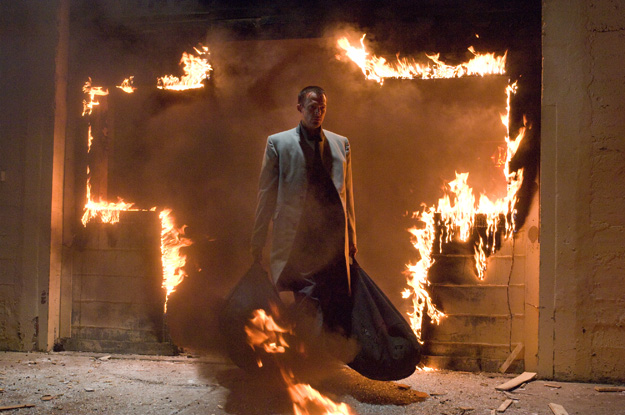
The plot of the film finds an investigative reporter, Mika Correti (Naomie Harris), delving too deep into the story of a ninja clan hired by various governments to do their dirty work.  These assassins are trained as very young orphans in brutal bouts of combat where their strength, sanity, and moral grounds are put to the test.  After being beaten to a pulp, the students are eventually reshaped into lurking, heartless, slice-and-dice shadows that can’t be seen.  Think the training sequences from “Batman Begins” with a penchant for Tarantino carnage.  The hero of the film is none other than a rogue warrior named Raizo (played by a man named Rain), the best of the best, who received a dishonorable discharge of sorts for his defiance against his teacher and the love he felt for his murdered counterpart.  He takes it upon himself to protect Mika and put an end to the entire clan, which includes the usual cleaning house of fifty or more ninjas sent to hunt him down.

If this movie will be remembered at all, it is for the Kill Bill-style batterings.  Even when the fight sequences can be hard to distinguish, the movie moves at such a rapid pace that I didn’t care much.  It’s the kind of B-movie that doesn’t bend the rules–it simply leaves them at the door.  The movie sprays more blood than most slasher movies, and would make the “Saw” franchise curl up in a corner.  Of course this is cheesy, CGI blood and guts that has that appealingly fake distinction.  By the time Raizo has been cut to shreds and has spilled more blood than could be physically kept inside his body, and still manages to get back up and fight ten more guys, I was at a loss for words.  This is where the movie can only be classified as a love-it or hate-it guilty pleasure.  It adds nothing new or exciting to its genre, can be visually confusing, and culminates into a total complete mess of a picture, but it is easy to chew popcorn to a whiplash of ninety minutes that relishes in being so far over the top and so ridiculously action-packed.

[Rating:3/5]

Robin Hood

Ridley Scott’s difficult epic finally reaches movie theaters after several failed attempts at reincarnating the infamous legend of Robin Hood.  The laborious project began as an investigation thriller under the title of “Nottingham,” and took the perspective of the Sheriff of Nottingham tracking the hits of the mysterious Robin Hood and his merry men.  The script was later altered to cast Russell Crowe as both Robin Hood and as the sheriff in disguise.  Finally, the movie delivered to audiences strips away a lot of its artistry and does much the same as ‘Iron Man 2:’ it exists purely and simply to ready a different, seemingly more exciting movie altogether, with little ability to stand on its own legs.

This take on the famed archer features Russell Crowe doing his very best Russell Crowe-in-Gladiator impression as a soldier named Robin Longstride, sent to deliver the sword of a fallen comrade to the man’s father in Nottingham.  Upon meeting Sir Walter Loxley (Max von Sydow), the elderly sightless fighter adopts Robin as his replacement son and forces an appearance-marriage on Robin and his daughter-in-law, Marion Loxley (Cate Blanchett).  Things get sticky when the newly appointed King John (Oscar Issac) decides to lay siege to all lands that refuse an unlawful tax.  Robin and William Marshal (William Hurt), the former ruler’s adviser, take it upon themselves to dupe the king into a civil war against his most trusted military adviser (Mark Strong) that ultimately leads up to a battle of macho butchery.  Now I have to ask: does this sound like Robin Hood to you in the slightest?

No, it does not.  This prequel of sorts spends 99 percent of its running time attempting to establish a franchise, and one that I don’t think audiences are going to buy into.  Granted, at surface value, the idea of reteaming Ridley Scott and Russell Crowe for a Gladiator-esque epic sounds like a grand idea.  Their collaboration on “Robin Hood,” however, takes a devastating blow.  Scott seems intent on mixing fact with fiction, setting Robin in the middle of the Crusades as a soldier put to death for standing against his king, and having him escape only to deliver a sword and take part in a final throwdown of steel.  A lot of this feels like “Gladiator,” and the problem is that it doesn’t feel like “Robin Hood.”  This film is simply a generic Crusades epic that may only be marginally better than Scott’s own “Kingdom of Heaven.”  I read a miniature review stating that Crowe still thinks he’s on the set of Gladiator, and Scott still thinks he’s directing Kingdom of Heaven–and I honestly couldn’t agree more.  I’m all for Ridley and the studio wanting to turn Robin Hood into a trilogy or series or whatever they want, but they forgot to make it exciting and fresh.  “Robin Hood” continuously falls flat when trying to advance the story, while the action and supporting actors work their magic to hold our interest.  This installment’s greatest drawback is the lacking parallels to what audiences know and expect from a Robin Hood film and what Ridley Scott has put together here.

Walking out of the film, I wanted to say I enjoyed it as a passable action epic filled with mostly good performances, but upon closer inspection I felt as though I had been duped.  The couple of battle sequences in this film are quite good–very bloody and violent, especially for a PG-13 rating–but once the dust settles on the plot and characters culminating this project, nothing holds up.  Robin Hood is supposed to be a character who robs from the rich and gives to the poor.  As written by Brian Helgeland, directed by Ridley Scott, and interpreted through a miscast Russell Crowe, he’s a complete bore of hero with confused motivations.  The movie spends its gritty time treading through uninteresting back story before finally declaring: “This man is an outlaw!”  Then before the credits role we read: “And so the legend begins…”  All the action, gorgeous cinematography, and amazing set design can’t quite compensate for a hollow hero and a lacking story that was constructed to postpone the movie audiences are thinking they’re paying to see, but will probably never witness (since I don’t think a sequel will actually surface).  The idea of a prequel might have worked if the backstory had actually been engaging, exciting, interesting, etc. and containing familiar elements of the well-known character.  Unfortunately, “Robin Hood” mostly lulls along, splicing a few impressive battle sequences into a bare-bones plot, providing a movie about the infamous character that I don’t think anyone would care to see.  If it is marginally enjoyed, it is because viewers, like me, will be forced to forget this is a movie about “Robin Hood” until the end credits.

[Rating:2.5/5]

Legion

Well, what can be said about Legion? It’s a bit too nonsensical for me to call it good. On the other hand it isn’t really badenough for me to talk about that either. It’s not remotely accurate to its subject matter, but it’s not irreverent enough to be offensive. Ultimately, when the lights go on and you’re walking away from this one, scratching your head, what you’re most likely to remember about the movie is exactly what you saw on the poster: an Archangel with a machine gun. And if that by itself isn’t worth a “hell, yeah,” it’s got to be at least worth a “heck, yeah.”

The movie opens with the text of Psalm 34:11, and actually builds on that theme pretty well. For all its faults, Legiondoes make God seem pretty scary. Fed up with man’s wickedness, He dispatches His angelic legion to exterminate us. However, the Archangel Michael (Paul Bethany) refuses to give up on man, and possibly refuses to believe that God has really given up. He drops into Los Angeles on Dec. 23 and hacks off his wings with a combat knife. He then breaks into and loots a gun store, steals a police car, and drives to a trailer park in the middle of nowhere called Paradise Falls.

But wait. It gets better.

At the Paradise Falls diner, we meet a motley crew of characters from different walks of life who either work in the diner or have had the misfortune to get lost/break down there. Most notably, we meet Charlie (Adrianne Palicki), a seemingly insignificant, poor, unwed mother to be, and Jeep (Lucas Black), her live-in boyfriend. Not only is Jeep not the father of Charlie’s child, but she has slept with just about everyone in town except him. Nonetheless, he loves her and offers to help her raise the baby.

Why sneak out the door with the guns when you can blow something up?

There follows an unintentionally comical scene, in which a little old lady (Jeanette Miller) orders a rare steak, uses the c-word, bites a guy on the neck, and then climbs the wall ala The Exorcist, before being shot to death by Kyle (Tyrece Gibson), the token gangsta of the film. Then we see a swarm of bugs that has nothing to do with the rest of the movie. Then Michael shows up and shoves sub-machine guns into everyone’s hands, telling them more like the old lady are on their way.

Michael explains that the deformed maniacs now assembling around the diner are possessed — not by demons, but by angels! He has come to protect Charlie, because her child is humanity’s hope for survival.

Yep. The male child of an insignificant, young, single girl, born on Dec. 25 in the middle of nowhere is humanity’s hope. Ever hear a story like that before? Other than a vague reference to the child “leading mankind out of darkness,” no explanation for Michael’s assertion is ever given. From there, Legion shifts from The Exorcist to Night of the Living Dead, as the Possessed try to fight their way into the diner.

The whole ordeal raises a lot of questions. If God has truly despaired of humanity, why is He committing so many resources to killing this child? And if He hasn’t, why not let the child live? Why do the Possessed sometimes exhibit a survival instinct and other times not?

What are the rules on angels? Are they truly immortal, or just tougher than humans? Do they lose their powers if they cut their wings off? The movie never seems to make up its mind. If humans possessed by angels can’t come near the child, why can Gabriel (Kevin Durand) walk right in the door? And when we see that God has apparently resurrected Michael and given him a new set of wings, just in time to save the day, are we to assume that Michael somehow changed God’s mind, or that this was what God had in mind all along?

Such questions matter not to director Scott Stewart. I don’t believe there was ever a hope on his part to do anything more than make a cool, scary action movie.

And action there is. Bethany gets a few fight scenes that would make Chuck Norris jealous. Near the end, there is a scene where Michael and Gabriel go one-on-one in the diner and tear the place apart. This scene, if you will pardon my technical jargon, is probably the most freakin’ awesome action sequence I have seen since Spiderman 3. It’s worth sitting through the rest of the movie for.

I can’t say I recommend this movie, but I definitely recommend searching YouTube for the angel smack-down scene. Can I get heck-yeah?

[Rating:2/5]

Daybreakers

Imagine a world where vampires live in fear. And not of Dr. Van Helsing or Blade, but of poverty, crime and environmental destruction. Sound hard to believe? That’s the world of Daybreakers (2009), directed by the Spierig brothers.

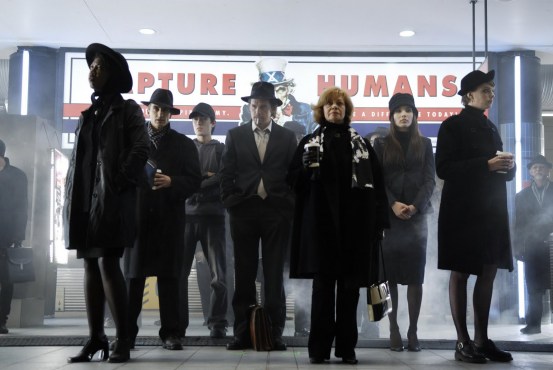
In 2019, vampires outnumber humans more than ten to one. The vampires have become somewhat comfortable with their dominant status, and now drive expensive cars away from suburban homes to boring white collar jobs in the city. Certain noteworthy changes in culture have resulted from this. For instance, all buildings and vehicles are now equipped with lead sheets that cover the windows during daylight hours, and loudspeakers broadcast warnings when there is one hour until daybreak. Vampires in suits line up at coffee stands for coffee with a shot of blood in it.

Subway commuters. And you thought vampires were cool.

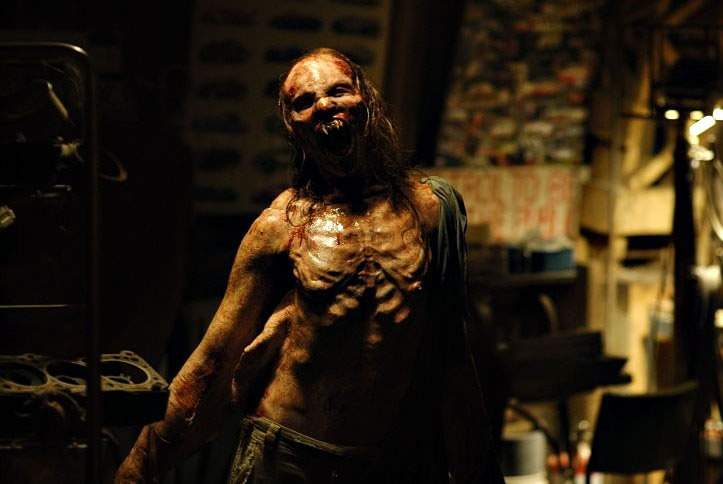
But of course, there’s a problem; one that you’ve probably already guessed. With so few humans left, vampires are in danger of starvation. Most of the humans still in existence are kept sedated, hooked up to giant machines ala The Matrix, being farmed for their blood. The government rations blood more and more strictly, with those in control keeping a little extra for themselves, naturally. An increasingly fearful – and hungry –middle class hurries past dark alleys and hides in their homes, and the lower classes, “subsiders,” deprived of blood, mutate into something out of … well, a vampire movie (below).

Amidst all this, we meet Edward Dalton (Ethan Hawke), chief hematologist for a corporation that controls most of America’s remaining blood supply. With riots breaking out over the blood shortage, the company is putting increasing pressure on Ed to create some kind of “blood-substitute.” Meanwhile, Ed wrestles with his conscience over being a vampire and refuses to touch human blood, to the detriment of his health. This creates a good deal of tension between Ed and his brother, Frankie (Michael Dorman), who hunts humans for the U.S. Army.

A small number of humans are still free, hiding in rural areas. After a chance meeting with some of them, Ed receives an invitation to the countryside to learn about a cure for vampirism that they have discovered, and a chance to restore balance to the food chain.

The cast drives this one home with a number of powerhouse actors. Sam Neil, whom we seem to see about as often as a real vampire, plays Charles Bromley, the CEO of Ed’s company. One of history’s most under-rated actors, Neil blends the smooth charm of a Manhattan sophisticate with the sinister nature of a bloodsucker in a fascinating way. The inimitable Willem Dafoe also appears as the grizzled former vampire who stumbled upon the miracle cure. A collection of Aussie stars (Daybreakers was filmed in Australia) rounds out the cast nicely.

Hawke and Dafoe do not suck in "Daybreakers."

Daybreakers could justifiably be called a horror movie, but not in the way one normally thinks of horror. It does get gory – even ridiculously so – at times, but it’s not about the gore. It’s about the horrors of a society that has gotten too comfortable, and is eating itself. As corrupt potentates drink blood wine and eat blood caviar, we wonder how much longer civilization can bear the strain. The pristine homes and manicured lawns of suburbia are nothing more than petty amusements the vampires use to distract themselves from their impending doom. Near the end, we bear witness to the kind of moral travesties that desperation is often used to justify. And it’s all horribly familiar; the story of our lives, retold through the bloodshot eyes of the undead.

I wouldn’t want to put anyone off this movie, because it is one of the best I have

Neil drinks blood, but still does not suck in "Daybreakers."

seen in a long time. For all of the negativity, it actually has a pretty uplifting ending (especially for a vampire movie), despite a few painfully sad moments along the way. There are also a number of genuinely fun scenes, including a hair-raising home invasion by a bat-like subsider. Even better, this scene is followed by an unintentionally hilarious crime-investigation scene, with every law enforcement cliché from the past 60 years standing around the decapitated body of this bizare creature from hell.

I figured I could get some work done during this movie, but my papers were left forgotten on the coffee table as I was glued to the screen. Daybreakers was only the second movie done by the Spierig brothers, but it’s as gripping and thought-provoking as anything out there. If you’ve got a strong stomach, it’s a must see.

[Rating:4/5]

Iron Man 2 (Take-Two)

Guess what? Summer begins early, as it does with the year’s major blockbuster movies.  Robert Downey, Jr. is back in action shooting to thrill, and let me just say, “Iron Man 2,” while not coming out blazing, still knocks last year’s hideous kick-start “Wolverine” out of the park.

Director Jon Favreau and his star Downey hit the jackpot two years ago with the release of “Iron Man.” Not only did it manage to be the year’s second biggest domestic hit, bested solely by “The Dark Knight,” but it inched past Spielberg’s return to “Indiana Jones,” and even managed to become one of the year’s best-reviewed films.  Audiences loved it even more.  With the release of Marvel’s second installment, the winning streak continues, but not nearly to the same effect.

“Iron Man” did the impossible.  It blended moderately abundant action sequences into an impressive character study of Tony Stark, a weapons creator so self-absorbed and ignorant to the reality of the business he deals in.  Upon a rude awakening, Stark changed his vision for developing the ultimate weapon, eliminating multiple trigger-fingers, and standing alone as the sole necessary weapon of the United States.  “Iron Man 2” picks up where we last found Tony, only this time out, returning director Jon Favreau seems to be less interested in the thrills so predominant in the first outing.

In “Iron Man 2,” Stark has to take on the U.S. government, demanding that the Iron Man weapon be turned over to the military, as well as face off against multiple foes (Sam Rockwell, Mickey Rourke) trying to end his career and his life.  His friendship with Rhodes (Don Cheadle) is tested, as is the sexual tension between him and Pepper Potts (Gwyneth Paltrow).  On top of that, Nick Fury (Samuel L. Jackson) starts hanging around to try and encourage Stark to stop fooling around and join the Avenger initiative.  Add in the fact that his new secretary (Scarlett Johansson) seems to have a secret looming and the reality that Tony’s power source that keeps him alive also has potentially fatal side effects on his body–it seems the man sure has his work cut out for him.  So much going on and so little intensity… But where’s all the kaboom??

It might be scary for fanboys to find out that “2” may have significant meaning in regards to the action on display in the film–the movie literally contains two action sequences to devour.  Not to say that burdens Tony Stark’s latest adventure, but it does allow for the content of this installment to be swarmed by multiple subplots and characters that never really advance the story in an exciting way.  Granted, this isn’t the cobbled mess that “Spider-Man 3” was, it just hasn’t the finesse of the film that preceded it.  Since no one could describe this as “an action-packed thrill ride,” Iron Man 2 luckily has brilliant actors and a very solid director in Favreau to save it.

This movie is totally, completely and utterly about Robert Downey, Jr.  Sure, we have all these great supporting actors, but every reason to see this movie rests upon the shoulders of a more-than-capable star portraying the single most interesting superhero character in the history of cinema.  Yes, I said that.  Who needs Bruce Wayne and his whiny-baby, cloak and dagger, angry teenager antics?  Who cares if Peter Parker can’t figure out if he’s more capable as a  human in love, a protector of New York, or an emo break-dancer?  Who wants to waste their time wondering why Wolverine can’t get his claws together and tell his past to go find someone who cares?  Tony Stark doesn’t play those games.  Downey has a fully realized character–top-dollar hilarious and engaging.  The movie goes for long stretches without things blowing up, and Downey manages to capture our attention with his inventiveness and brilliance as actor.

If the movie never reaches the level of the 2008 predecessor, it’s because the movie has a lot more down time and subplots.  The studio seems so bent on bridging “The Avengers” movie two years out, that Stark’s story suffers, and the movie becomes overwhelmed with exposition and witty banter.  At least it doesn’t kill the movie, and the action in the film really does deliver even in its limited doses.  Even Favreau allows himself to have a little game time, upping his role in the film, and kicking some butt in the middle of the big finale.  “Iron Man 2” may not be the film that ups the ante as far as sequels typically go, but the movie still manages to be plenty entertaining for two hours, and it contains a fully-realized hero that consistently breaks all the rules and dares to be wholly memorable.  Even if fanboys are left wanting more explosions, I’m sure they’ll be satisfied with this outing and jazzed about the upcoming showdown.

[Rating:3/5]

Iron Man 2

This is why great movies shouldn’t have sequels. Make no mistake, Iron Man was a great movie. It took a character from the depths of obscurity and made him a national symbol. Sure it was a comic book movie, but it had more heart and more flare than a lot of more serious films. The story of a man totally absorbed in himself and his own pleasure being changed and using his power to protect those who couldn’t protect themselves was truly inspiring, led by a truly gifted actor. The action, while limited in quantity, was excellent in quality.

How do you follow an act like that? Well, at the command of the almighty dollar, Marvel Studios had to try. To be fair, what they came up with is watchable, in fact clearly a better sequal than their colossal disappointments of Spiderman 2 and X2: X-Men United, but it has none of the power of Iron Man.

The scene in Iron Man where Stark rescues the villagers from the Ten Rings is a scene I’ll probably never forget. It took two thirds of the movie to get to Stark’s first heroics as Iron Man, but it was well worth it.

If you’re thinking that, now that we have the origin story out of the way, we’ll get some extra action and heroics, think again. Marvel has to cram in more subplots and implausible characters to eat up time. Well, that’s not so bad, you say, more plot development is good, right?

Not when the writers are used to writing for comic books. Comic books have room for stories that go in circles, whereas movies simply don’t. For example, in part 2, Stark finds out that he’s dying due to the effects of the reactor core he built in part 1. Precious time for action sequences disappears forever while he remodels his workshop to build a machine and creates some “new element” that was supposedly impossible to create through a process the movie never even tries to explain. This new element magically cures his ailment and everything goes back to normal, so it doesn’t even drive the story. If I were to read through a decade’s worth of monthly comic book issues, I would expect some filler crap like this, but for a movie, it’s just wrong.

Similarly, after Stark seemed to have gotten a new set of priorities in part 1, in part 2, we get more of him staggering drunkenly, driving sports cars, and trying to score. When someone turns over a new leaf, is it unreasonable to expect them to never relapse? Probably. But that’s not the point. Why are we paying to watch the same stuff over?

Unlike comic serials, which are expected to keep a story going perpetually, a movie can, and should, present a coherent story that stands on its own and doesn’t waste time with filler. Judging by the buzz among nerds over the past few years, and by the easter eggs in both Iron Man movies, Marvell plans on changing this. Iron Man 2 is actually set-up for movies about Thor and the Avengers (who include Iron Man). In other words, Marvell plans on making movies more like comic books, written not so much to entertain as to advertise the next movie and keep you coming back for more. This might score with the hardcore comic nerds, but I doubt the general public will tolerate it for long.

I should probably say that Iron Man 2 is not horrible, and is even kind of entertaining if you turn your brain off. I’m sure there will be a third one, and I’ll probably see it. After all, both Spiderman and X-Men made improvements with their third installments. Once Iron Man 2 is out on video, it won’t be a bad way for you to kill two hours.

[Rating:2/5]

Judge Dredd

There’s an old computer term called WYSIWIG.  It comes from the days of dot-matrix printers and non-TrueType fonts that basically means what you see on the screen is what comes out on paper (this used to be a big problem, actually).  Judge Dredd is a perfect example of this concept applied to a movie.  To explain what I mean, just take a look at the trailer:

We’ve got guns, explosions, fights, chases, tree-trunk-sized action stars, and some sweet cathphrases too.  The film is pretty much everything you see in the trailer expanded to 90 minutes, but I ask you, is that a bad thing?  My answer is a resounding “no.”  We’re not talking Dark Knight or Terminator 2 here (despite a scene with Stallone riding his police chopper that looks like was ripped directly from T2), and there’s little in the way of subtext and certainly nothing even remotely resembling subtlety.  But this is precisely why I found the movie to be so entertaining.  It’s a straight-up action movie with a ripped-to-shreds Sylvester Stallone, lots of cool weapons, and a straightforward plot that never deviates from its purpose.  And to be honest, you just don’t see that too much anymore.  There’s even a cool enemy robot that’s (gasp!) an actual animatronic creature instead of a shiny, sterile CGI creation.  Is it cheesy?  Sure, but that’s part of the fun.  Don’t take this one too seriously–just grab a busket of popcorn, sit back, and enjoy the ride.

A thousand years from now, the earth is so overpopulated that the only practical way of doling out justice is through the use of Judges with the legal authority to arrest and sentence anyone on the spot.  Entrusted with high-tech crimefighting implements like multifunction handguns, impenetrable body armor, hover-cycles that break down the instant the rider hits the throttle, and a litany of cool quips like “Court’s adjourned” and “I’ll be the judge of that,” these judges run around town responding to threats with an expediency that would make our current legal system wet its collective legal pants.

Judge Dredd

Judge Dredd: He. Is. The. Law. Don't believe it? He'll tell you so.

Stallone, basically the Master Chief of Judges, is falsely convicted of a murder and sentenced to a plane ride next to Rob Schneider and must find a way to clear his good name before he ends up in a Deuce Bigalow movie.  Several explosions later he ends up back in Mega City on a mission to find his estranged brother who, wouldn’t you know it, is the evil genius behind it all.

Somehow Diane Lane and Max Von Sydow were tricked into joining the cast, along with ex soap opera heartthrob Armand Assante, which makes Judge Dredd a somewhat anomalous compilation of A-grade acting talent (Rob Schneider notwithstanding) in a B-level script.  Don’t come to the show expecting character development either–Dredd was genetically engineered to be the perfect crimefighting tool, so he possesses none of those inconvenient traits like empathy, love, or self-doubt that so often lead to such annoyances like interpersonal relationships or romantic conflicts.  But the movie never takes itself too seriously, and even Von Sydow seems to be winking at the camera during a few scenes.  Fortunately there’s an outstanding production value to the whole spectacle, so the death-deflying stunts, high-speed chases, and human/robot showdowns are all fantastically realized.

The cheese meter is maxed out here, but unlike Stallone’s other future-based blow ’em up movie, Judge Dredd is more entertaining than embarrassing.  Walking a fine line between Michael Bay excess and Uwe Boll stupidity, it’s an outstanding guilty pleasure that gives you exactly what you would expect without overstaying its welcome.  Watching Judge Dredd is kind of like going to McDonald’s and going all-out for the biggest Angus Burger on the menu.  It’s not fine cuisine, but it sure does get the job done.  And sometimes that’s all you want.

Rating:[Rating:3.5/5]

Alien 3

Alien3The third entry in the Alien franchise has been the series’ whipping boy ever since its release in the early 1990s.  Whereas the fourth film, Alien Resurrection, is such an oddity it’s more of a redheaded stepchild than a true Alien movie, the third film walks a fine line between terror and action–the hallmarks of its two predecessors–and though it ultimately succeeds at neither one, it is a compelling film and certainly worth watching.  Much has already been written about how the movie more or less betrayed fans by eliminating Hicks, Newt, and for all intents and purposes, Bishop, the main characters from Aliens, and re-imagining the action heroine Ripley as a brooding emo girl.  Add to that the film’s notoriously problematic production (including a walkout by first-time director David Fincher near the end of the shoot) and one could easily dismiss this as a throwaway sequel far better suited for the $5 Wal-Mart DVD Bargin Bin than on the shelf of any true science fiction fan.  However, despite these shortcomings I have found Alien3 to be far better than most people give it credit for.  Is it a worthy sequel to Aliens?  Not exactly.  But it is a good film, and worth a second look for those who have not seen it in a while or dismissed it altogether.

Where Alien set a new benchmark for realism in science fiction films, as well as a reinvention of monster movies that continues to influence filmmakers today, and Aliens set the gold standard for action films that has yet to be topped (save perhaps by the the director himself with Terminator 2), Alien3 excels at nothing in particular and introduces nothing really new into the franchise.  But in place of groundbreaking filmmaking, David Fincher brought incredibly deep thematic elements into the mix for the first time ever.  Essentially starting with a clean slate on a dirty planet, Fincher uses the Alien mythology as a backdrop from which to examine heavy themes of life and death, spirituality and salvation, and a look into human nature that bears a striking similarity to Golding’s “Lord of the Flies.”

Alien3 Ripley

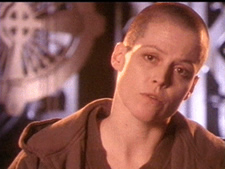
Sigourney Weaver reprises her genre-busting role as Ellen Ripley sans perm.

As the movie begins, Ripley’s escape pod from Aliens has crash-landed on Fiorina “Fury” 161, a prison planet run by the infamous Weyland-Yutani corporation from the first two movies.  The planet is all but forsaken, and only a handful of men are still around to “keep the pilot light on.”   These men, we are told, are all convicted murders, rapists, and generally nasty human beings who are kept in check by the ill-tempered warden Andrews (Brian Glover) and a spiritual guru-of-sorts named Dillon (Charles S. Dutton).  In essence we see humanity at its worst:  criminals devoid of any contact with the outside world, struggling to maintain a sense of order and decency lest they slip into anarchy.  They have all taken vows to maintain a sort of peace and order in the prison, and despite the lack of a true disciplinary force, they all realize the consequences should they get out of line.  Venerable actor Charles Dance is along for the ride as Clemens, a medical officer who has made some very costly mistakes years ago that continue to haunt him.  It’s a motley crew to be sure, and a rich tapestry from which to present a tale about morality and humanity.

During the opening moments we see an image of a cross silhouetted against the setting sun as debris and junk rolls across the landscape surrounding the prison–a harbinger of the thematic elements that will be explored in the film.  Dillon’s pastoral leadership of the prisoners, from his refusal to let them break the Third Commandment to his moving spiritual eulogy during the cremation of Ripley’s fallen comrades, is a stark contrast to the gun-toting reluctant leader Ripley was in the second film.  (In fact, the entire cremation/birth scene has some serious parallels to Coppola’s masterful baptism scene in The Godfather.) Dillon in essence shepherds the prisoners–a task warden Andrews, not one to upset the order or cause ripples in the water, is all to happy to have him do.  But how does one deal with a metaphysical God and satan when a very real monster is literally killing off inmates one by one?  The idea of rebirth, both spiritual and physical, is also very prominent in Alien3.  It is only through the death of a host that the alien can live, but the prisoners on Fury 161, all serving life sentences, are essentially dead anyway and it is only through death at the hands of the alien that they are set free from this mortal coil.  Ripley, with an alien queen implanted inside her, must decide whether the good of the one outweighs the good of the many, and is in fact the only human on the planet that the alien will not kill.  Elements of David Fincher’s classic directorial style are present in abundance:  a notoriously dark color palette, a cast of tragically flawed characters, and an ending that could hardly be classified as happy (not quite as bleak as the ending of Se7en, but close).  A typical action/horror film this is most certainly not.  And while Fincher lays it on pretty thick, at least there is a message and a subtext here, unlike many action blockbusters.

Alien3 Dillon

Dillon, the spiritual leader of the gang of prisoners.

But for all these high marks, there are serious flaws in Alien3 that are hard to overlook.  There are only a couple characters who are even close to relatable, and I must admit that in all my times of re-watching the movie I never felt a true emotional connection with anyone in it.  In any survival movie there must be someone whom we want to survive, but virtually everyone in Alien3 (including Ripley, unfortunately) is so unsympathetic that watching the film is akin to reading a report filled with bullet points about the tragedies that ensue when letting killer aliens run amok on a bleak prison planet.  It’s a tough bit of oil to swallow, to be sure, especially after the brilliant Ripley/Newt relationship from Aliens.  The prisoners are almost indistinguishable from one another, and possess nothing in the way of distinct personalities–a transgression that is compounded by the fact that they all look virtually identical thanks to their tattered brown clothes and shaved heads.  And as if to salt the wound, Fincher’s alien looks like a sock puppet compared to James Cameron’s ultra-realistic living, breathing xenomorphs in Aliens (with one notable exception).

For those who dismissed the film years ago, I urge you to give it another shot–you might find yourself pleasantly surprised.  For those who never saw it, by all means give it a rental.  While not exactly a worthy successor in the franchise, there is far more to this film than people often give it credit for.

Rating:[Rating:3.5/5]