Archives for May 2010

It’s Complicated

It's ComplicatedSeveral years ago there was a television show called Lifestyles of the Rich and Famous wherein heavily-accented host Robin Leach would indulge viewers in glimpses of how people who were, well, rich and famous, lived their everyday lives. For the ten-year run of the show, viewers were entranced with visions of indoor swimming pools, personal chefs, expensive vehicles, and extravagant wardrobes.  It was escapist television, and offered a snapshot of what life could be like for the mortal average guys and gals who punched in at nine and out at five.  Watching It’s Complicated is kind of like Leach’s show, save for the fact that we are asked to possess a certain degree of empathy for the characters, specifically divorcee Jane (Meryl Streep) as she struggles with feelings of attraction to her ex-husband Jake (Alec Baldwin) while simultaneously being courted by her architect Adam (Steve Martin).  But in watching these highbrow socialites as they struggle through midlife crises, empathy is somewhat hard to come by.  Fortunately the movie doesn’t take itself too seriously, and provides enough lighthearted humor to be entertaining, if rather forgettable.

It's Complicated Jake

Give it up, Alec...you'll forever be Jack Donaghy in our minds. :)

The casting of It’s Complicated is as smart as they come, and it’s nearly worth the price of admission alone to see Alec Baldwin slipping into his role like a pair of comfy jeans.  After ten years of divorce, Jake is unhappily remarried to a typical Stock Hollywood Annoying Wife Character #4-C Agness (Lake Bell) with Stock Hollywood Bratty Kid #3-F Pedro (Emjay Anthony) in tow.  As luck (or movie logic) would have it, Jake and Jane meet up in the bar of the hotel where they are staying for their son’s graduation from NYU.  Sure enough, they hook up for the night and spend the next few days re-thinking their lives along with a series of romantic trysts at Jane’s new house.

Meanwhile Adam continues to develop feelings toward Jane, which leads to a bit of a conundrum for Jane:  Does she reunite with her ex-husband, with for whom she is beginning to develop some serious feelings of affection, or does she go for the Adam, the safe bet who is searching for love after a few years of his own divorce?  Despite the movie’s title, it’s actually not all that complicated, and this type of love triangle is nothing we haven’t seen before.  Streep and Baldwin have an infectious screen chemistry, and much of the fun of the movie comes from watching the two of them romp around like a pair of twitterpated high school lovebirds.  Martin’s incredible talent seems woefully underused, though, and only has a handful of truly funny scenes throughout the entire movie.

It's Complicated Meryl Streep Steve Martin

Jane and Adam, looking for love in all the wrong places. Like behind a lilac bush.

It’s Complicated plays on the premise of relationship confusion, something all of us have gone through. But Streep’s problems really don’t seem all that bad–she is the owner of a posh cafe where a single croissant will set you back over $10, she’s got a good relationship with her children, and has a group of Stock Hollywood Divorced Friends #6B-F with whom to gossip and eat pastries.  And Jack seems to be doing pretty well with his new marriage, even though his wife exhibits such egregious character flaws as wanting to know why he is out at all hours of the evening and why he seems to be having secret conversations on his cell phone.

Despite the somewhat questionable logic at work here, director Nancy Meyers must be commended for crafting a film that does not cater to the lowest common denominator:  though It’s Complicated secured an R rating, typical scatalogical gags, bathroom humor, and even swearing are almost nowhere to be found.  It’s a film that tries to be an exploration of midlife crises, past regrets, second chances, and horribly awkward video iChat sessions.  Ultimately it feels a little hollow, but at the same time it’s enjoyable as an escapist fantasy.  These individuals live in a world far removed from my own, and that of everyone else I know, and their fairly inconsequential problems and supposedly complicated relationships are a bit of an insult to the real people with actual problems and genuinely complicated relationships who will be watching the movie.  But sometimes it’s good to just sit back and enjoy a lighthearted movie for what it is.

Rating:[Rating:3.5/5]

Robin Hood

Ridley Scott’s difficult epic finally reaches movie theaters after several failed attempts at reincarnating the infamous legend of Robin Hood.  The laborious project began as an investigation thriller under the title of “Nottingham,” and took the perspective of the Sheriff of Nottingham tracking the hits of the mysterious Robin Hood and his merry men.  The script was later altered to cast Russell Crowe as both Robin Hood and as the sheriff in disguise.  Finally, the movie delivered to audiences strips away a lot of its artistry and does much the same as ‘Iron Man 2:’ it exists purely and simply to ready a different, seemingly more exciting movie altogether, with little ability to stand on its own legs.

This take on the famed archer features Russell Crowe doing his very best Russell Crowe-in-Gladiator impression as a soldier named Robin Longstride, sent to deliver the sword of a fallen comrade to the man’s father in Nottingham.  Upon meeting Sir Walter Loxley (Max von Sydow), the elderly sightless fighter adopts Robin as his replacement son and forces an appearance-marriage on Robin and his daughter-in-law, Marion Loxley (Cate Blanchett).  Things get sticky when the newly appointed King John (Oscar Issac) decides to lay siege to all lands that refuse an unlawful tax.  Robin and William Marshal (William Hurt), the former ruler’s adviser, take it upon themselves to dupe the king into a civil war against his most trusted military adviser (Mark Strong) that ultimately leads up to a battle of macho butchery.  Now I have to ask: does this sound like Robin Hood to you in the slightest?

No, it does not.  This prequel of sorts spends 99 percent of its running time attempting to establish a franchise, and one that I don’t think audiences are going to buy into.  Granted, at surface value, the idea of reteaming Ridley Scott and Russell Crowe for a Gladiator-esque epic sounds like a grand idea.  Their collaboration on “Robin Hood,” however, takes a devastating blow.  Scott seems intent on mixing fact with fiction, setting Robin in the middle of the Crusades as a soldier put to death for standing against his king, and having him escape only to deliver a sword and take part in a final throwdown of steel.  A lot of this feels like “Gladiator,” and the problem is that it doesn’t feel like “Robin Hood.”  This film is simply a generic Crusades epic that may only be marginally better than Scott’s own “Kingdom of Heaven.”  I read a miniature review stating that Crowe still thinks he’s on the set of Gladiator, and Scott still thinks he’s directing Kingdom of Heaven–and I honestly couldn’t agree more.  I’m all for Ridley and the studio wanting to turn Robin Hood into a trilogy or series or whatever they want, but they forgot to make it exciting and fresh.  “Robin Hood” continuously falls flat when trying to advance the story, while the action and supporting actors work their magic to hold our interest.  This installment’s greatest drawback is the lacking parallels to what audiences know and expect from a Robin Hood film and what Ridley Scott has put together here.

Walking out of the film, I wanted to say I enjoyed it as a passable action epic filled with mostly good performances, but upon closer inspection I felt as though I had been duped.  The couple of battle sequences in this film are quite good–very bloody and violent, especially for a PG-13 rating–but once the dust settles on the plot and characters culminating this project, nothing holds up.  Robin Hood is supposed to be a character who robs from the rich and gives to the poor.  As written by Brian Helgeland, directed by Ridley Scott, and interpreted through a miscast Russell Crowe, he’s a complete bore of hero with confused motivations.  The movie spends its gritty time treading through uninteresting back story before finally declaring: “This man is an outlaw!”  Then before the credits role we read: “And so the legend begins…”  All the action, gorgeous cinematography, and amazing set design can’t quite compensate for a hollow hero and a lacking story that was constructed to postpone the movie audiences are thinking they’re paying to see, but will probably never witness (since I don’t think a sequel will actually surface).  The idea of a prequel might have worked if the backstory had actually been engaging, exciting, interesting, etc. and containing familiar elements of the well-known character.  Unfortunately, “Robin Hood” mostly lulls along, splicing a few impressive battle sequences into a bare-bones plot, providing a movie about the infamous character that I don’t think anyone would care to see.  If it is marginally enjoyed, it is because viewers, like me, will be forced to forget this is a movie about “Robin Hood” until the end credits.

[Rating:2.5/5]

Legion

Well, what can be said about Legion? It’s a bit too nonsensical for me to call it good. On the other hand it isn’t really badenough for me to talk about that either. It’s not remotely accurate to its subject matter, but it’s not irreverent enough to be offensive. Ultimately, when the lights go on and you’re walking away from this one, scratching your head, what you’re most likely to remember about the movie is exactly what you saw on the poster: an Archangel with a machine gun. And if that by itself isn’t worth a “hell, yeah,” it’s got to be at least worth a “heck, yeah.”

The movie opens with the text of Psalm 34:11, and actually builds on that theme pretty well. For all its faults, Legiondoes make God seem pretty scary. Fed up with man’s wickedness, He dispatches His angelic legion to exterminate us. However, the Archangel Michael (Paul Bethany) refuses to give up on man, and possibly refuses to believe that God has really given up. He drops into Los Angeles on Dec. 23 and hacks off his wings with a combat knife. He then breaks into and loots a gun store, steals a police car, and drives to a trailer park in the middle of nowhere called Paradise Falls.

But wait. It gets better.

At the Paradise Falls diner, we meet a motley crew of characters from different walks of life who either work in the diner or have had the misfortune to get lost/break down there. Most notably, we meet Charlie (Adrianne Palicki), a seemingly insignificant, poor, unwed mother to be, and Jeep (Lucas Black), her live-in boyfriend. Not only is Jeep not the father of Charlie’s child, but she has slept with just about everyone in town except him. Nonetheless, he loves her and offers to help her raise the baby.

Why sneak out the door with the guns when you can blow something up?

There follows an unintentionally comical scene, in which a little old lady (Jeanette Miller) orders a rare steak, uses the c-word, bites a guy on the neck, and then climbs the wall ala The Exorcist, before being shot to death by Kyle (Tyrece Gibson), the token gangsta of the film. Then we see a swarm of bugs that has nothing to do with the rest of the movie. Then Michael shows up and shoves sub-machine guns into everyone’s hands, telling them more like the old lady are on their way.

Michael explains that the deformed maniacs now assembling around the diner are possessed — not by demons, but by angels! He has come to protect Charlie, because her child is humanity’s hope for survival.

Yep. The male child of an insignificant, young, single girl, born on Dec. 25 in the middle of nowhere is humanity’s hope. Ever hear a story like that before? Other than a vague reference to the child “leading mankind out of darkness,” no explanation for Michael’s assertion is ever given. From there, Legion shifts from The Exorcist to Night of the Living Dead, as the Possessed try to fight their way into the diner.

The whole ordeal raises a lot of questions. If God has truly despaired of humanity, why is He committing so many resources to killing this child? And if He hasn’t, why not let the child live? Why do the Possessed sometimes exhibit a survival instinct and other times not?

What are the rules on angels? Are they truly immortal, or just tougher than humans? Do they lose their powers if they cut their wings off? The movie never seems to make up its mind. If humans possessed by angels can’t come near the child, why can Gabriel (Kevin Durand) walk right in the door? And when we see that God has apparently resurrected Michael and given him a new set of wings, just in time to save the day, are we to assume that Michael somehow changed God’s mind, or that this was what God had in mind all along?

Such questions matter not to director Scott Stewart. I don’t believe there was ever a hope on his part to do anything more than make a cool, scary action movie.

And action there is. Bethany gets a few fight scenes that would make Chuck Norris jealous. Near the end, there is a scene where Michael and Gabriel go one-on-one in the diner and tear the place apart. This scene, if you will pardon my technical jargon, is probably the most freakin’ awesome action sequence I have seen since Spiderman 3. It’s worth sitting through the rest of the movie for.

I can’t say I recommend this movie, but I definitely recommend searching YouTube for the angel smack-down scene. Can I get heck-yeah?

[Rating:2/5]

It Might Get Loud

It Might Get LoudA few years ago director Davis Guggenheim set out to create a documentary about one of the most iconic instruments in music, and the driving force behind the entire rock and roll scene since its inception:  the guitar.  His way of doing so was to get the perspective of three musicians, each in some way the driving force behind a particular brand of rock music.  Jimmy Page, the guitarist from Led Zeppelin; The Edge, the genius behind the unique and experimental sound of worldwide rock sensation U2; and…Jack White from The White Stripes.  Guggenheim essentially films a conversation between the three men as they sit with their guitars in the middle of a warehouse, talking about their personal stories, influences, creative visions, and thoughts on the history of rock music.  It’s a daring concept to be sure, and one that is inherently fraught with musical controversy:  ask any guitarist to name their three heroes in the genre, and it’s doubtful Page, Edge, and White would all be mentioned in the same sentence.  The three are masters of their craft, but how many hundreds or thousands of brilliant, influential guitarists (Eric Clapton, B.B. King, Chuck Berry, Neil Young, Stevie Ray Vaughan, or modern virtuosos like Buckethead, John Petrucci, or even Mark Tremonti) were left off the list?  Why these three specifically?  The answer, it turns out, doesn’t really matter.  This isn’t a movie about the best, or most influential, or most popular, or most innovative, or hardest-shredding guitarists.  It’s just a movie about three dudes who are masters of their craft and offer their perspective–take it or leave it.

It Might Get Loud: Jack White, The Edge, Jimmy Page

Jack White, The Edge, and Jimmy Page. Two out of three ain't bad, I guess.

Beyond just filming a conversation, Guggenheim offers a much richer experience than just watching three dudes wax nostalgic about their geetars.  He offers glimpses into the creative processes each musician has gone though to lead them to where they are.  From Page’s humble beginnings as a studio musician and then playing backup for the Yardbirds, to the streets of Detroit where White, the youngest of 10 children, spent his days working in an upholstery shop and playing music with his boss in the evenings.  Even The Edge, who practically sleeps and bathes with a full set of pedals and FX boards, takes a trip back to the high school where he and his friends practiced music in their teacher’s classroom after the bell rang.

On some levels the movie succeeds quite well, and it’s fascinating to see how each of these men have taken the guitar and made it their own.  The most captivating is Page, who having achieved the pinnacle of rock and roll stardom, and been there/done that by any definition of the phrase, is just as enthusiastic as ever about the guitar.  Like watching a child utterly captivated by the simple pleasure of a rubber ball or toy car, Page jams away to classic Zeppelin tunes like Ramble On, exuding joy from every pore.  Watching him play air guitar as he listens to his early influences like Link Wray’s classic instrumental Rumble is the standalone highlight of the entire documentary, as his infectious affectation for the molasses-thick riffs practically oozes through the screen.

It Might Get Loud: Jimmy Page

Jimmy Page, rambling on with no regrets.

In stark contrast to Page and Edge, Jack White spends much of the film brooding over the sad state of over-produced music today, and strumming out harsh contrivances on old dusty guitars as if trying to make some kind of point about keeping the soul of music pure. It’s rare that he smiles, even when sitting inches away from Page and Edge, and watching him play the piano while encouraging his son (with whom he shares a scarily identical wardrobe of slacks, vest, and dour scowl) to simply bang on a guitar with his foot, as if the nonsensical rubbish were some kind of expression of musical purity, was actually a tad frightening.

Seeing the bombed-out haunts of Edge’s childhood in conflict-ravaged Dublin, the cavernous Headley Grange mansion where Zeppelin recorded IV, and the dirty streets of Detroit where the White family struggled to make ends meet is all very interesting, but the trouble is there’s just not much substance in the movie to go along with the powerful imagery.  It Might Get Loud seems like an extended trailer for what would make three very interesting biographies, and by merely touching on the primal elements from which some of the greatest tunes in recent history were born, it feels like so much more could have been explored that time just did not allow for.  It Might Get Loud is an interesting curiosity, though it lacks a true punch or even a real message.  So the guitar is a cool instrument–whether it’s a basic acoustic setup or a high-tech magical wand at a U2 show.  We already knew that.  And seeing these three men talk about it, while watching bits of their personal biographies, comes across like the impromptu jam session they find themselves in near the end:  curious but more than a little awkward.

Rating:[Rating:3.5/5]

Daybreakers

Imagine a world where vampires live in fear. And not of Dr. Van Helsing or Blade, but of poverty, crime and environmental destruction. Sound hard to believe? That’s the world of Daybreakers (2009), directed by the Spierig brothers.

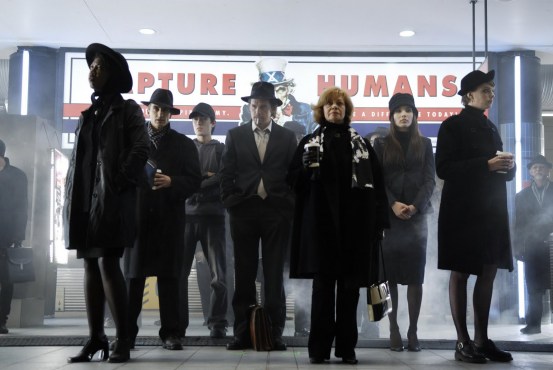
In 2019, vampires outnumber humans more than ten to one. The vampires have become somewhat comfortable with their dominant status, and now drive expensive cars away from suburban homes to boring white collar jobs in the city. Certain noteworthy changes in culture have resulted from this. For instance, all buildings and vehicles are now equipped with lead sheets that cover the windows during daylight hours, and loudspeakers broadcast warnings when there is one hour until daybreak. Vampires in suits line up at coffee stands for coffee with a shot of blood in it.

Subway commuters. And you thought vampires were cool.

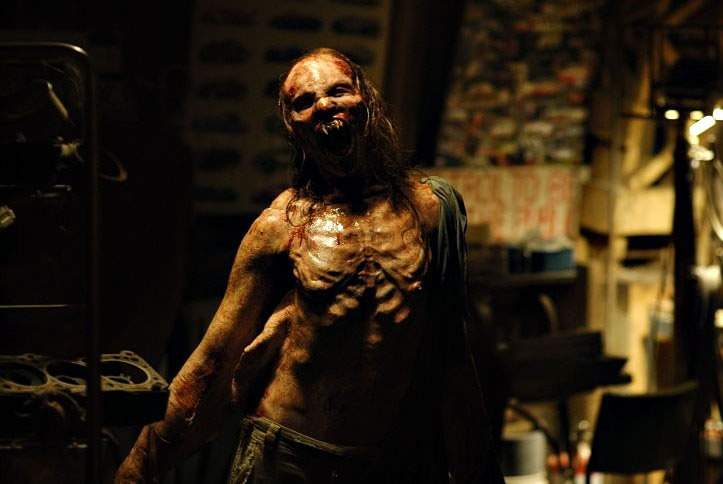
But of course, there’s a problem; one that you’ve probably already guessed. With so few humans left, vampires are in danger of starvation. Most of the humans still in existence are kept sedated, hooked up to giant machines ala The Matrix, being farmed for their blood. The government rations blood more and more strictly, with those in control keeping a little extra for themselves, naturally. An increasingly fearful – and hungry –middle class hurries past dark alleys and hides in their homes, and the lower classes, “subsiders,” deprived of blood, mutate into something out of … well, a vampire movie (below).

Amidst all this, we meet Edward Dalton (Ethan Hawke), chief hematologist for a corporation that controls most of America’s remaining blood supply. With riots breaking out over the blood shortage, the company is putting increasing pressure on Ed to create some kind of “blood-substitute.” Meanwhile, Ed wrestles with his conscience over being a vampire and refuses to touch human blood, to the detriment of his health. This creates a good deal of tension between Ed and his brother, Frankie (Michael Dorman), who hunts humans for the U.S. Army.

A small number of humans are still free, hiding in rural areas. After a chance meeting with some of them, Ed receives an invitation to the countryside to learn about a cure for vampirism that they have discovered, and a chance to restore balance to the food chain.

The cast drives this one home with a number of powerhouse actors. Sam Neil, whom we seem to see about as often as a real vampire, plays Charles Bromley, the CEO of Ed’s company. One of history’s most under-rated actors, Neil blends the smooth charm of a Manhattan sophisticate with the sinister nature of a bloodsucker in a fascinating way. The inimitable Willem Dafoe also appears as the grizzled former vampire who stumbled upon the miracle cure. A collection of Aussie stars (Daybreakers was filmed in Australia) rounds out the cast nicely.

Hawke and Dafoe do not suck in "Daybreakers."

Daybreakers could justifiably be called a horror movie, but not in the way one normally thinks of horror. It does get gory – even ridiculously so – at times, but it’s not about the gore. It’s about the horrors of a society that has gotten too comfortable, and is eating itself. As corrupt potentates drink blood wine and eat blood caviar, we wonder how much longer civilization can bear the strain. The pristine homes and manicured lawns of suburbia are nothing more than petty amusements the vampires use to distract themselves from their impending doom. Near the end, we bear witness to the kind of moral travesties that desperation is often used to justify. And it’s all horribly familiar; the story of our lives, retold through the bloodshot eyes of the undead.

I wouldn’t want to put anyone off this movie, because it is one of the best I have

Neil drinks blood, but still does not suck in "Daybreakers."

seen in a long time. For all of the negativity, it actually has a pretty uplifting ending (especially for a vampire movie), despite a few painfully sad moments along the way. There are also a number of genuinely fun scenes, including a hair-raising home invasion by a bat-like subsider. Even better, this scene is followed by an unintentionally hilarious crime-investigation scene, with every law enforcement cliché from the past 60 years standing around the decapitated body of this bizare creature from hell.

I figured I could get some work done during this movie, but my papers were left forgotten on the coffee table as I was glued to the screen. Daybreakers was only the second movie done by the Spierig brothers, but it’s as gripping and thought-provoking as anything out there. If you’ve got a strong stomach, it’s a must see.

[Rating:4/5]

Grave of the Fireflies (Hotaru no haka)

Grave of the FirefliesI often watch movies in 20-minute chunks while I eat breakfast, and while this sometimes creates a somewhat disjointed effect it is also the only practical way for me to consume cinematic material on a regular basis.  Recently a friend of mine suggested, in response to a Facebook post asking for suggestions of a good anime film, that I watch Grave of the Fireflies.  But, he cautioned, I should do so all at once instead of breaking it up into segments while I munch on rice krispies.  And so when I was at a conference recently I decided to shut out all distractions in my hotel room and focus solely on this movie while I watched it in its entirety.  Turns out my friend was right, and I was treated to one of the most engrossing tales of humanity ever committed to the silver (or, in the case of me and my laptop, LCD) screen.  Grave of the Fireflies is a heart-wrenching tale of devotion and despair, and one of the saddest movies I have seen since Schindler’s List.  The opening words, spoken by young teenager Seita, set the tone for the rest of the movie:  “September 21, 1945…that was the night I died.”  We then see him, bruised and hungry, as he lives out his final moments in a dirty train station.  The rest of the story is told in flashback as we see Seita and his young sister Setsuko and how their lives are transformed during the allied bombings of Japan during World War II.  Since the outcome is never in question, the focus of the film is shifted to the relationship between the two children as Seita struggles to care for his sister in the wake of their mother’s death during an air raid.

Grave of the Fireflies - Catching Fireflies

Seita and Setsuko reveling in the simple joys of childhood.

And what a relationship it is.  Though the two characters are colored drawings, they possess a deep humanity that is rarely seen in any movie whether live-action or animated.  The focus of the movie is on the simple moments that reinforce the love that Seita has for his sister, and the degree to which she depends on him for everything she has.  They play in the ocean, eat fruit drop candies, gather supplies for their makeshift shelter by a river, and catch fireflies in the moonlight.  Through it all Seita will do anything for his sister, sacrificing whatever he has and doing whatever it takes to get her the food and care she so desperately needs.  And that’s about it:  no conspiracies, no double-crosses, no hidden agendas, just a boy determined to care for his sister in the face of incredible odds and dwindling resources.  And even though we are fully aware of what will happen (to Seita, at least–the fate of Setsuko, though predictable, is not shown until the end of the film) we can’t help but be thoroughly enraptured with this simple tale of innocent care and affection.

In fact, I kept on expecting another shoe to drop:  when a group of children stumble across their shelter, my American movie sensibilities were bracing for the worst:  they would surely burglarize or vandalize the shabby campsite, leaving Seito and Setsuko even worse off than before.  But such conventional narrative tricks are nowhere to be found here, and serves to elevate Fireflies far beyond the level of typical cinema.

Grave of the Fireflies Seita Setsuko

War, as seen through the eyes of a child.

After Seita and Setsuko leave their hometown of Kobe they go to live with their aunt Akemi, and I found this to be one of the most frustrating segments of the narrative as Seita refuses to help out around the house, secure employment, or otherwise help the war effort of his native country.  After several sharp rebukes from Akemi, he decides to take his sister and seek shelter on their own–a choice that eventually leads to tragic ends for both children.  If only Seita had been more responsible, if only he had listened to his aunt, if only he had sought medical care for Setsuko sooner…if only.  And yet my frustration at the well-meaning but ultimately tragic decisions of Seita reinforces the strength of the film as a whole, as these flaws only served to draw me deeper into the story.

The simplicity of the story allows for a deep emotional connection to develop between the viewers and the characters:  sometimes Seita makes some fairly dumb decisions, and I found myself growing frustrated and irritated as I watched.  Setsuko is one of the most convincing young children I have ever seen in a movie–animated or live action–and the impeccable voice acting perfectly complements the stunning animation.  Metaphors abound too:  from the fireflies, which burn bright but reach the end of life so quickly, to Seita himself as a representation of Japan and her stubbornness to admit defeat in the face of overwhelming opposition.

I am not a soldier, and from the comfort of my living room which I so freely enjoy thanks to the ones who have bravely served in the line of duty, I am hardly in a position to make any sort of political statement on the validity of war.  But having seen many, many war films from Bridge on the River Kwai andThe Great Escape to Platoon and Saving Private Ryan, I can say that Grave of the Fireflies stands toe to toe with the greatest war films of our time, and possibly even since the inception of the medium.  It is a profound and deeply personal tale of how the hardships of war can affect the deepest of human connections.

Rating:[Rating:4.5/5]

As a side note, I cannot stress how important it is to see this film presented in Japanese. The voice acting is absolutely superb, and the American voiceover, as is the case with most anime, strips the film of much of its emotional weight.

Iron Man 2 (Take-Two)

Guess what? Summer begins early, as it does with the year’s major blockbuster movies.  Robert Downey, Jr. is back in action shooting to thrill, and let me just say, “Iron Man 2,” while not coming out blazing, still knocks last year’s hideous kick-start “Wolverine” out of the park.

Director Jon Favreau and his star Downey hit the jackpot two years ago with the release of “Iron Man.” Not only did it manage to be the year’s second biggest domestic hit, bested solely by “The Dark Knight,” but it inched past Spielberg’s return to “Indiana Jones,” and even managed to become one of the year’s best-reviewed films.  Audiences loved it even more.  With the release of Marvel’s second installment, the winning streak continues, but not nearly to the same effect.

“Iron Man” did the impossible.  It blended moderately abundant action sequences into an impressive character study of Tony Stark, a weapons creator so self-absorbed and ignorant to the reality of the business he deals in.  Upon a rude awakening, Stark changed his vision for developing the ultimate weapon, eliminating multiple trigger-fingers, and standing alone as the sole necessary weapon of the United States.  “Iron Man 2” picks up where we last found Tony, only this time out, returning director Jon Favreau seems to be less interested in the thrills so predominant in the first outing.

In “Iron Man 2,” Stark has to take on the U.S. government, demanding that the Iron Man weapon be turned over to the military, as well as face off against multiple foes (Sam Rockwell, Mickey Rourke) trying to end his career and his life.  His friendship with Rhodes (Don Cheadle) is tested, as is the sexual tension between him and Pepper Potts (Gwyneth Paltrow).  On top of that, Nick Fury (Samuel L. Jackson) starts hanging around to try and encourage Stark to stop fooling around and join the Avenger initiative.  Add in the fact that his new secretary (Scarlett Johansson) seems to have a secret looming and the reality that Tony’s power source that keeps him alive also has potentially fatal side effects on his body–it seems the man sure has his work cut out for him.  So much going on and so little intensity… But where’s all the kaboom??

It might be scary for fanboys to find out that “2” may have significant meaning in regards to the action on display in the film–the movie literally contains two action sequences to devour.  Not to say that burdens Tony Stark’s latest adventure, but it does allow for the content of this installment to be swarmed by multiple subplots and characters that never really advance the story in an exciting way.  Granted, this isn’t the cobbled mess that “Spider-Man 3” was, it just hasn’t the finesse of the film that preceded it.  Since no one could describe this as “an action-packed thrill ride,” Iron Man 2 luckily has brilliant actors and a very solid director in Favreau to save it.

This movie is totally, completely and utterly about Robert Downey, Jr.  Sure, we have all these great supporting actors, but every reason to see this movie rests upon the shoulders of a more-than-capable star portraying the single most interesting superhero character in the history of cinema.  Yes, I said that.  Who needs Bruce Wayne and his whiny-baby, cloak and dagger, angry teenager antics?  Who cares if Peter Parker can’t figure out if he’s more capable as a  human in love, a protector of New York, or an emo break-dancer?  Who wants to waste their time wondering why Wolverine can’t get his claws together and tell his past to go find someone who cares?  Tony Stark doesn’t play those games.  Downey has a fully realized character–top-dollar hilarious and engaging.  The movie goes for long stretches without things blowing up, and Downey manages to capture our attention with his inventiveness and brilliance as actor.

If the movie never reaches the level of the 2008 predecessor, it’s because the movie has a lot more down time and subplots.  The studio seems so bent on bridging “The Avengers” movie two years out, that Stark’s story suffers, and the movie becomes overwhelmed with exposition and witty banter.  At least it doesn’t kill the movie, and the action in the film really does deliver even in its limited doses.  Even Favreau allows himself to have a little game time, upping his role in the film, and kicking some butt in the middle of the big finale.  “Iron Man 2” may not be the film that ups the ante as far as sequels typically go, but the movie still manages to be plenty entertaining for two hours, and it contains a fully-realized hero that consistently breaks all the rules and dares to be wholly memorable.  Even if fanboys are left wanting more explosions, I’m sure they’ll be satisfied with this outing and jazzed about the upcoming showdown.

[Rating:3/5]

Iron Man 2

This is why great movies shouldn’t have sequels. Make no mistake, Iron Man was a great movie. It took a character from the depths of obscurity and made him a national symbol. Sure it was a comic book movie, but it had more heart and more flare than a lot of more serious films. The story of a man totally absorbed in himself and his own pleasure being changed and using his power to protect those who couldn’t protect themselves was truly inspiring, led by a truly gifted actor. The action, while limited in quantity, was excellent in quality.

How do you follow an act like that? Well, at the command of the almighty dollar, Marvel Studios had to try. To be fair, what they came up with is watchable, in fact clearly a better sequal than their colossal disappointments of Spiderman 2 and X2: X-Men United, but it has none of the power of Iron Man.

The scene in Iron Man where Stark rescues the villagers from the Ten Rings is a scene I’ll probably never forget. It took two thirds of the movie to get to Stark’s first heroics as Iron Man, but it was well worth it.

If you’re thinking that, now that we have the origin story out of the way, we’ll get some extra action and heroics, think again. Marvel has to cram in more subplots and implausible characters to eat up time. Well, that’s not so bad, you say, more plot development is good, right?

Not when the writers are used to writing for comic books. Comic books have room for stories that go in circles, whereas movies simply don’t. For example, in part 2, Stark finds out that he’s dying due to the effects of the reactor core he built in part 1. Precious time for action sequences disappears forever while he remodels his workshop to build a machine and creates some “new element” that was supposedly impossible to create through a process the movie never even tries to explain. This new element magically cures his ailment and everything goes back to normal, so it doesn’t even drive the story. If I were to read through a decade’s worth of monthly comic book issues, I would expect some filler crap like this, but for a movie, it’s just wrong.

Similarly, after Stark seemed to have gotten a new set of priorities in part 1, in part 2, we get more of him staggering drunkenly, driving sports cars, and trying to score. When someone turns over a new leaf, is it unreasonable to expect them to never relapse? Probably. But that’s not the point. Why are we paying to watch the same stuff over?

Unlike comic serials, which are expected to keep a story going perpetually, a movie can, and should, present a coherent story that stands on its own and doesn’t waste time with filler. Judging by the buzz among nerds over the past few years, and by the easter eggs in both Iron Man movies, Marvell plans on changing this. Iron Man 2 is actually set-up for movies about Thor and the Avengers (who include Iron Man). In other words, Marvell plans on making movies more like comic books, written not so much to entertain as to advertise the next movie and keep you coming back for more. This might score with the hardcore comic nerds, but I doubt the general public will tolerate it for long.

I should probably say that Iron Man 2 is not horrible, and is even kind of entertaining if you turn your brain off. I’m sure there will be a third one, and I’ll probably see it. After all, both Spiderman and X-Men made improvements with their third installments. Once Iron Man 2 is out on video, it won’t be a bad way for you to kill two hours.

[Rating:2/5]