Archives for November 2009

Star Trek

This review isn’t exactly timely, as Star Trek was released in theatres over six months ago, but having just watched it for the fifth time (four times in the theatre, once at a friend’s house a few nights ago), I think it’s high time we had a writeup of one of the best science fiction movies in years here on Walking Taco.

My history with Star Trek dates back nearly twenty years: the first episode I remember seeing was Final Mission, with my cousins Jason and Nathan at their home in Saint Louis when I was only about ten years ago.  Since that young age I have been hooked on Star Trek, not just for its portrayal of science fiction, but for the characters.  The genius of Gene Roddenberry’s creation lies not in fantastic tales of starships exploring the galaxy, but in using that backdrop as a canvas to paint a tapestry of human interactions and as a way of exploring the human condition in 45-minute chunks every week.  Several spinoffs and ten movies later, it’s this core strength of Star Trek that keeps it relevant in a world where many of the futuristic gadgets and fiction elements of the series are now most decidedly fact.

Part of Star Trek movie lore is that the even-numbered movies are generally the best:  Wrath of Khan, The Voyage Home, Undiscovered Country, and First Contact are the better of the celluloid-based incarnations of the series.  The cycle was broken…no, entirely blown away, with Star Trek Nemesis, though, a film that debuted at #2 on its opening weekend, next to Maid in Manhattan.  Yes, any time a movie series opens below a Jennifer Lopez movie, you know there’s trouble.  And so the series stagnated, and after seven years it was time for a reboot–not only of the franchise, but of the entire Star Trek timeline as a whole.  Star Trek (no subtitle this time, folks) is a reinvention of the franchise that turns everything we know about Trek on its head, while staying true to the core concepts so deeply rooted in Roddenberry’s original series in such a way that most of the newer TV spinoffs and movies have never even done.  It makes Star Trek relevant again, and updates the series for a new generation of youngsters raised on the science fiction movies and TV shows that have cropped up in the wake of Star Trek, but unaware of how amazing the source material, when peeled back to its basic fundamentals, can truly be.

Spock and Kirk, reimagined for a new generation of moviegoers.

Spock and Kirk, reimagined for a new generation of moviegoers.

The movie, directed by J.J. Abrams, begins aboard the U.S.S. Kelvin, a starship out exploring during the early days of Starfleet.  Upon investigating what is described as a lightning storm in outer space, the crew realized it’s actually a black hole-type of anomaly with a giant ship emerging from it.  The commander of the ship orders the captain of the Kelvin to come over for a chat, which leaves George Kirk in charge of the Kelvin.  Shortly thereafter, the captain of the Kelvin is killed, a battle ensues, everyone abandons ship including Kirk’s pregnant wife who has just gone into labor.  But wouldn’t you know it, Kirk is the only one who can fend off the incoming torpedoes long enough to provide an escape for the exiting shuttlecraft.  Sure enough, Kirk ends up sacrificing his life for his crew, but gets just enough time to go over baby names with his wife before he kicks the bucket.  And yes, their son, born amidst the chaos of a space battle, grows up to become the famous James T. Kirk we all know and love.

Right away the movie deviates from established canon of the series, as any Star Trek fan knows Captain Kirk was born in Iowa and knew his father rather well–a fact that is actually acknowledged by the movie at one point.  But the appearance of the mysterious spaceship (which, we find out, came back from the future to prevent a planetwide catastrophe) serves to alter the history of Star Trek lore altogether.  This genius move by Abrams and co. allows them to have near-total creative freedom within the Star Trek universe–no longer constrained by what *should* happen, according to the hundreds of hours of existing Star Trek TV shows and movies, they are free to have the characters we know and love do anything they want to.  And yet Abrams

Simon Pegg does an excellent job as Scotty, the ever-frazzled chief engineer.

Simon Pegg does an excellent job as Scotty, the ever-frazzled chief engineer.

plays this mechanic with a very even hand, not having the familiar characters deviate from their expected norms, but at the same time crafting a Kirk, Spock, Uhura, and the rest of the bridge crew, who are familiar and brand new at the same time.  In fact, the actors do an amazing job of inhabiting their characters throughout the movie, especially Zachary Quinto in the role of Spock.  His every nuance is so dead-on that it’s almost as if Leonard Nimoy himself were playing the role, and when Quinto’s Spock meets up with Nimoy’s Spock at the end of the movie, it is as if we really are watching the exact same character, to the point that it hardly even seems like two different actors.

The plot is outlandish and far-fetched, but fits the tone of the movie perfectly.  Planets are destroyed, armadas are locked in combat, ships explode, people are chased by giant monsters, and in the middle of it all are two time-traveling spaceships whose existence changes the entire fabric of the universe.  And even after watching the movie five times, I am still amazed at how much action there is.  Hardly a minute goes by when there’s not a fistfight, firefight, spaceship battle, or black hole sucking in everything in its path.  But at its core, the movie is not about action, explosions, or spaceships:  it’s about a young man coming face to face with his own destiny.  It’s a retelling of the Hero Myth we have heard time and time again from infancy–a myth that is forever immortalized by Luke Skywalker staring at the twin suns of Tattoine as he contemplates what the future holds.  Indeed, Star Trek even acknowledges this with young Kirk gazing at the Enterprise while it is still under construction, pondering what lies ahead for him.  My only thought now is what lies ahead for the series, and this movie leaves me with more hope and excitement for Star Trek than I have had in quite some time.

Rating: [Rating:5/5]

Batman: Mask of the Phantasm

I really liked Batman: The Animated Series when I was growing up.  It was a cartoon that dealt with some very weighty subjects, was not often played for simple laughs, and pushed the limits of what could be seen on afternoon network TV in terms of violence and thematic material.  But woe to the concerned parent who confuses violence with bloodiness, as the animated bullets were rarely the cause of death, and Batman himself was never one to go around shooting people or even killing his enemies.  In fact, the show was more of a morality play than anything else, and certainly dealt with mature life-and-death themes than anything else on TV at the time (think Power Rangers and Animaniacs).  But despite my affinity for the Animated Series, I never got around to watching the bigscreen incarnation of the show until just this past week.

From what I could tell before watching Phantasm, it was set to offer more of what made the Animated Series so great:  weighty subjects, conflicted heroes, and a world that was far more grey than black-and-white in terms of the good guy/bad guy vignettes that played out in similar TV shows and movies.  And while the movie does have these elements, it is also lacking in the sort of grandiose presentation and storyline that I had hoped from a cinematic adaptation of such rich source material.

The story purports to be multi-layered, and in some ways it is, but again, not as much as I suspected it might be.  Batman is once again fighting villains, both internal and external, and faces off against one of his longest-running foes as well as a new one, the Phantasm referenced in the title.  Local underworld bosses and masters of organized crime leaders are being offed by the Phantasm, a shadowy ghostlike figure impervious to bullets with the ability to appear and disappear at will.

The Phantasm.  Has Batman met his match?  Tune in next week...same bat-time, same bat-channel!

The Phantasm. Has Batman met his match? Tune in next week...same bat-time, same bat-channel!

Trouble is, the public is led to believe that Batman is the one doing the killings, and even good ol’ Commissioner Gordon finally turns on our intrepid hero.  Bruce Wayne, meanwhile, is reintroduced to his old flame Andrea, the woman to whom he was once engaged before beginning his days of crimefighting.  This type of relationship, the genesis of which is told through a series of flashbacks, is endemic to the series as a whole, as it presents serious themes of desire, longing, and the chasm between reality and the carrot that is perpetually just out of reach not only for Bruce Wayne but for many of us as well.  The one thing that will bring the most happiness to Wayne is the one thing he can’t have, and this realization is what leads him to ultimately shut himself off from the real world, and real relationships, and take on a secret identity of reclusive crimefighter.

Origin stories are nothing new to theatrical adaptations like this, and I appreciate that instead of seeing another recap of how Bruce Wayne’s parents were murdered, we see what is essentially the cliffs notes version of Batman: The Teenage Angst Years.  Seeing Andrea again brings all these long-buried questions back to the surface for Wayne, and it casts Batman in a different light that I find particularly refreshing and altogether human.

However, the creators bring the ever-present Joker into the mix, at which point the storyline devolves into a more-or-less typical after school Batman episode.  Joker is once again running amok in the city but this time the mysterious Phantasm is also trying to thwart his criminal exploits.

Bruce Waynes old flame, Andrea Beaumont.  But is there more to her than meets the eye?  Hmm...

Bruce Wayne's old flame, Andrea Beaumont. But is there more to her than meets the eye? Hmm...

The identity of the Phantasm is thus another layer to the plot, but it’s not too hard to figure out and the reveal is somewhat of a predictable letdown.  In fact, the climax of the movie has a girl in distress whose only hope is to be saved by Batman.  Holy déjà vu!

While I appreciate the effort to flesh out some of the Bruce Wayne/Batman persona, I wish this movie wouldn’t have fallen back on some of the tried-and-true tricks of the trade.  I also find the (forgive the expression) cartoonish lack of explanations for various elements frustrating.  The Phantasm is, of course, a real person and not a ghost (anyone who’s ever seen an episode of Scooby Doo will know this immediately) but their (and I use the improper plural pronoun on purpose) ability to absorb bullets and disappear in a puff of smoke is never explained.  The ending chase/rescue is a bit much to take even by cartoon standards.  On a side note, however, it was nice to hear Mark Hamill back at his blood-curdling evil-villain-laughter best once again.  :)  All in all the movie is decent entertainment, but not as good as it could have been given its wonderfully brilliant pedigree.

Rating: [Rating:3/5]

Dr. Horrible’s Sing-Along Blog

Dr. HHave you ever found a movie sufficiently interesting that you watched the director’s commentary, hoping it would enhance your enjoyment of the film, only to waste two hours listening to pointless self-congratulations? Dr. Horrible’s Sing Along Blog (Dir. Joss Whedon) has one of those few commentaries that I actually watched a second time – and just might watch a third. What makes the commentary so good is the same thing that makes the movie so good – the music. Dr. Horrible revives a dying art: musical theatre. Many genres of music are exhibited in the film, and in Commentary: the Musical.

Neil Patrick Harris of Doogie Howser fame stars as Dr. Horrible, an aspiring megalomaniac who is striving to be admitted into the Evil League or Evil (ruled by a horse – go figure), but is hampered by his aversion to murder. Meanwhile, he gazes longingly at Penny (Felicia Day), a girl he sees at the laundry mat (“I’m just a few weeks away from a real audible contact!”). As the script would have it, Dr. Horrible’s crucial heist of “wonderflonium” to fuel his freeze ray is the same occasion that Penny first talks to him. He succeeds in stealing the wonderflonium, but is nearly foiled, and badly beaten, by his nemesis, Captain Hammer (enthusiastically played with ample cheese by Nath3an Fillion). Captain Hammer is an unsympathetic super hero who fights crime mainly for the pleasure of beating up on mad scientists and taking advantage of groupies (“this is so nice, I just might sleep with the same girl twice!”). To add insult to injury, the chaos gives Hammer the chance to save Penny, and Dr. H. watches them fall for each other (right). Hammer’s bullying eventually pushes Dr. H. over the edge and leaves him willing to do what he must to get into the E.L.E. (Penny may cry, but her tears will dry when I hand her the keys to a shiny, new Australia.)

This film debuted in the summer of 2008, being broadcast over the internet. Whedon funded the project himself, at just over $200,000, and used his home as a studio. The production is a bit rough. One thing you’ll notice is that the actors wear little-to-no makeup, showing their blemishes to the world. Gutsy. Hammer’s “costume” is a T-shirt with an iron-on. The movie was blogged while in production, and the marketing was immediately taken over by Whedon’s internet-savvy fans. When the film was finally broadcast, the network almost crashed from the number of viewers.

I rented this one on Netflix and wound up watching it over and over, not so much for the movie as for the songs. At 43 minutes, the film doesn’t develop its story very well. Then again, that doesn’t stop people from loving The Phantom of the Opera. Much like Phantom, Dr. Horrible is more of a concept album with a moving picture in the background than a real movie. That said, also like Phantom, Dr. Horrible is worth watching just for the music. Harris in particular demonstrates some real voice talent. The lyrics have a depth to them that you don’t see in contemporary pop music, and keep coming up with different rhyming patterns. Almost every scene involves a well written and well performed musical number, my two favorites being the anguished “My Eyes” and the ominous “Brand New Day.”

As if that wasn’t enough, they added Commentary, in which they brought back virtually everyone who was involved in the movie to sing at least one song. Just about every type of music you can think of is covered, including a rag, jazz, and lounge singing. To top it all off, Marissa Tancharoen, co-writer and “groupie #1” sings a rant about how “no one’s Asian in the movies” (not sure where she gets that).

The DVD also includes videos of applications for E.L.E. membership that fans sent in. Each one has an original song. Be warned, some of them are what you’d expect from geeks filming in their living rooms. Some, however, are quite good, most notably an evil rabbi who pitches a plan to blow the tip off the Washington Monument, and a Catholic priest who has a disturbing take on Catholic theology in the form of a rap.

I have to say the writers really dropped the ball on Act III of the film, because the ending sucks. It’s the kind of ending that gives the impression that they meant to do more, but just ran out of time/money/steam. The idea seems to be that Dr. H. get everything he ever wanted, except that he inadvertently destroy the thing he wanted most. But it’s implausible to the point of not making sense. It tries to do in 5 minutes what would have taken about 50, and leaves the audience feeling like they’ve been plunged into nihilistic darkness for no reason.

The decision of what rating to give this film was a difficult one. It’s a bit too simplistic and unintentionally comical to be considered a true contribution to the world of cinema, which would justify a four-star rating. In fact, with an ending that falls flat on its face, I can’t even consider it a solidly good movie, which would merit three stars. On the other hand, it’s too well done and innovative to be passed off as just another piece of mindless entertainment (two stars). Hence, I have decided to give it

[Rating:2.5/5]

American Movie

The first time I saw American Movie was sort of like the first time I saw This Is Spinal Tap.  I didn’t get it.  I didn’t see the humor, I didn’t understand the point, and I was just plain ol’ bored.  I remember renting it with my brother Andy and cousin Jeremy clear back in high school and after an hour or so we gave up and watched Terminator instead.  And for a while I thought nothing of it, but noticed that American Movie would show up on various “Top Movies” lists put out by various print and online publications from time to time.  I found this curious, but little more, and it wasn’t until I stumbled across Rotten Tomatoe’s 50 Movies for 50 States list that I decided to give American Movie another try.  Was it worth it?  Yes and no.

Ostensibly, American Movie is a documentary that chronicles would-be director (and beer-swilling Wisconsin thoroughbred) Mark Borchardt as he struggles to complete his horror film Northwestern.  Due to a severe lack of funds, though, Borchardt decides to finish another film he had been working on called Coven instead.  His plan is to sell 3,000 copies of Coven, at $14.95 each, which would give him enough financial wherewithal to accomplish his goal of completing Northwestern.  Documentarian Chris Smith thus follows the filming of Coven for over three years, and in doing so, creates what is essentially a Spinal Tap for low-budget indie flicks (one of the jokes being that American Movie is itself a low-budget indie flick).

Mark Borchardt and Mike Schank, the dynamic duo of Milwaukee filmmaking

Mark Borchardt and Mike Schank, the dynamic duo of Milwaukee filmmaking

The hero, or perhaps simply the protagonist, of American Movie is Borchardt, a guy in his upper 20’s with a dream of becoming a filmmaker.  He has almost no means by which to accomplish his dream, though, and instead whiles away his days by drifting from one odd job to another (one day he’s delivering papers, the next he’s a cemetery custodian), occasionally parenting his children, trying to make a relationship with his girlfriend work, and also get in some shots for Coven.  Helping him out is his longtime friend and movie-making buddy Mike, a burnout with a penchant for playing the guitar and barely enough motivation to even get out of bed in the morning.  Rounding things out is Mike’s uncle Bill, a miserly, crotchety, bitingly sarcastic retiree who lends money to Mark even though he’s not entirely sure why.

No one can fault Borchardt for a lack of vision, though, and despite all common sense he dutifully forges ahead with the filming of Coven, oblivious to a fault to just how badly the odds are stacked against him.  He has grand visions of what he wants to accomplish, but things never seem to work out quite right.  Actors (read: locals who responded to “casting call” flyers in grocery store windows) don’t show up for filming, equipment breaks down, footage is lost, and money is virtually nonexistent.  Nevertheless, Borchardt continually forges ahead with Coven, often at the expense of family and friends, not to mention a relationship with his own children.

The cynical, sarcastic, and profoundly hilarious Uncle Bill

The cynical, sarcastic, and profoundly hilarious Uncle Bill

And this is where American Movie becomes more than a simple documentary about a guy who wants to make a movie.  It’s a deeply profound insight into the plight of the American Dream as it exists today.  Beneath that is also an indictment of the grade-school creedo that you can accomplish anything you put your mind to.  Borchardt has to face the harsh realities that span the gulf between dream and realization, but one thing that stands in his way more than anything else is his refusal to take stock of his situation and realize that he could possibly change things if he wanted to.  Better planning, a clearer line of communication between him and his (albeit somewhat limited) support staff, some community college courses in film production…any number of things could have been done by this aspiring director to lift himself, and his projects, to the heights he dreams for them.  He really does want to make movies, and he really does set his mind to it, but he seems condemned to wander the path of mediocrity.

But something about Borchard’s story is very interesting, engrossing, and often flat-out entertaining.  Watching him interact with Uncle Bill is often downright hilarious, and one priceless scene involves Borchardt trying to get his uncle to say what is supposed to be the opening line of the movie–a very simple recording process that just doesn’t quite work out.  Another highlight of the film is a scene in which a man’s head is shoved through a cabinet.  Borchard knows what he wants to happen, but he and his “crew” just can’t get it right:  the cabinet door doesn’t break like it’s supposed to, the cameras aren’t positioned correctly, and when they finally get the man’s head through, he is seriously injured and lays on the floor bleeding.  A microcosm of the movie as a whole, really, that also showcases Borchard’s odd sort of dedication to his craft:  he is so concerned with wanting to be a good director that he doesn’t just be a director.  Smith also includes a host of clips from interviews with Borchard’s family, friends, and people around town who have heard of him through the grapevine.  In the end we get a very intimate portrait of a dedicated but somewhat misguided man (his fumbling camerawork often comes at the expense of even having a good relationship with his children), and yet, we are never asked to gawk like distracted commuters passing an interstate accident.  We are instead shown the portrait of a man with myriad personal faults who chases his cinematic windmills with such aplomb that it’s perhaps even a bit inspiring.

And so I leave American Movie with some confused semi-admiration for its subject, wondering if I witnessed something deeply profound, profoundly sad, or confoundingly entertaining.  Maybe in another ten years I’ll give it another shot and see what happens.

Rating: [Rating:3.5/5]

The Taking of Pelham 123

the-taking-of-pelham-1-2-3Armed men hijack a New York City subway train, holding the passengers hostage in return for a ransom, and turning an ordinary day’s work for dispatcher Walter Garber (Denzel Washington) into a face-off with the mastermind (John Travolta) behind the crime (IMDB).

Tony Scott’s attempt at remaking 1974’s “The Taking of Pelham One Two Three” surprisingly fails, when in reality with all this talent involved, it should be sizzling. Not that there’s much you can do to improve the other classic film, but giving it a modern spin with scenery chewing actors like Denzel Washington and John Travolta should be one of the most exciting films of the year. Not to be. Scott’s infamous MTV editing that overwhelmed “Man on Fire” and “Domino” is on display here once again, the dialogue is trashy, and the director also seems to have little faith in the suspense of the story. Truthfully there isn’t much, unlike the original, and so Scott splices some ridiculous crash sequences (which really feel quite stupid) in between Travolta’s rantings.

That brings up Travolta, a talented actor and sometimes entertaining villain (Face/Off, Broken Arrow) and other times not so much (Swordfish). But what seems a perfect vehicle for him, turns out to be one of his most ham-fisted performances in quite some time. His constantly whiny bad guy, Ryder, seems to lack any shred of intelligence, and his dialogue in this thing is often unbelievably campy. While Denzel Washington has a settled in, humbled performance that doesn’t require much, Travolta is rather hilarious and doesn’t play well in generating any tense moments.

This new “Pelham” is not the wild ride and sparring match-up it should have been. I typically like Tony Scott’s work (True Romance, Crimson Tide, Enemy of the State, Spy Game) and even much of his maligned work (Man on Fire, Domino, Deja Vu). But “Pelham 123” is a ludicrous bore that has none of the suspense of the original, and wants to be a popcorn actioner when it should be an intense thriller. A major disappointment. I encourage anyone interested in this film to check out the original film first.

[Rating:2.5/5]

-MJV & the Movies

Paranormal Activity

paranormal-activity-poster“Paranormal Activity,” an $11,000 horror-wonder, has used its marketing and word-of-mouth among the college crowd to succeed as a $100 million hit for Paramount Pictures.  While a post-Halloween review of the film may be a little late in the game, the film is still having an impressive impact at the box office and will likely add another $10-15 million to its unbelievable haul.  Only unbelievable in comparison to its budget, the film really is 2009’s “Blair Witch Project,” another handheld documentary-esque horror film that kickstarted this whole shaky-cam push for the “it’s-really-happening” approach–a film that also managed to gross over $100 million.

I do appreciate a well-constructed horror film.  Too often ‘horror’ as a genre fails to reach beyond the cliche-riddled approach of the slasher flick, and now the ‘torture porn’ arena that has exploded in cinemas with movies like the “Saw” canon and “Hostel.”  While it may appear that the shelf life of splatter cinema is dying out (look at Saw VI’s box office), “Paranormal Activity” retrospectively plays on some of the horror genre’s greatest strengths–spirits, ghosts, demonic possession, haunted houses, and all those unearthly entities that cannot be beaten.

The story here actually centers around a seemingly “typical” American couple, Katie and Micah, terrorized by an unseen force in their house.  Warnings from a local ghost-whisperer warn the pair that the spirit is no ghost, but an angry demonic presence that he cannot deal with.  The couple is strapped for options, and so Micah sets up a home video camera to capture the events occuring throughout the day and night, and of course, creepy images abound and the terror increases over time.

Audiences have overall been praising this one, overhyping to unbelievable levels–or at least that’s what I read all over the internet.  Anyone I’ve actually talked to about the film in person seems have only been mildly amused by the film’s proceedings.  I mostly agree.  While “Paranormal Activity” deserves props for its atmosphere and its accomplishments with such a small budget, the film still takes too much time between the events taking place.  This is a film that really stretches out the patience of audiences not initally gripped by its very proposal of a potential demonic spirit.  Doors slam, crash noises occur, lights flick on and off, and grunting noises come through a digital audio feed.  By that time the film has reached beyond its halfway point, and when creepier things do happen, the pacing picks up some.  But I couldn’t help but feel underwhelmed by the ordeal.  The film also preys on the character’s isolation quite a bit.  Of course it helps to maintain the sense of dread and confinement, but I constantly questioned why Katie and Micah simply don’t leave the house.  Yes, their ghostbuster guy tells them that it won’t matter if they leave (the demon will follow them), I find it hard to believe they would put up with some the film’s later events without giving it a shot.  Also, these characters seem normal other than the fact that they’re home all the time.  Do they not have normal everyday jobs?  Are they not around several other people?  I don’t know, but if my house was haunted– first, I’d be out of there, and second, the world would know about it.  These two choose to stay in this house of horror, and somehow manage to sleep at night.

Unfortunately, the film was a bit of a letdown–an admirable step in the right direction for the genre, but one that misfired for me.  A lot of the hype probably had something to do with it, and the fact that the home-video style has worn out its welcome for me.  The ads on TV mostly showcase audience reaction to the film rather than actual footage of the movie, and while that’s an awesome approach in marketing, I sat in a packed audience that never screamed at the screen.

[Rating:2.5/5]

-MJV & the Movies

Zombieland

Z-land posterWhat is with all these zombie movies?? Is our culture really so morbid that we can’t get enough of seeing human bodies hacked to pieces? Zombieland (Dir. Ruben Fleischer) is only the latest in a veritable flood of ketchup-splattered, limb-laden flicks from the past few years in which humans are transformed into flesh-eating monsters and terrorize the few souls unaffected by the radiation, virus, or whatever.
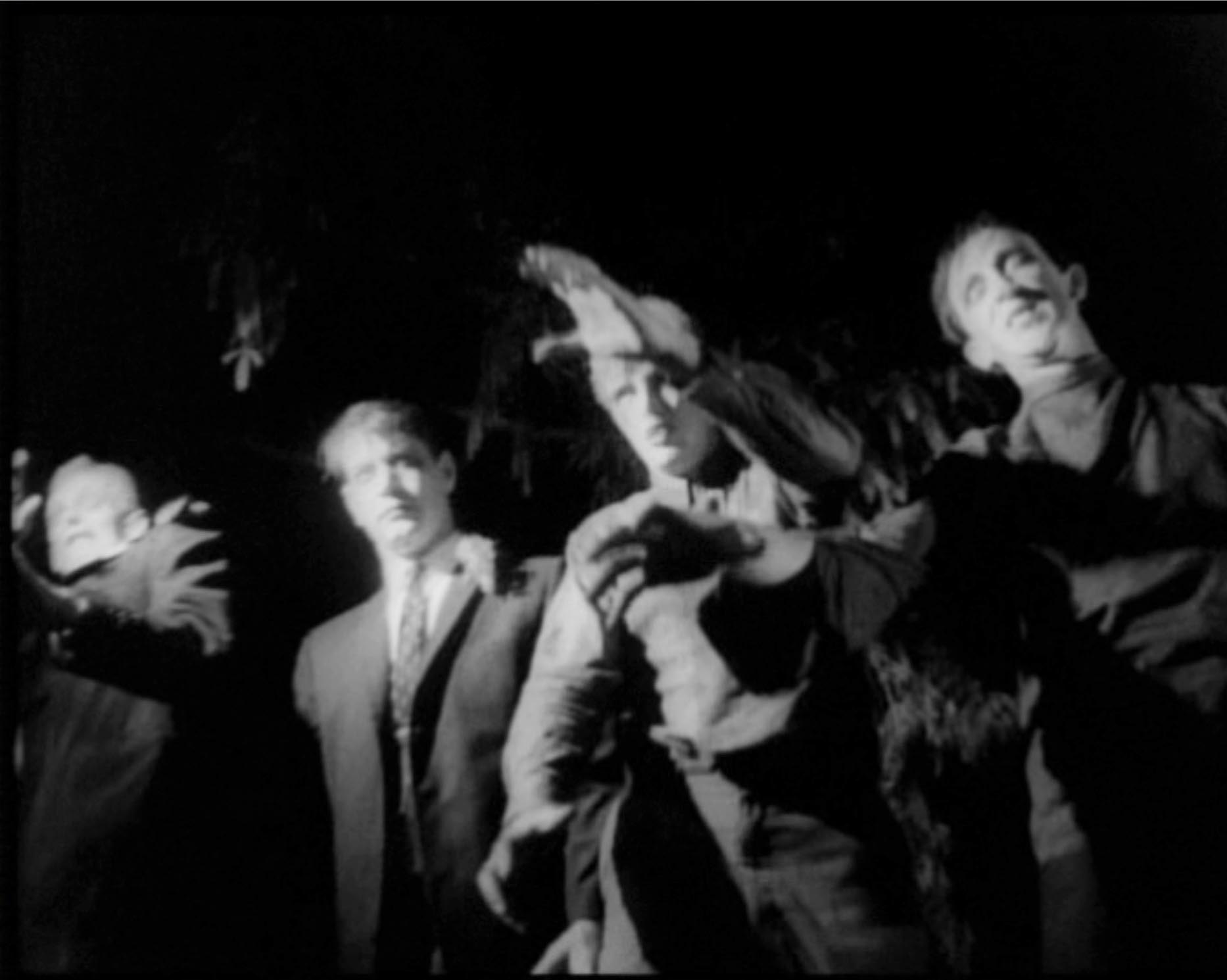
The zombie phenomenon began as a trickle in 1968, with Night of the Living Dead (Dir. George Romero), whose two sequels didn’t arrive until 1978 and 1985. Those three movies were later re-made, however, along with new sequels City of the Dead and Land of the Dead. Add to that the Resident Evil series (Dir. Russell Mulcahy) and 28 Days Later and its sequel 28 Weeks Later (Dir. Danny Boyle), and it becomes clear that what once appeared to be a few strange but isolated incidents is now an epidemic sweeping the world. Indeed, a trip to the movie section at Wal-mart will turn up no end of little-known, low budget zombie flicks that never made it to theaters, each boasting its “gruesome” and “shocking” qualities. And now, we are soon to be hit with a remake of the Worst Movie Ever Made, Plan 9 fom Outer Space.

Night of the Living Dead; the first zombie movie, and probably the best.

Night of the Living Dead; the first zombie movie, and probably the best.

The term “zombie” originated in Afro-Caribbean folklore, in which the dead could be revived by a “bokor” or sorcerer. By the 1950s, zombism (well, it’s a word now) was caused by radiation, just like everything else back then. More recently, zombism is usually caused by a virus, as in 28 Days or Zombieland.

As the bard will tell you, all fiction eventually becomes a satire of itself. Such was the case in Edgar Wright’s Shaun of the Dead in 2004. Shaun is not the best of films, but nonetheless demonstrates a certain comedic brilliance in the way it backhands the zombie sub-genre. Our hero, Shaun (Simon Pegg), is staggering through his mediocre life, working the same dead end job, day after day, having problems with his girlfriend, etc. Which is why the trailer asks “do you ever feel like you’re turning into a zombie?” As luck would have it, Shaun’s world is overrun by real zombies. But even with a zombie apocalypse is in full swing, it takes Shaun a long time to notice that anything is amiss. One morning, he stumbles, half awake, across a street, past a burning car and a distant crowd of zombies into his neighborhood quick shop. He retrieves a beverage from a refrigerator inside, oblivious to the bloody handprints on the glass door, and proceeds to the counter, barely pausing when he slips in something all over the floor. Finding no one at the counter, he drops some money on it and heads for the door. As he’s leaving, the clerk, now a zombie, comes shambling out of the back room. Shaun yells “hey Eric, I left the money on the counter,” and leaves.

Shaun: A hero must rise. From his sofa.

Shaun: A hero must rise. From his sofa.

Shaun and his friends survive one scene by pretending to be zombies; something that Zombieland borrows. Perhaps uniquely among zombie movies, Shaun ends with the crisis actually being solved by the authorities – and the zombies being employed in the service industry. The final scene is of Shaun playing video games with his roommate, who is now a zombie and chained to the wall, lest he take a bite out of Shaun. The point of it all being: If the recently dead did reanimate and seek to feast on human flesh, things really wouldn’t be that different from the way they are now.

But is that such a fresh message? Zombie stories always implied that civilization was inherently fragile and left us wondering if humans were that different from zombies. Dawn of the Dead takes place in a shopping mall, after all. Heck, zombie fiction was probably spawned by the breakdown of societal relations.

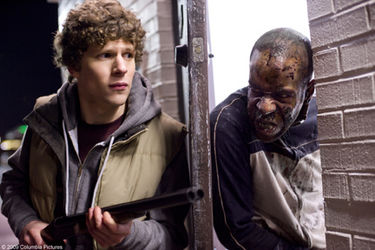
Zombieland is definitely more comedy than horror. It’s not even scary, unless you count the occasional cheap shock (industry term for when something jumps out at you). I laughed pretty hard, though. It’s hard to believe a movie that goes through so many drums of corn syrup could be this lighthearted. The main part of the action kicks off in Garland, Texas (“it might look like zombies destroyed it, but that’s just Garland”), where we meet our narrator (Jesse Eisenberg), who identifies himself only as “Columbus,” the city he’s from. He explains his rules for surviving Z-land, which are superimposed on the screen as amusing graphics. He then has a chance to demonstrate them in an encounter with three zombies (below).

Columbus practics Rule 3: Beware of bathrooms.

Columbus practics Rule 3: Beware of bathrooms; only one way out.

This 3D text actually provides a major source of entertainment for the film, being knocked over by running characters and spattered with gore.  You kind of have to see it to appreciate what I’m talking about. Columbus, a virginal nebbish who spent his pre-Z-land life playing World of Warcraft, comments “I might seem like an unlikely survivor, with all my phobias and irritable bowel syndrome, but I have the advantage of not having any family connections or close friends.” However, as he trudges down an abandoned highway, he has to admit, it would be nice to see a familiar face, or just any face without blood dripping from its lips and bits of flesh between its teeth. His wish is granted when he meets Tallahassee, a gun-slinging, whisky-swilling, zombie-killing machine (Woody Harrelson). No sooner have the pair begun to get along than they meet Wichita (Emma Stone) and her sister Little Rock (Abigail Breslin), who swindle them out of their guns and transportation – time after time. Once again, it seems that even those unaffected by the virus are behaving like zombies – as Sweeny Todd put it, man devouring man. Columbus comments, “I’m not sure which was more depressing, the fact that all my family and friends were gone, or that fact that I’d never really had a family.”

Zombie kill of the week?

Zombie kill of the week?

Z-land diverges from from most of the sub-genre however, because amid all the gore, what it’s really about is the forming, not the destroying, of relationships. After risking his life to save Witchita’s, Columbus concludes “In Zombieland, if you don’t have somebody, you might as well be a zombie.” It’s an odd feeling as the credits roll, and you suddenly realize that what you just saw was actually a feel-good movie.

This flick has some genuinely fun moments, including one of the cleverest cameos I have ever seen, and a climactic scene in which Tallahassee runs through an amusement park with a huge arsenal, doing what he does best. All this, of course, is set amidst a giant playground of unlocked doors and all manner of goods and material comforts, abandoned by man kind. Maybe that’s what it is about all these zombie movies: the thrill of having everyone else out of the way and the world at your fingertips. Plus there’s the allure of a fun war – no remorse about “killing” the enemy. I have yet to meet a reanimated corpse or virus-induced cannibal in real life, but I think with our materialism and violent tendencies, a zombie apocalypse would be the least of our worries.

[Rating:3/5]

War of the Worlds (Video Review)

Rating: [Rating:4/5]