Archives for 2009

Arrested Development

Arrested DevelopmentI’m not much of a fan of sitcoms.  Though I grew up on watching Full House ad nauseum, I started to realize in the middle of my high school years that something just didn’t sit right with me when it came to situational comedies.  The inane punch lines, extremely predictable joke setups, and worst of all, the canned laughter (it’s as if the TV is telling me “You’re too dumb to realize when something is funny…so we’ll tell you when to laugh!”) really started to grate on my nerves after a while.  Some time during college, possibly when one of the worst sitcom offenders of modern times, Friends, was hitting its apex (or as I would say, its nadir), I virtually swore off sitcoms altogether.  Even now I can hardly sit through a 22-minute episode of any given sitcom with a laugh track–it’s a dead giveaway that the characters were spawned after many a focus group session, and I can see the jokes coming a mile away.

It was with this vestige of trepidation that I approached Arrested Development.  During its short run on the airwaves a few years ago I heard a few online critics sing its praises, and a handful of my friends told me they liked it, but I thought it was another cookie-cutter sitcom and dismissed it outright.  But oh, how wrong I was.  How very, very wrong.

George Michael Bluth, played by the venerable Michael Sera.

Having just finished the entire series on DVD a week ago, I still find no other way to describe it than to simply say it is quirky.  Sometimes it’s funny, as in ha-ha funny, and other times it’s odd, and on a few occasions its downright uncomfortable.  But it is not, in any way possible, guilty of the sins of its forbears:  formulaic plots, cardboard cutout characters, predictable punchlines, or a laugh track.  The premise of the show, which revolves around the Bluth family, is neatly explained in the opening credits:  And now the story of a wealthy family who lost everything, and the one son who had no choice but to keep them all together… It’s Arrested Development. The family in question, though, is far from normal, and its this collection of odd characters that makes the show so downright endearing.

To list off the members of the Bluth family does not do their characters justice, and this space does not really allow for an adequate summary.  Suffice it to say, though, that the family is very very odd.  From the manipulating, womanizing, but somehow lovable patriarch George, to his sneaky but charming wife Lucille, to their grown children Gob, Michael, Lindsay, and Buster, the cast is as strange as they come.  But strange due to circumstances:  a life of wealth and luxury has resulted in a virtual growth stunt for all involved, and hardly any of them know how to function in a world where people need jobs, goals, and gumption to succeed.  Each family member is seriously flawed but ultimately lovable, and its these characters, not necessarily the situations they find themselves in, that form the basis for one of the best shows in recent years.

Lindsay's husband, Tobias Funke (David Cross), who provides some of the more memorable character moments.

Any show can claim to have a cast of eccentric characters, and simply putting these people in a given situation does not guarantee quality.  Rather, its the combination of odd individuals, strange situations (the family vehicle is an airport stair car, the side business is a frozen banana stand, George Michael may or may not be in love with his cousin Maeby, Buster’s hand gets bitten off by a rogue seal that escaped from one of Gob’s magic shows, etc.) and solid writing that raises Arrested Development above the level of so many of its would-be peers in Sitcom World.

Each episode is more or less anchored by Michael, the one member of the family who has any sense of real-world gumption, direction in life, or moral fortitude.  As the rest of his family struggles to correct their lives, all the while oblivious to just how stupid their various ideas and plans are, Michael strives in vain to bring order to chaos, meanwhile trying to be the kind of father that he never had.  In most episodes, a host of odd conflicts are introduced and play out in various unpredictable ways, until being (mostly) tied up at the end–often through the use of a plot device that seemed trivial at the beginning.

And that’s where the genius of the show comes in:  not in one-off punch lines or cheap sexual innuendos, but in using eccentric characters to drive the interesting conflicts, and bring things to a logical (if sometimes far-fetched) conclusion by the end of each episode. And through it all is the omniscient Narrator (voiced by show creator Ron Howard), a character unto himself, who often speaks the things that we the audience are thinking, and provides bits of insight into the situations at hand.  It’s the icing on an already delicious cake that makes the show even more enjoyable to watch.

I wonder how things would have played out had the show not been prematurely canceled by FOX.  But I do appreciate that during the final episodes the creators knew they were faced with cancellation (at one point the Narrator actually begs the viewers to “tell your friends” about the show) and brought the many plotlines of the show back together for a brilliant final episode that is the very definition of the literary concept of bookending.

Some have talked of a movie based on the show, and others moved on to similar shows like 30 Rock and Scrubs, but I am just looking forward to the opportunity to watch the existing series again.  It was a gem of intelligence and wit, and broke the Sitcom mold to become one of the best shows on TV.  It was Arrested Development.

The Bluth Family: Gob, George Sr., Lindsay, Tobias, Michael, Lucille, George Michael, Maeby, and Buster.

Rating:[Rating:5/5]

Avatar (Take-Two)

Avatar is not a movie.  It is an experience.  It is a thoroughly engrossing cinematic wonder, mighty and powerful to behold as it grips you with images and sights too incredible to believe, while simultaneously touching you with a tender story that is, at its most basic level, a simple tale of star-crossed love–the kind of tale which has been told for generations upon generations and is as old as time itself.  Avatar is a technological marvel, while thoroughly obliterating the barrier between technology and reality.  Avatar is a film unlike any I have ever seen.

Perhaps it’s the adrenaline talking here, as I left the theatre not more than a half hour ago, and am still trying to process just what it was that I saw.  Perhaps it’s my admiration for James Cameron.  Perhaps it’s my inner sci-fi fanboy being set loose once again–the same force that caused me to go see The Phantom Menace more than ten times in the theatre, just because it was Star Wars.  Or perhaps, perhaps, Avatar really is that good.

Before discussing the storyline, I have to first deal with the planet itself.  All the action of Avatar takes place on Pandora, a world far from here that is a mixture of ecologies unlike anything seen in film or art.  To call it a jungle would be like saying the Mona Lisa is just some painting.  Pandora is as rich and full of life as any locale here on earth, and is inhabited by animals, trees, and human-like beings so realistic there is literally nothing to distinguish them from any of the visual elements of the movie that actually are real.  This is computer-generated imagery the likes of which has not been seen.  Ever. If Weta Digital’s creation of a thoroughly realistic Gollum was a foot in the door, showing us what was possible with computer graphics, the world and creatures of Pandora take that door and blow it to kingdom come.

Jake Sully and Col. Miles Quatrich examine the village the Na'Vi call home.

After this, anything is possible.

To be clear:  every frame, every single frame, of what I saw onscreen last night displayed more life, depth, and richness than what I thought was possible in any given movie as a whole.  I don’t know how James Cameron thought of this world, but he serves up vistas so grand and stunning, supported by creatures so fair and delicate (the floating “seeds” that come down from one special tree are exquisite wisps of life that look so real you will try to reach out and touch them), that it feels as if you aren’t watching a movie, but living right alongside the Na’Vi as they explore the planet of Pandora.

If one could level any criticisms at Avatar, it would be for the fairly lightweight story:  humans = bad, native peoples = good.  Humans want a precious mineral that resides underneath the Na’Vi’s main village, they must either convince them to leave or force them to leave.  Since the humans are mostly a military bunch, headed by a greedy corporate honcho and a trigger-happy Marine commander, and since this is also a James Cameron movie, it’s a foregone conclusion from the get-go that the two forces will end up battling each other rather than just talking their way out of the mess.  But rather than say the story is simplistic, I would describe it as simply uncomplicated.  No labyrinthine plotlines or story mechanisms are required here:  Cameron simply asks us to watch as he lets his world unfold before our eyes, to see marine Jake Sully fall in love with Neytiri, the Na’Vi who helps Sully’s avatar learn the ways of her people.

Sully's avatar experiences the floating seeds of Pandora.

Some movies are fun to see in a theatre because of the loud volume, big screen, and excitement of the crowd.  Avatar is a film that must be experienced in a theatre, especially one that has a 3D projector.  Cameron uses the third dimension to eliminate any last vestige of reserve that might exist in the viewer’s mind that this world is imaginary.  There are no cheap gimmicks here, or things flying at the viewer just for the sake of doing it in 3D.  No, the 3D element renders the movie completely, utterly immersive.  A believable depth of field surrounds the viewer, and everything from smoke and dust particles to missiles exploding and trees collapsing takes place in all three dimensions.  The best special effects, like the best seasoning on a meal, are the ones that are so good the viewer doesn’t even notice them or single them out as effects.  Cameron’s use of 3D is so elemental to Avatar that you forget it’s there, and become completely enveloped in the experience of it all.

Children enjoy fairy tales partly because they like to entertain the possibility that such fantastical worlds of dragons, fairy godmothers, and magical wizards could really exist.  Avatar is a fairy tale come to life, and James Cameron invites his viewers to return to their childhood imaginations and believe, for two and a half hours, that the world of Pandora really exists.  And when I stepped out of the theatre, I was almost convinced it was actually real.

Rating:[Rating:5/5]

Avatar

‘King of the World’ James Cameron rises back from the depths of the sea after his “Titanic” success twelve years ago to deliver one of the most epic films of all time with “Avatar.”

Let’s get the main two questions out of the way: Is it a good movie?  Heck yes.  Is it a game-changing film that will transform movies forever? Well, possibly.  But can any film really do that?  On a technical level, movies can always advance special effects and what can be accomplished as far as the limits of imagination and reality go.  And to its credit, Cameron’s imagination graces every expensive frame of this movie to an unbelievably believable effect.

I’ve heard much complaining about the simplicity and cliche of his storyline.  I’m at a loss to understanding the reasoning of such complaints.  ‘Avatar’ presents a classic Pocahontas narrative.  In 2154, the American government dispatches a high-tech military unit to ransack the planet of Pandora in an effort to obtain a valuable mineral deposit.  The problem?  An indigenous race of humanoid Na’vi warriors (standing over twice the size of a human) refuse to relocate and give up the forests of their planet for human greed.  The plan?  American scientists are utilized to understand the Na’vi and negotiate a compromise.  After one of the scientists is killed in action, his twin marine brother, Jake Sully (Sam Worthington, Terminator Salvation) arrives to replace him and operate a genetically-engineered and remote-controlled avatar of a Na’vi that will infiltrate their race.  The expected happens when Jake soon loses his militaristic ideals, becomes one with their race, and falls for his Na’vi counterpart, Neytiri (Zoe Saldana, Star Trek).

Call the plot cliche or predictable, but I found it to be the perfect setup for Cameron’s world.  Never once does the audience not know where the story is headed, but never once do they know what this incredible director will show us next.  The very world he creates rivals any other cinematic achievement in history to date.  Witnessing the incredible design of the creatures inhabiting Pandora generated serious awe for me, as they felt authentic and extremely realistic.  Even on the human side of things–all of the military equipment: the helicopters, weaponry, and human-operated tank-bots stand as incredible accomplishments in design.  Cameron has pronounced every detail of his endless visionary world.  And I haven’t even mention the 3D factor.

This is, above all things considered, the most profound and immersing use of 3D to date.  It really opens up Pandora and allows you to enter its universe.  I can’t stress enough the level of detail utilized in the film, and the 3D really eliminates all the barriers from receiving a truly monumental movie experience.  Whether or not the movie will play as well at home remains to be seen.  Even without the third-dimension factor, the visual effects still top anything Michael Bay threw at the screen this year.  The motion-capture used to create the Na’vi characters works tremendously well in capturing authentic expression and emotion.  You can actually see the faces of Sigourney Weaver, Sam Worthington, and Zoe Saldana under the layers of computer-animation.  How this was all accomplished is way beyond me, but Cameron fails to let us down after all the hype surrounding the technology he furthered to create his vision.

James Cameron may not be a storytelling genius, but the man knows what works, and he consistently tackles all of his projects with huge success and accomplishment.  ‘The Terminator,’ ‘Aliens’, ‘The Abyss,’ ‘Terminator 2: Judgment Day,’ ‘True Lies’ and ‘Titanic’ (all among my favorite films) pushed the limits of filmmaking and what could be done with their budgets.  Luckily, Cameron doesn’t puke throwaway spectacle all over the screen.  He delivers something special and memorable with characters you care about and themes that are universal.  “Avatar” continues his streak as a filmmaking pioneer pushing the boundaries of technology to show audiences the limitless potential of the imagination.  This is certainly one of the best films of 2009, and one of the great movie-going experiences of all time.  Get up out of your chair, head to the multiplex, purchase a big tub of popcorn, and witness this incredible film in all its 3D glory.

[Rating:4.5/5]

-MJV & the Movies

Wild Wild World of Batwoman

What could be better than kicking back with a good movie? Well, every so often, you don’t have the appetite for the meat and potatoes of a well-crafted film, and you just want a light cinema snack. Hence of the profitability of mediocre (and worse) films like Transformers, Twilight, and 300. Our culture has a fascination with bad movies (unlike with other mediums), and much has been written about which films are the worst of all time. In 1980, critic Michael Medved and his brother Harry published The Golden Turkey Awards, in which they listed their picks for the worst movies of all time. They ultimately selected Plan 9 from Outer Space (Dir. Ed Wood) as the Worst Movie Ever Made. People tell me I’m competitive, which might be why I felt compelled to find a worse one. Recently, I did.

For an unending source of putridly bad movies, it’s hard to beat Mystery Science Theatre 3000, a serial in which host Mike Nelson (usually) and two robots are silhouetted in front of one of the worst low-to-no-budget flops the producer can find. Mike and the ‘bots make the movie bearable by inserting lines, yelling out jokes and generally lampooning the movie. It turns what would be a traumatic experience into a load of laughs. Usually.

Even Mike’s sense of humor was no match for the horrendous work of Jerry Warren, however, as shown by the colossally bad movie The Wild, Wild World of Batwoman (1966).

WWWB is about … well, that’s the problem, you really can’t tell. The character who seems to be the lead (Katherine Victor) wears a costume, vaguely reminiscent of a superhero costume, complete with a bat logo painted on her breasts. She doesn’t do much to fight crime, however, throwing one punch in the entire movie. Her response to “crisis” situations is usually to call bureaucratic meetings with her underlings, a cult-like troupe of teenage girls who carry guns but spend more time dancing the Jerk than anything else.

All this dancing makes them vulnerable because the “super villain” in this movie, whose costume basically amounts to a bowler hat and a ski mask, and who has an equally ridiculous name (Rat Fink), attacks them by serving them drugged drinks that make them begin dancing uncontrollably. There’s one particularly painful scene in which Batwoman confronts Rat Fink (Richard Banks) while one of her sidekicks is slowly doing an involuntary jig in the background – for about 10 minutes. These “Batgirls” are always doing odd things in the background, e.g. fighting over a horseshoe, and are sometimes more interesting to watch than the characters in the foreground.

Warren offered the role of Batwoman to Victor, but, having worked on Warren’s  Teenage Zombies and The Curse of the Stone Hand, Victor was not eager to work with Warren again. To convince her, Warren promised Victor large production values, color photography and her own bat boat in the film. None of these promises were kept.

Our herione.

Our herione.

Our Mystery Science heros are clearly overmatched by this one, as evidenced by Mike’s sudden plea (whether to the director or God, I’m not sure) in one of the most pointless scenes “Please, God, cut away to anything, please!” I felt pretty much the same way. Even Mike and the ‘bots’ lampooning wasn’t enough to ease the pain of this one.

As bad as this film is, you still might ask why I say it’s worse than Plan 9. With Plan 9, if you have the stamina to sit through it, you can sort-of figure out what it’s supposed to be about. It starts with an alien invasion, then we see the dead rising from the grave; eventually the movie sort-of  ties the two together, leading to a climactic scene inside a spaceship that looks oddly like a wood shop.

The villain.

The villain.

The production of WWWB was downright schizophrenic, largely due to the director’s egocentricism. Victor told Wikkipedia that, on set, if an actor rubbed Warren the wrong way, their lines would be cut out or given to other actors. Victor claimed “the pretty brunette who was kidnapped in the beginning of the picture was supposed to be the lead girl, but for some reason Jerry thought she was getting to big for her britches and gave all her lines to the girl in the leopard tights”. All of this sudden mind-changing by Warren left its mark on the movie. WWWB features, among other things, a man who wears a Hitler mustache for no reason, and another who shambles around the set like a dog, being treated like a pet by a guy who is apparently supposed to be some kind of mad scientist (George Andre). This mad scientist never really does anything, however. He does venture into a cave under his lab once, where he witnesses monsters that are just recycled footage from The Mole People. We see these creatures for two seconds and no explanation for their presence is ever given. At the end, Dog Boy comes off of … whatever he was on, and tells some kind of story about an atomic bomb made out of a hearing aide.

Warren first released the film under the title Batwoman. Then, after being sued, he re-released it as She was a Hippy Vampire (there is no vampirism in the movie). As you can imagine, the film suffered a quick and painful death at the box office. Decades later it was released on video under its current name.

If you’re someone who combs through vaults of old movies, looking for unsung classics, this is one to avoid. It’s astonishing production wrapped before too many cast/crewmembers simply stormed off the set. Even the MST3K version is unbearable. Ed Wood must be spinning in his grave.

[Rating:0/5]

A Christmas Story

A Christmas StoryFirst, a confession:  Until last week I had never seen A Christmas Story.  I had heard all the references that tend to crop up around this time of year, with people around me tossing jokes around like “You’ll shoot your eye out!” and something about a leg lamp, as well as sticking tongues to flagpoles.  And until last week I would laugh mildly, vaguely knowing what they were talking about but secretly, shamefully, knowing that I run a movie review web site but had not seen Bob Clark’s timeless Christmas masterpiece.

But no more!  Having finally laid witness to the tale of young Ralphie and his quest for a Red Ryder BB Gun, I not only finally understand all the jokes and references, I also understand why this movie really deserves its status as a tried-and-true classic.  It’s not just about a boy who wants a present, it’s a tale that captures the essence of childhood in a simpler time when computers, internet, and even things like thermostat-controlled furnaces in homes were the stuff of far-flung science fiction.  Young Ralphie has a Norman Rockwell existence:  two married parents, one younger brother, an elementary school close enough to walk to, and a big radio in the living room that fills his head with stories of Annie Oakley adventures.  Sure his parents argue, there’s bullies at school who torment him and his friends, the family car is less than reliable, and he gets into trouble for swearing, but the idyllic Americana on display here is indellibly vintage, and I would wager that anyone, whether kid or adult, could find something with which to identify in this (dare I say it?  Yes, I do!) charming little movie.  And its the way in which this exaggerated tale of childhood perfectly captures its subject matter that raises it above so many similar movies and into the realm of American film canon.

When filming, the pole was warm and Flicks tongue was stuck on an air compressor.  :-)

When filming, the pole was warm and Flick's tongue was stuck on an air compressor. :-)

The story is delightfully simple: Grinning, wide-eyed Ralphie wants nothing more than a Red Ryder BB Gun for Christmas, and will do anything to make it happen.  He tries to drop hints to his parents, writes a theme paper about it for his teacher, and waits for hours in line at a department store to meet Santa and tell him personally.  But Ralphie’s quest is a backdrop for which the idea of childhood longing and imagination, as well as a loss of innocence, are beautifully played out.  From the moment he lays eyes on the BB Gun in a store window, the thought of owning it consumes Ralphie–he dreams of saving his family from a band of marauders, and wistfully listens to radio programs extolling the virtues of the heroes of the Old West, knowing that he could join their ranks if only he was presented with the small-gauge Excalibur he so desperately wants.  But like many things we all long for, it lies just painfully out of reach, though that leaves him perpetually undaunted, and like Quixote, he will continue to chase after his Red Ryder windmill despite the futility of such a gesture–what with every adult in his life telling him that such a prize would doubtless render his biological ocular instrument duly incapacitated.

Because the story is narrated by a grown-up Ralphie, recounting those events of his childhood, the entire movie is populated with exaggerated caricatures:  an out-of-touch father who screams profanities when things don’t go his way, a mother who almost literally smothers her offspring with overbearing gestures of caretaking, a teacher who obviously had no childhood herself and exists only to soullessly pound requisite educational materials into her pupils’ skulls full of mush, a yellow-eyed schoolyard bully…and so on.  In fact, much of the movie reminded me of a live-action Calvin and Hobbes comic.  Ralphie’s overactive imagination magnifies people to ridiculous proportions (his teacher, he imagines, nearly swoons over his A-grade writing assignment.  His parents and brother hail him as a conquering hero as he defends the house against would-be robbers with his new BB Gun), but isn’t that how we all remember life when we were kids?

A Christmas Story isn’t perfect, but rarely does a movie so perfectly capture the essence of what it’s like to be a kid.

Rating:[Rating:4.5/5]

The Twilight Saga: New Moon

twilight_new_moon_poster_0509I sat next to my fiancee in packed a theater full of young teenage girls just oooing and ahhhing over the opening title sequence of the highly-anticipated sequel to last year’s major blockbuster romance “Twilight.”  Soon enough, however, the excitement seemed to subside as “New Moon” descended into a monotonous bore of a film where so little happens for 130 straight minutes.  Even my fiancee and her best friend (huge fans of the books) felt shorthanded by the stupidity onscreen.

To the series’ credit, I enjoyed the first “Twilight” on its own terms.  The film actually had a serviceable romance and two solid lead actors out of Kirsten Stewart and Robert Pattinson as two young lovers with their own mortality (or lack thereof) doing battle.  The obligatory physical threat of competing vampires showed up far too late in the game, but the chemistry of the two stars and interest of the story carried the film.  Outside of choppy hit-or-miss visual effects sequences, I can see the appeal.  Director Catherine Hardwicke deserves far more credit than she earned as the movie took off into phenomenon-status, and the studio began to search for a more spectacle-driven director.

Summit Entertainment found Chris Weitz, fresh off his stateside box-office behemoth of a flop–“The Golden Compass.”  That film turned out to be a worldwide success coming close to $400 million and earning an Oscar win for its special effects.  Let’s forget it was an awful movie.  “New Moon” is about as much of a disaster, if not more.

The story picks up right after the last film.  The Cullen vampire family throws Bella (Kirsten Stewart) a birthday party, and through a course of events, the young lady cuts her finger which sets off Edward’s (Pattinson) blood-thirsty brother.  Edward enters into a brief tussle to protect Bella, and winds up realizing that she, as a human in his world, will find nothing but danger.  He decides to leave her, giving her a chance at a normal life, abandoning her in a forest which sends her into a state of depression.  Months go by before Bella develops a friendship with her childhood pal Jacob (Taylor Lautner).  He has secrets of his own, and wouldn’t you know it (for the only two readers who don’t know), he turns out to be a werewolf.  Now who is Bella to choose?  And does anyone really care when the movie moves at a turtle’s pace, throwing up incalculable volumes of awful dialogue, and implausible teeny soap opera nonsense?

In theory I could be chastised for falling into the first film’s trap of teeny-bopper romance fodder and then turning around to complain about this chapter, but something struck me with the two lead actors in the last outing, and I liked the film solely for their work which rose above anything I would’ve expected for such fluff.  I have to conclude that Catherine Hardwicke knew how to put the focus on the two actors, and inject some passion into the film’s proceedings.  That so-called ‘passion’ is completely absent here.  ‘New Moon’ is a 130-minute bore of massive proportions. So little happens, and the dialogue and much of the plot developments are excruciatingly painful.  Hardwicke made the sap-crap watchable.  Chris Weitz simply hits the gag-reflex.  Perhaps, the void comes from the fact that this story isn’t much about Pattinson and Stewart’s relationship.  Once he leaves early on in the film, Stewart is left to wallow and moap, while developing a new connection with Taylor Lautner’s character.  Lauter is a disappointment.  Whether his lacking talent as an actor has more to do with it than his terrible dialogue remains to be seen in further chapters.  But much of the film focuses on an awkward relationship between the Bella and Jacob characters that never fully works because she obviously doesn’t want to be with him.  She longs for Edward, and sets herself up for death-defying situations to catch a glimmer of his watchful apparition that appears when she finds her way into danger.  Needless to say, the attempt at establishing the Bella/Jacob relationship doesn’t work and feels like a waste of time for the audience when the real chemistry exists only between Pattinson and Stewart.

Eventually, Pattinson does return in the film’s ‘climax,’ a howler of sequence as he attempts to end his life in front of the head governing vampires over odd plot developments.  Too little, too late.  The sequel suffers without the Pattinson/Stewart romance.  No amount of spectacle that Weitz tries to amplify this time around can save the movie’s lack of a pulse.  With the lead characters seperated, Weitz could have possibly saved the project by delving further into vampire/werewolf mythology, and tying in some more mature storytelling and exploration of the major assortment of characters he’s been given (something Hardwicke missed as well in “Twilight”)–but why do something interesting when you can make a bare-bones cadaver of a movie?

“New Moon” undoubtedly blew up at the box-office, grossing $140 million in its first three days, and $72 million of that total on its first day alone.  Sitting currently at $270 million, it has been dropping pretty hard since its release, but it’ll still wind up in the $300 million range, making it a walloping success for the studio backing it (and far bigger than its predecessor last year with $192 million total).  Too bad it’s a stale installment.  Hopefully Director David Slade of the bloodbath vampire thriller “30 Days of Night” can develop a much more mature and exciting film out of “Eclipse” due in theaters June 30th of next year.

[Rating:1.5/5]

2012

There’s a marked difference between Roland Emmerich and Michael Bay, though it’s sometimes hard to pinpoint exactly what makes the two directors different given the subjet matters of their movies.  Both directors are famous for over-the-top action sequences, larger-than-life heroes, and generally punishing their audiences into abject submission.  Bay’s directorial resume includes such cinematic bombast as Bad Boys 1 and 2, Con Air, Armageddon, and both Transformers movies.  He also tried his hand at a tad bit of character-driven stories with The Island and Pearl Harbor, but middling box office returns sent him right back to the safe territory of blow-the-heck-out-of-everything movies.

Emmerich, on the other hand, has a curriculum vitae that includes a similar cachet of explosion-riddled celluloud:  Stargate, Independence Day, Godzilla, The Day After Tomorrow, and now 2012.  True, he has also attempted projects that are at least in the same metaphorical continent as what we might consider subtlety (The Patriot being his most notable, though its black-and-white, good-and-evil depiction of the Revolutionary War was hardly true-to-life), but his hallmark is, like Bay, blowing lots of stuff up.

Where the two directors differ, though, is in how they approach their audiences.  Bay seems to have a general contempt for his viewers, as if each subsequent movie is another blow to a mythical schoolyard bully upon whom he is still trying to exact retribution.  “Oh yeah?” he screams with each round of lightning-quick cuts and exploding flotsam, “Take that!  Still not had enough?  Well here’s some more!” Repeat ad nauseum, and thus Transformers 2 was born.

No master of understatement himself, Emmerich seems to understand that people go to his movies (and here is the key difference) to have a good time. Yes there are political messages (ID4 implored earthlings to recycle, Day After Tomorrow aimed an icy claw at Vice President Dick Cheney) but this is the director who brought us Will Smith’s very funny one-lining Captain Steven “Maybe I’ll just leave this here with you” Hiller and Mathew Broderick’s do-gooding geeky scientist in Godzilla.  People see Emmerich’s movies for the whiz-bang effects, but they also identify more with the characters (as opposed to Bay’s caricatures), and the story is more often than not the vehicle that carries the scenery–again, a moviemaking philosophy which is diametrically opposed to that of Michael Bay.

John Cusack does an admirable job in his first action movie role in nearly a decade.

John Cusack does an admirable job in his first action movie role in nearly a decade.

That brings us to Emmerich’s latest opus, the aw-heck-just-blow-up-everything 2012.  If you have seen the trailer (click the poster above if not), you have pretty much seen the movie or at least know what’s going to happen when you pay your $8.50 at the box office.  Not content with eviscerating buildings, cities, or countries, Emmerich now does away with pretty much the whole world.  But you already knew that.  The question, though, remains:  is it a good movie?

The answer is more than a simple “Yes” or “No” (Bay would do well to note this concept).  Is the movie entertaining?  Certainly.  Is it engaging?  More often than not.  Does it have its missteps?  Absolutely.  But when it’s all said and done, and the bucket of popcorn is sitting at your feet next to your empty soda cup, will you like the movie?  Yeah, probably.

Believe it or not, what carries this movie isn’t just a load of special effects.  It’s actually a pretty solid story about a regular guy named Jackson Curtis (John Cusak) who is down on his luck and forced to make some incredible choices and sacrifices in order to save his family.  What makes it more interesting, though, is that he and his wife Kate, played by Amanda Peet, are divorced, his children call him by his first name, and he also manages to find good qualities in his ex wife’s new boyfriend.  In fact, the new boyfriend Gordon is also a pretty decent guy who really does seem to care for Kate, and has his own share of heroics and self-sacrificing moments throughout the movie.

Not to belabor the point, but it’s these sorts of character-driven stories beneath all the special effects that are the hallmark of Emmerich’s films.  No, we’re not talking Shawshank Redemption or anything, but by making the protagonist just a regular dude who’s trying to save his family, one can strip away all the visual trappings of 2012 and find a nice heartwarming story underneath.

If all you want is explosions and destruction, 2012 has you covered.

If all you want is explosions and destruction, 2012 has you covered.

Characters aside, though, I must admit the reason I was so eager to buy my ticket to see the movie was to bear witness to some of the most epic destruction sequences ever committed to film.  And I was not disappointed.  Like True Lies did with the action hero genre, 2012 simultaneously pokes fun at the disaster movie genre by going so over the top that one can’t help but admire and enjoy it.  Skyscrapers tumble, mountains explode, entire coastlines are laid to waste, and when the Yellowstone caldera explodes we are treated to one of the most gargantuan explosion scenes ever in the history of movies.  It’s awesome, man.  The sheer spectacle of it all is just fantastic, and a whole lot of fun to watch.

At the same time, though, there’s a healthy dose of death and sorrow to go with the high-energy explosiveness, but in a film about the end of the world that sort of thing is to be expected.  We see entire crowds crushed beneath falling buildings, watch people plummeting to their deaths, and witness mass-scale human terminations of genocidal proportions.  And while it’s not bloody per se, it is pretty intense and even a tad depressing.  But hey, it’s a film about the end of the world–what would you expect?

There’s a few subplots here and there to tug at the ol’ heartstrings too, but the story of a brave scientist trying to reconnect with his estranged father, a president who, for inexplicable reasons, refuses to be saved during the evacuation of the White House, and a heartless Russian billionaire with all the money in the world but lacking the one thing money can’t buy (spoiler alert: he’s lonely.  Awww.), are all just window dressing and almost serve as distractions.  Also, the runtime of 3 hours is a bit much to take, and a few scenes could definitely have been trimmed out.

Nonetheless, 2012 is an enjoyable movie–comparisons to Michael Bay notwithstanding, I had a good time and enjoyed John Cusak in his first true action role since  Con Air. And while end-of-the-world movies can be a bit of an emotional drag, this one had enough eye candy to make me want to see it again.  Here’s hoping the DVD has a stellar director’s commentary…

Rating:[Rating:4/5]

Time Machine

60s poster 2In 1894, H.G. Wells published his novel The Time Machine, which, while short and simplistic, was in interesting thought experiment regarding mankind’s hopes for the future. Wells, a student of Marx, expressed a belief through metaphor that there could never be true equality, and there would always be those above, and those who served them. None the less, he told an ironic tale of how those on top would eventually get theirs.
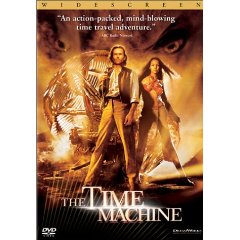
Wells’ novel was made into a movie by George Pal. The film was released in02 poster 1960. A second version, starring Guy Pierce and Directed by Simon Wells, H.G.’s grandson, was released in 2002. I have yet to meet someone, besides me, who has read/seen all three versions, which is really too bad. People often ask me which version is the best. The truth is, it’s really hard to pick one, because they are all so different, and each one is strangely apropriate to their time. You might say, reading the book and then watching the movies is a trip through time in itself. I’ll explain.

book coverIn the book, the “Time Traveller,” who is never named, believes that if he travels far enough into the future, he will find mankind in a perfect state. No further explanation of this belief is ever given. Wishing to see mankind’s triumph, his first time-trip is a non-stop journey to the year A.D. 802,701. (Does this seem strange to anyone else? I mean, there’s a reason the Wright Bothers didn’t take their first flight over the Grand Canyon, and early sailors didn’t try to cross the Atlantic.) Once he stops, the Time Traveller first meets the Eloi, a society of childlike people. They live in small communities in futuristic yet deteriorating buildings, doing no work and eating a frugivorous diet. His efforts to communicate are hampered by their lack of curiosity or discipline, and he concludes that they are the result of humanity conquering nature with technology, and adapting to an environment in which strength and intellect are no longer advantageous.

Returning to the site where he arrived, the Time Traveller finds his time

Artist's conception

Artist's conception

machine has been dragged into a nearby Sphynx with heavy doors, locked from the inside. Later, he is approached menacingly by the Morlocks, pale, apelike people who live underground, where he discovers the machinery and industry that make the above-ground paradise possible. He alters his theory, speculating that the human race has evolved into two species: the leisured classes have become the ineffectual Eloi, and the downtrodden working classes have become the brutish, light-fearing Morlocks. Deducing that the Morlocks have taken his time machine, he explores the Morlock tunnels, learning that they feed on the Eloi. His revised analysis is that their relationship is not one of lords and servants but of livestock and ranchers, and with no real challenges facing either species, they have both lost the intelligence and character of Man.

Rod Taylor as H. George Wells

Rod Taylor as H. George Wells

In the 1960 film, the motives of the Traveller (now bearing the name George, and a license plate on his Machine that reads “H. George Wells”) are a bit more clear, if not much more sensible. In 1899, George (Rod Taylor), a brilliant physisist, has been offered a contract by the government of England to design weapons. Being a pacifist, he finds this horrifying and longs to discover man in a perfect, peaceful state. Believing that somewhere in the future he will find such a civilization, he sets off through time. He watches the world change rapidly around him until he sees his windows boarded up in the year 1914. Curious, he stops the Machine and gets out. He strolles across the street and meets the son of his friend from the beginning, David Philby

The Morlocks of 1960

The Morlocks of 1960

(both played by Alan Young). He learns that Philby has been killed in the First World War. Obviously, he decides to keep going. Back in the Time Machine, he makes a brief stop in 1940, where he sees London being bombed by the Nazis. He then continues to 1966 (six years in the future at that time) where he sees everyone walking around in radiation suits. He once again meets Philby’s son, who remarks that he saw George on the same spot in the same clothes 52 years before. Sirens begin blaring and every one runs, shouting “get to the shelter!” Philby points to the sky and says to George, “There, an atomic satelite zeroing in!” He tries to drag George to the shelter, but George refuses to leave his Machine, so Philby abandons him and runs for safety. Seconds later, a blast rips through London, resulting in some impressive (for 1960) miniature work. George, narrating, lamants “The labor of centuries gone in an instant!” A lava flow heads for the Time Machine, and George has to rush to activate it before the flood hits. He suddenly finds himself traveling through time inside a wall of rock. He is forced to keep traveling through time at breakneck speed, lest he be crushed. Unable to move his machine in space, he has no choice but to wait for time to wear down the mountain he is inside of.

George meets Weena.

George meets Weena.

When it finally does, he sees futuristic buildings springing up around him, and notes there doesn’t seem to be weather. He asks “had man finally learned to control the elements … and himself?” He stops at the year A.D. 802,701 once again, and meets the Eloi, who in this version are still human, although their frail bodies and pale skin are reminiscent of the creatures from the book. The Eloi still speak broken English (no explanation for this), and have little interest in technology or the past. George is so disapointed by the “perfect” world he has discovered that he berates he Eloi “What have you done?? Thousands of

The Sphynx.

The Sphynx.

generations of men struggeling and sacraficing, and for what? So you can swim and dance and play! I’m going back to my own time. I won’t tell them about the useless struggle, but at least I can die among men!” Upon attempting this however, he finds that his Machine has again been dragged into the Sphynx and he is trapped.

Lambs to the slaughter.

Lambs to the slaughter.

In this version, the Morlocks provide the Eloi with food and clothing, as in the book. However, instead of snatching them one at a time, they use (of all things) air-raid sirens to lure them underground in droves (left). In one scene, the siren cuts off, and the door to the Morlocks’ slaughter house slams shut, denying entrance to the Eloi still outside. George shakes one who seems to be in a trance (below), and the Eloi tells him “it is all clear,” meaning the air raid has ended, essentially.  Apparently, the Morlocks are able to do this because humans are so conditioned from fleeing underground at the sound of sirens ever since 1960. shake

Eventually, a girl named Weena (Yvette Mimieux) leads George to a room full of “talking rings” which seem to be surviving records of Earth’s past. The rings hold the voices of people describing nuclear and other wise horrible wars; the last recording annouces that Earth’s atmosphere has been all but destroyed and most of the human race is fleeing underground to escape the Sun’s harmful rays. A few have decided to “take our chances in the sunlight, however small they might be.” George deduces that those who fled underground were the ancestors of the Morlocks and those who remained were the ancestors of the Eloi.

And so, in both the book and the 1960 film, the division of humanity is caused by a social evil that preocupies the author, resulting in one side becoming a race of monsters that preys upon the other. In 1894, when Marxism was popular among the wealthy elite of Europe (did you note the irony there?), the division was caused by the oppression of the lower classes. This resulted in a kind of ironic justice, when the upper classes became food for the lower classes. In 1960, when everyone feared the Bomb, the division was caused by the continuing folly of war, which finally drove one side underground. The element of ironic justice is

George fights the Morlocks in their labyrinth.

George fights the Morlocks in their labyrinth.

conspicuously lacking here, which may be why the script calls for George and the Eloi to triumph over the Morlocks. While the Traveler simply returned to his own time in despair of Man’s future, George follows his beloved Weena into the Morlocks’ slaughterhouse. Once there, he is able to inspire the Eloi to join him in fighting against the Morlocks. Once they escape, at George’s direction, they throw large amounts of dry wood down the wells that connect the surface to the underground to stoke an underground inferno. The Morlocks’ lair caves in. Shortly after, George returns to his own time and tells the tale of his adventure to several collegues who leave, scoffing at him. Except Philby. A few minutes later, Philby and George’s housekeeper (Doris Lloyd) discover that George has once again disapeared in his Time Machine, and that he has taken three books from his library with him. Having searched for his purpose for years, George has apparently found it in rebuilding civilization in A.D. 802,701. And, of course, being with Weena.

Joey Film GeekIn the 2002 version, which also starts in 1899, the time traveller is Alexander Hartdegen, a physics professor who wants his students to abandon the expectations of society and conquer nature with technology. His fiance, Emma (Sienna Gullory), feels like he’s more attracted to model T cars than to her. Philby (Mark Addy) asks Alexander if he thinks Man could ever go too far whith technology. Alex scoffs “No such thing.” That night Emma is killed by a mugger in the park. He decides to use his skill with technology to change the past and bring her back. He works for four years on a time machine. When it’s complete, he

"In a week, we'll have never have had this conversation."

"In a week, we'll have never have had this conversation."

dresses in his best and gets into a chair with parasol-like apparati above and below it that spin, generating a sphere around the machine in which time does not pass. The scene changes before we see his journey. He goes back to the night Emma died, meets her, and steers her away from the park. He extracts a promise from her to go home and stay there until morning. Just when he thinks he has triumphed, a model T goes hay wire and runs her over.

The Time Machine of 2002. Also makes a great cup of jo.

The Time Machine of 2002, often mistaken for a coffee maker.

In the next scene, Alex mutters to himself “Why can’t I change the past? I could come back a thousand times; see her die a thousand ways. I can’t find the answers here … not here … not now…” Only then do we see his now archetypal journey forward as the sun becomes a blurred line overhead and trees spring up like gysers around him. We see a pull-back shot in which a biplane, then a twin prop, then a modern jet and finally a satelite fly over Alex, before we see a shuttle landing on the moon. Alex’s attention is caught by an advertisement declaring “the future is now!” and he stops in 2030 (28 years in the future at that time). A pedestrian looks at his time machine and remarks “bet that makes a hell of a capuchino.”

The advertisement is for realestate on the moon, where a colony is being built. Alex walks into the Fifth Avenue Public Library, drawn by all the new techonology, where he meets Photonic (Orlando Jones), a sarcastic computer program who walks inside panes of glass and offers to retrieve data from the library’s system (below). When Alex asks to learn about time travel, Photonic

"Live long, and prosper."

"Live long, and prosper."

rolls its eyes. Disapointed, Alex gets back into the time machine and travels forward another 7 years. When he sees chaos around him, he stops. Military vehicels race through the streets, and the ground shakes violently. Upon dismounting, Alex is accoasted by several soldiers who urge him to come with them underground. He demands to know what’s going on, assuring them “Yes, I’ve been living under a rock!” They tell him that the demolitions for the lunar colony over the past 7 years have changed the moon’s orbit, and caused the moon to start breaking up. Alex looks skyward and sees the moon, much larger than ususal, and riddled with cracks. At that moment a crack opens in the earth. Alex races to his Machine before the crack destroys it, and mangaes to throw it into gear just in time. However, his Machine is rocked by the disaster, and he hits his head, and is knocked uncouncious.

Samantha Mumba as Mara.

Samantha Mumba as Mara.

Out of control, the Machine hurtles through time. We see glacers come and go and the ground rise above the timeless sphere and then fall back below it. Rivers carve canyons in the blink of an eye. Alex eventually regains conciousness just long enough to stop the Machine at (you guessed it) A.D. 802,701, before slipping back into oblivion. He awakens in a bed somewhere with a bandage on his head. He walks out into a community of huts built on the side of a cliff. He is confronted by people he is unable to communicate with, until a woman named Mara (Samantha Mumba) asks “Do you know my words?” in perfect English. It turns out that the Eloi in this version have discovered “the Stone Language” carved in stone and concrete relics from our time, and have kept it alive as a tradition. Most Eloi lose the ability to speak it by adulthood, but Mara teaches children, so she has retained it.

Quite different from the Eloi in 1894 and in 1960, the Eloi of 2002 are highly industrious, growing crops, and building windmills. There is no evidence of anything being done for them by anyone else. However, they live under the opression of a fear that they refuse to speak of. Alex suspects it has to do with the reason none of the Eloi seem to be older than their early twenties. He awakens one night from a nightmare in which he is being drawn toward a frightening statue in the forest. Mara tells him “we all have that dream,” but refuses to say more. We later learn that that same night, Alex’s pocket watch was stolen by Morlocks, which explains why the Eloi have no machines. Alex gazes up at the remains of our moon, now a collection of chunks that make a spectacular stream across the sky, and thinks “You were right, David. We did go too far.”

He learns what the Eloi’s unspoken fear is when the Morlocks first attack. The Morlocks of 2002 are considerably more formidable than in the other versions, traveling fast on all fours, and then fighting on two legs. They bear more resemblance to the Uruk Hai from The Lord of the Rings, stalking between rows of their machines. After Mara, along with others, is dragged underground in an

Guy Pierce gets mideval in the 8000th century.

Guy Pierce gets mideval in the 8000th century.

attack,  Alex demands to know why the Eloi will not fight back. An Eloi replies “those who … ‘fight’ are taken first.” So between 1894 and 2002, the relationship has made a full transition from ironic justice to shameless opression. The Eloi lack technology not because of laziness, but because the Morlocks use coordinated attacks to keep them helpless. The end result, however, is essentially the same, as Alex finds out. He discovers Photonic again, its panes of glass tarnished and cracked, but still functional (after 800,000 years. Right). Photonic directs him to the statue he dreamed of, this version’s Sphynx. He climbs down into it and discovers a grizly slaughterhouse scene that audiences were spared in 1960. After being captured, he sees Mara locked in a cage and meets the “Uber Morlock,” brilliantly played by Jeremy Irons, though he is well hidden in a great makeup job.

Spy Morlocks mark targets for Hunters.

Spy Morlocks mark targets for Hunters.

The Uber Morlock extends peculiar hospitality to Alex, protecting him from the bestial Morlocks, answering his questions and even returning his Time Machine and pocket watch. He explains:

“After the Moon fell from the sky, the Earth could no longer sustain the species. Some managed to stay above, while others escaped below, and centuries later when we tried to emerge into the sunlight, we found we could not. So we bred ourselves into casts.”

The hunter Morlocks are bred to be predators but also to be controlled. The Uber Morlock is of a cast that concentrated on expanding its cerebral abilities. He says that without control the hunters would exhaust the food supply in a matter of months. He also controlls the Eloi and keeps them fearful.

The Uber Morlock calls Alex by name and knows who he is and why he has traveled through time. He also projects pictures into Alex’s head, putting him back in his laboratory with Emma. Alex learns learns that some Eloi, like Mara, are not consumed, but instead are used as“breeding vessels” for Morlock colonies (yuck).

Alexander is reunited with Mara.

Alexander is reunited with Mara.

Finally, the UM explains to Alex “You built your time Machine because of Emma’s death. If she had lived it would never have existed, so how could you use it to save her? You are the inescapable result of your choices, just as I am the inescabable result of you (?).” He then shows Alex the Time Machine. “You have your answer. Now go.” At this point, Alex has to be thinking “I came 8,000 centuries for a lame explanation like that?” This is the first version that tries to adress paradox in time travel, but it completely ignores exerything besides Emma’s death that Alex changed by going back.

Tell me this isn't scary.

Tell me this isn't scary.

Long story short, Alex kills the UM. After outsmarting a creature that has demonstrated the ability to read and controll his thoughts, Alex uses his pocketwatch to jam his Machine. Mara asks “What are you doing with it?” He replies “Changing the future.” The jamming results in a sort of explosion of time, that rusts metal and rots Morlocks in the blink of an eye, and destroys their lair. This, while undeniably ham-fisted, is also undeniably cool. He saves Mara and they live happily ever after.

Rather than inequality or war, this version is concerned with rappidly

The Time Machine of 1960, now in a museum.

The Time Machine of 1960, now in a museum.

expanding technology. Once again, the social evil warned of in 1899 creates havoc in the near future that forces part of humanity undergroud to evolve into monsters, who return to feed on those above. The time traveler once again abandons what he set out to find, and finds happiness in the time he has traveled to.

All three versions suffer a certain weakness. The problem with basing a story that covers 800,000 years on a single societal concern should be obvious. 800,000 years eclipses all of recorded history aproximately 100 times. And yet, even the near future is hard to portray acurately. George Pal’s portrayal 1966 looks quite droll only 50 years later. Simon Wells’ portrayal of 2030 will no doubt look the same in 2050. It’s rediculous for a writer to asume that what’s on his mind at the moment will be shaping the world so far down the road. Good science fiction will, of course, include some social critisism, but there’s a reason most science fiction stories don’t take place so far into the future. The book comes the closest to acknowledging this, as it doesn’t try to tell a story that weaves all the centuries together. Wells’ hero simply leaves Wells’ time, goes to a time when the world was unrecognizable, comes back, and tells the tale. However, this also makes the book the least engaging and most depressing version.

George comes home, looking how I felt at 1 am after finishing this review.

George comes home, looking how I felt at 1 am after finishing this review.

For dramatic purposes, Pal’s version is a clear improvement over the book, because it takes the same basic plot and makes it into a story of rebirth, rather than degeneration, and of good triumphing over evil. It’s rather hard to buy the hippie philosophy 50 years later, however. The 2002 version seems to be the least preachy of the three, and while it does at times sacrafice thought for Hollywood sensationalism, it has some good messages about facing your fears and finding what’s truly important in life. Each version is a noteworthy embodiment of the values of its time. In sum, I would have to say I liked the version from my century the best. But of course, I would.

The book

[Rating:2/5]

1960 version

[Rating:3/5]

2002 version

[Rating:3/5]